Exploring the Meaning of Tuphonikos in Greek
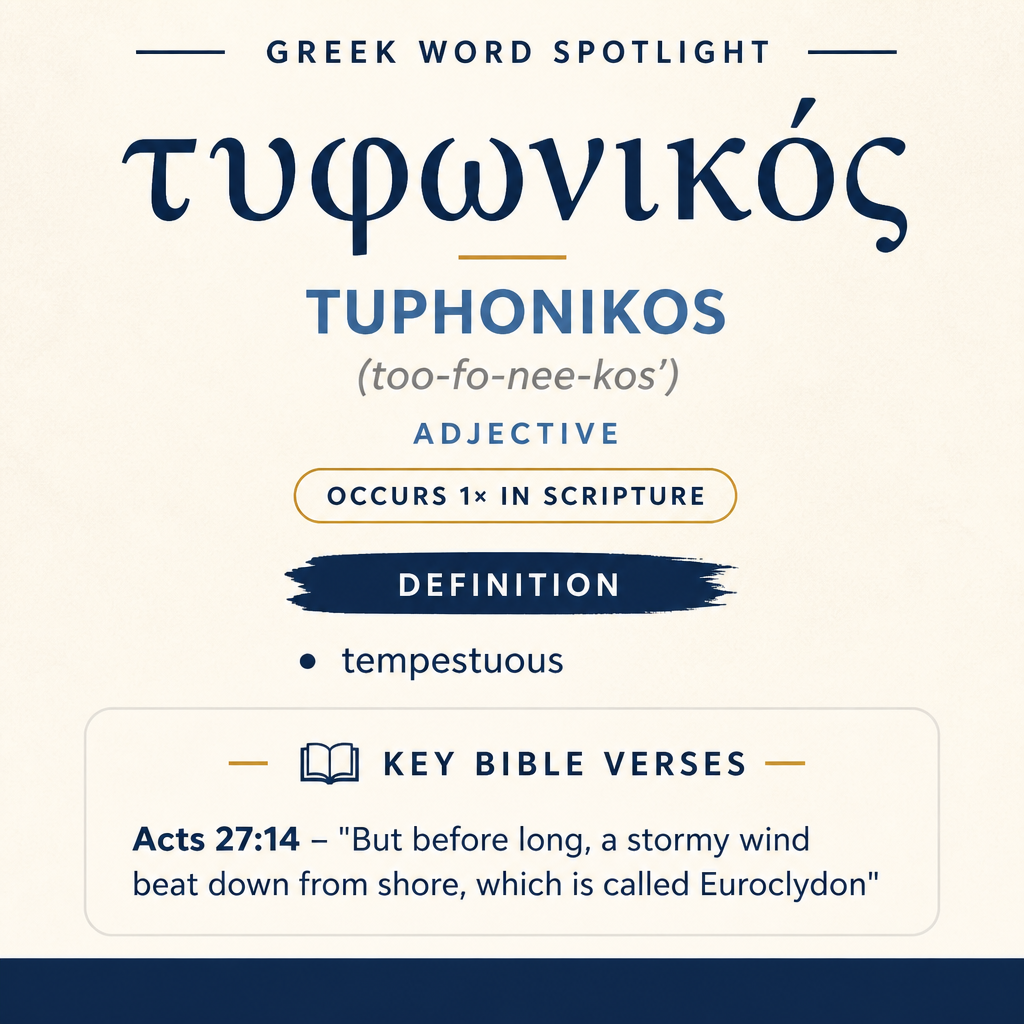
τυφωνικός means “tempestuous” and appears once in Scripture in Acts 27:14 describing a stormy wind called Euroclydon.
Context in Acts
In Acts 27:14 it describes a stormy wind that beat down from shore, called Euroclydon.
Learn More →τυφωνικός means “tempestuous” and is used once in the New Testament, in the narrative of the voyage and shipwreck in Acts 27. In that setting it characterizes a wind that suddenly sweeps down and drives events beyond ordinary human control.
Root and Related Words
τυφωνικός is derived from the verb typho (τύφω), “to smoulder” (Strong’s G5188). The related verb provides a verbal background for the adjective’s formation.

Occurrences
“But before long, a stormy wind beat down from shore, which is called Euroclydon.” (Acts 27:14)
In Acts 27:14, τυφωνικός supplies the key descriptive force in the phrase “a stormy wind.” The verse turns on abrupt timing—“before long”—and on sudden movement—“beat down from shore.” Within that compressed description, the adjective marks the wind as not merely brisk or inconvenient but as belonging to the category of weather that disrupts plans and overwhelms ordinary seamanship. The narrative does not present the wind as a background detail; it is the immediate cause of a crisis, introduced with the same directness as the wind’s assault. By characterizing the wind in this way, the wording prepares the reader to understand that what follows is driven by powerful external conditions rather than by a minor change in the voyage.
The clause “which is called Euroclydon” sets the tempestuous wind within the concrete world of named winds known to sailors. The adjective and the naming work together: the naming gives specificity, while τυφωνικός gives the qualitative assessment that this is a violent, hazardous wind. The action “beat down” (as the wind’s impact) is compatible with that assessment; the verse depicts a force that comes down upon the ship from the landward side and presses it into a new, dangerous situation. Thus, τυφωνικός functions as an interpretive descriptor inside the narrative itself, telling the reader how to classify the wind’s character at the very moment it appears.
Sense and Usage
The sense “tempestuous” in this passage is not an abstract label but a practical, situational description: it denotes wind that behaves like a storm and carries storm-level threat. The context gives several cues for how the adjective is meant to land. First, it is paired with the concrete noun “wind,” anchoring the description to a physical phenomenon rather than to emotions or social turmoil. Second, it is placed in a clause that stresses rapid onset (“before long”), highlighting that the tempestuous quality includes suddenness and escalation. Third, the wind is said to “beat down,” an expression of forceful descent and pressure; the adjective frames that force as belonging to storm conditions rather than to routine weather.
Because τυφωνικός appears only here, its usage must be read tightly within the immediate scene. Acts 27:14 does not describe the wind’s speed, direction, or duration in technical terms; instead, it characterizes the wind’s nature. “Tempestuous” therefore works as a qualitative categorization—this is the kind of wind that turns a voyage into an ordeal. The verse’s structure also shows that the adjective’s function is to set the stage for consequences that will unfold in the narrative: the wind’s tempestuous character is introduced as the decisive new factor. In that way, τυφωνικός contributes a narrative hinge—conditions shift from manageable travel to a storm-driven struggle.
The naming of the wind (“Euroclydon”) also shapes how “tempestuous” is heard. A named wind suggests a recognizable pattern familiar to those who sail, and the adjective situates the name within an evaluation: this particular named wind is not just identifiable but dangerous. The combination keeps the description from being vague. The writer is not merely saying that weather worsened; he is pointing to a specific, known type of storm-wind that arrives with force. In this single use, then, τυφωνικός has a pointed narrative role: it is the word that signals a shift to extreme conditions in a setting where wind governs what can and cannot be done.
Imagery
The imagery carried by τυφωνικός in Acts 27:14 is the sudden overpowering of a human journey by violent weather. “Beat down from shore” evokes not only wind but the sensation of being pressed upon from above and driven off course. By calling the wind “stormy,” the verse paints a scene in which the natural world asserts itself with enough strength that even the naming of the wind becomes part of the account: the tempest is not anonymous, but a known and feared force that arrives swiftly and strikes hard.
Sources: Lexical data from Strong’s Exhaustive Concordance and the Translators Brief Lexicon of Extended Strongs for Greek (STEPBible, CC BY). Occurrence data from the Translators Amalgamated Greek New Testament (STEPBible, CC BY). Scripture quotations from the World English Bible (public domain).