Exploring the Meaning of Timon in Greek
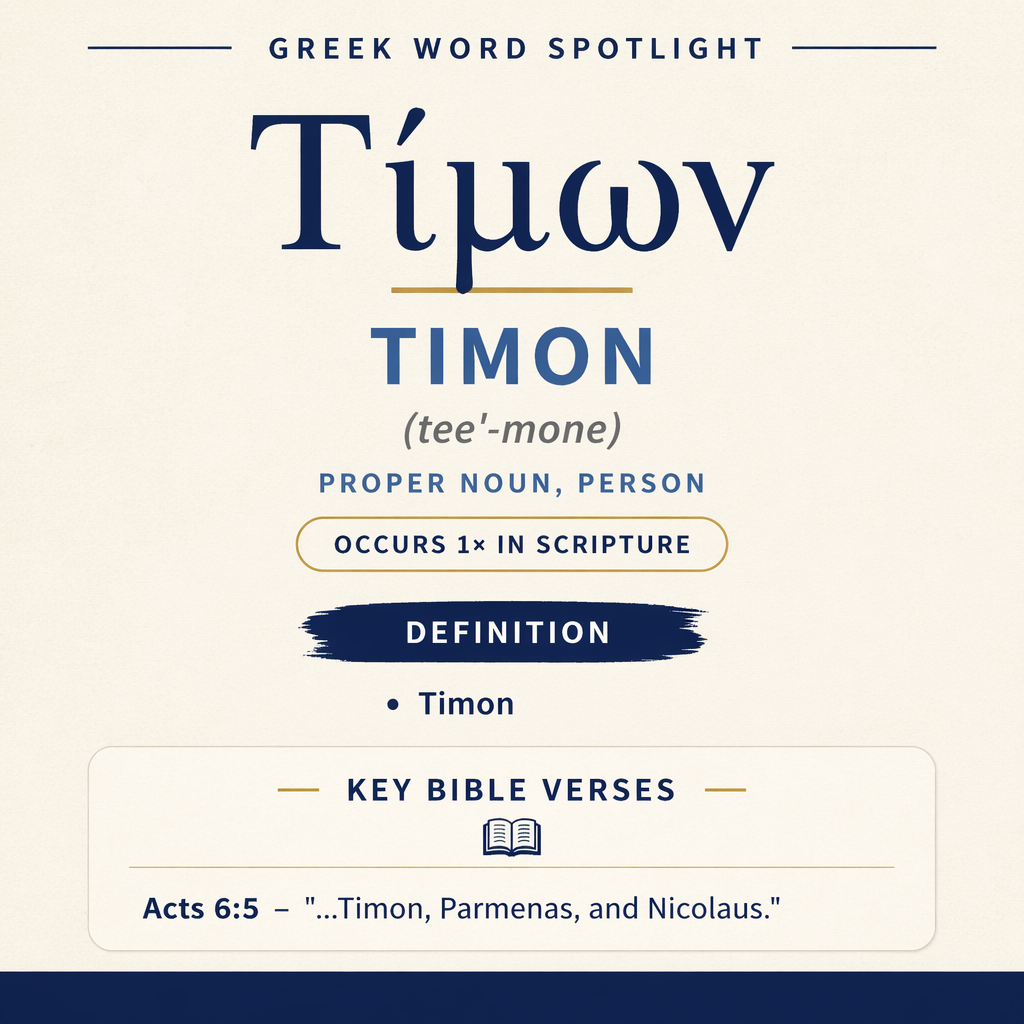
Τίμων (Timon) is the name Timon, appearing once in Scripture in Acts 6:5.
Verse Context
In Acts 6:5, Timon appears in a list of men chosen by the whole multitude.
Learn More →Tímon is a personal name, appearing in the list of men chosen by the Jerusalem community in Acts 6:5. In that setting, the name functions as part of a formal roll of those selected for a specific communal responsibility.
Root and Related Words
Tímon is related (as a derived form) to timē (τιμή), “honor” (Strong’s G5092). This relationship links the name to the vocabulary of honor as a lexical family connection.

Occurrences
These words pleased the whole multitude. They chose Stephen, a man full of faith and of the Holy Spirit, Philip, Prochorus, Nicanor, Timon, Parmenas, and Nicolaus, a proselyte of Antioch; (Acts 6:5)
In Acts 6:5, Tímon occurs within a coordinated list of seven individuals: “Stephen… Philip, Prochorus, Nicanor, Timon, Parmenas, and Nicolaus.” The verse presents the selection as the unified action of the community: “These words pleased the whole multitude. They chose…” Within this sentence, the name contributes to the concrete, administrative clarity of the narrative: the multitude does not merely agree with a proposal in the abstract, but expresses its approval by appointing identifiable persons.
The list places Tímon among named associates whose identities are anchored by the way the verse frames them. Stephen is described in character terms: “a man full of faith and of the Holy Spirit.” Nicolaus is distinguished by origin and status: “a proselyte of Antioch.” Tímon, by contrast, is given without further description; his role in the verse is to be one of the chosen men, a member of the group defined by the community’s decision. The name therefore functions as part of the passage’s stress on accountability: the choice is public and specific, recorded in a set of personal names rather than left vague.
The ordering of the names also situates Tímon within a collective unit. He is neither isolated nor introduced in a separate clause, but embedded in a series joined by commas and a final “and.” That syntactic placement underscores the communal nature of the appointment. Tímon is one among others, and the narrative emphasis falls on the shared selection: the whole multitude chooses a group, not merely an individual. In this way the name serves the narrative by marking the breadth of the appointment and by contributing to the completeness of the roster.
Finally, the immediate context of the verse highlights a contrast between communal deliberation and decisive action. The multitude is first described as pleased: “These words pleased the whole multitude.” Then they act: “They chose…” Tímon is part of the action clause, not the reaction clause. The name belongs to the concrete outcome of agreement—a selection that results in identifiable persons entrusted with a task.
Sense and Usage
As a proper name, Tímon’s meaning in Acts 6:5 is exhausted by its function as personal identification within a community record. The verse does not use the name for description or metaphor; it uses it to point to an actual person who is counted among those appointed. In narrative terms, the effect of including such names is to make the episode read like a formal community decision preserved for memory: named individuals embody the community’s response to a need, and the list itself becomes part of how the text represents orderly life in the believing multitude.
The presence of brief qualifying notes for some individuals (“a man full of faith and of the Holy Spirit”; “a proselyte of Antioch”) shows that the list can carry extra identifying or characterizing information when the writer chooses to supply it. Tímon stands without such an appositive phrase, which makes his name function in a straightforward way: it is a marker of membership in the chosen group. The reader is meant to recognize that the group is not anonymous and that the appointment has a concrete, human face, even where no additional biographical detail is offered.
Because Tímon occurs only in this roster, the name’s usage is tightly tied to the communal act of choosing. In Acts 6:5, the community’s unity (“the whole multitude”) and its approval (“pleased”) are immediately expressed through the naming of those selected. Tímon therefore participates in the passage’s depiction of consensus moving to action, in a way that is simple but weighty: a name inscribed in the list is a sign of a real appointment, given in the open, with the community’s approval.
Imagery
The imagery carried by Tímon in Acts 6:5 is the imagery of a public roll call: a gathered multitude, a proposal that pleases them, and a set of names spoken as the outcome of their shared decision. The verse paints no physical scene in detail, but the naming itself suggests an ordered moment of communal choice, where recognition and responsibility are attached to particular persons.
Sources: Lexical data from Strong’s Exhaustive Concordance and the Translators Brief Lexicon of Extended Strongs for Greek (STEPBible, CC BY). Occurrence data from the Translators Amalgamated Greek New Testament (STEPBible, CC BY). Scripture quotations from the World English Bible (public domain).