
Exploring the Meaning of Tithemi in Greek
τίθημι means “to place” and occurs 100 times in Scripture, including Matthew 5:15, 12:18, 22:44, 24:51, 27:60 and Mark 4:21, 6:29.
Core Meaning
τίθημι is defined as “to place.” It appears in contexts of putting, laying, making, or appointing within the cited verses.
Learn More →Gospel Examples
In Matthew 5:15 and Mark 4:21 it describes putting a lamp under a basket or on a stand. In Matthew 27:60 and Mark 6:29 it describes laying a body in a tomb.
Learn More →Range of Use
In Matthew 12:18 it is used for God putting His Spirit on His servant. In Matthew 22:44 it is used for making enemies a footstool, and in Matthew 24:51 for appointing a portion.
Learn More →τίθημι expresses the act of placing, and in these passages it appears in scenes ranging from household life and public ministry to burial and divine enthronement. The selected occurrences show the verb’s flexibility for concrete placement, purposeful bestowal, and judicial or administrative setting.
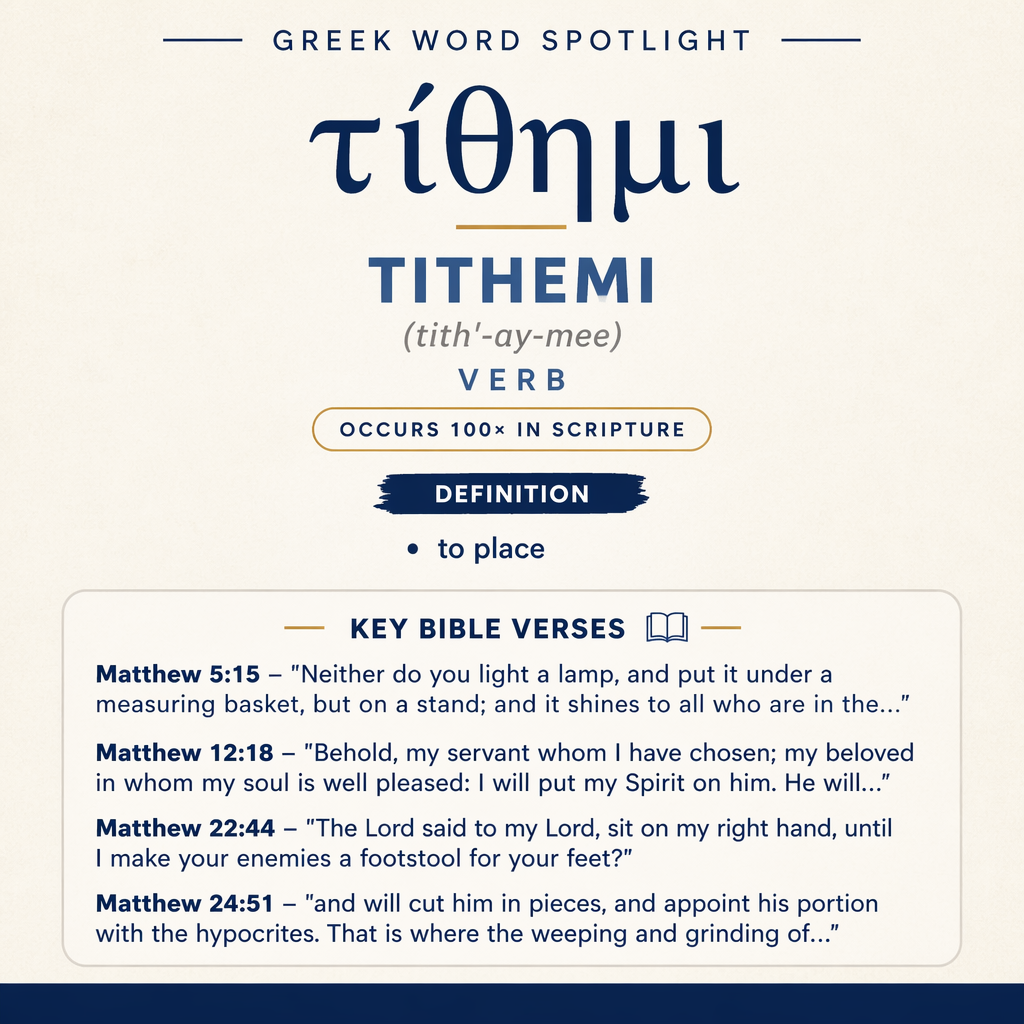
Occurrences
“Neither do you light a lamp, and put it under a measuring basket, but on a stand; and it shines to all who are in the house.” (Matthew 5:15)
Here τίθημι frames a contrast between hiding and positioning. The lamp is “put…under a measuring basket” versus “on a stand,” so the placement determines whether the light reaches “all who are in the house.” The verb contributes a straightforward physical action with practical consequence: where the lamp is placed governs what the lamp does in the room.

“Behold, my servant whom I have chosen; my beloved in whom my soul is well pleased: I will put my Spirit on him. He will proclaim justice to the nations.” (Matthew 12:18)
In this proclamation, τίθημι describes God’s deliberate action of putting “my Spirit on him.” The placement is not spatial arrangement within a room but a bestowal “on” the servant, directly linked to the servant’s ensuing work: “He will proclaim justice to the nations.” The verb marks the initiating act that equips and commissions.
“‘The Lord said to my Lord, sit on my right hand, until I make your enemies a footstool for your feet?’” (Matthew 22:44)
τίθημι operates within royal imagery. The speaker promises action “until I make your enemies a footstool for your feet,” a vivid picture of enemies being put into a subordinated position. The verb supplies the force of arranging a new status: the enemies are set as something under the feet, emphasizing a decisive reordering of relations.
“and will cut him in pieces, and appoint his portion with the hypocrites. That is where the weeping and grinding of teeth will be.” (Matthew 24:51)
In this warning, τίθημι underlies “appoint his portion with the hypocrites.” The verb depicts assigning or setting someone’s share and company. Placement here is judicial and relational—being set “with” a group—resulting in a defined outcome described by “weeping and grinding of teeth.”
“and laid it in his own new tomb, which he had cut out in the rock, and he rolled a great stone against the door of the tomb, and departed.” (Matthew 27:60)
τίθημι is used for the careful act of burial: the body is “laid…in his own new tomb.” The surrounding details—“cut out in the rock,” “rolled a great stone against the door”—heighten the concreteness of the placement. The verb carries the solemn finality of putting the body into a prepared resting place, followed by departure.
“He said to them, “Is the lamp brought to be put under a basket or under a bed? Isn’t it put on a stand?” (Mark 4:21)
This saying again uses τίθημι for the positioning of a lamp. The verb highlights intentional placement in a household setting: under a basket, under a bed, or on a stand. The rhetorical questions assume the expected, sensible placement “on a stand,” so τίθημι draws attention to purpose and propriety in where something is put.
“He said, “How will we liken God’s Kingdom? Or with what parable will we illustrate it?” (Mark 4:30)
In this question about comparison and illustration, τίθημι contributes to the act of setting something forth for understanding—choosing what parable to put forward in order to “liken” and “illustrate.” The verb’s placing is conceptual in effect: a parable is set in front of hearers as a means of explaining the Kingdom.
“When his disciples heard this, they came and took up his corpse, and laid it in a tomb.” (Mark 6:29)
τίθημι appears in the immediate, physical aftermath of death: disciples “took up his corpse, and laid it in a tomb.” The verb describes the final act of placing the body, and the brief wording underscores the stark transition from taking up to laying down, moving the corpse from exposure to confinement.
“Wherever he entered, into villages, or into cities, or into the country, they laid the sick in the marketplaces, and begged him that they might just touch the fringe of his garment; and as many as touched him were made well.” (Mark 6:56)
Here τίθημι depicts repeated public action: people “laid the sick in the marketplaces.” The placement is strategic—putting the sick where Jesus might pass—and the narrative links it to urgent request (“begged him”) and outcome (“as many as touched him were made well”). The verb conveys the communal effort of positioning the needy within reach of healing.
“He took them in his arms, and blessed them, laying his hands on them.” (Mark 10:16)
τίθημι describes a gesture within blessing: “laying his hands on them.” The placement is gentle and personal, coordinated with “He took them in his arms” and “blessed them.” The verb marks the tangible contact by which blessing is enacted in this scene.
“For David himself said in the Holy Spirit, ‘The Lord said to my Lord, “Sit at my right hand, until I make your enemies the footstool of your feet.” ’” (Mark 12:36)
This repeats the enthronement picture: enemies are made “the footstool of your feet.” τίθημι again contributes the idea of putting enemies into a defined, humbled placement beneath the enthroned figure. The verb’s force is not merely movement but establishment of an enduring arrangement “until” the action is completed.
“They struck his head with a reed, and spat on him, and bowing their knees, did homage to him.” (Mark 15:19)
Within this description of mockery, τίθημι contributes to the staged act of “bowing their knees.” The placement is bodily: knees are set in a bowed posture as part of feigned “homage.” The verb helps portray a deliberate, performative positioning that matches the surrounding actions of striking and spitting.

Sense and Usage
Across these contexts, τίθημι consistently conveys purposeful placement, whether the object is a lamp, a body, sick persons, hands, or enemies pictured as a footstool. In domestic scenes (Matthew 5:15; Mark 4:21), the verb’s placement is evaluated by its suitability: the lamp is placed either to conceal or to enable shining. In public ministry scenes (Mark 6:56; Mark 10:16), it describes placing people or hands in a way that facilitates encounter—setting the sick where contact may occur, and setting hands upon children in blessing.
The verb also extends naturally to acts of appointment and establishment. In Matthew 12:18, putting the Spirit “on” the servant is an act that initiates proclamation; the placement functions as an investiture tied to mission. In Matthew 24:51, “appoint his portion with the hypocrites” uses placement language for assigning a person to a share and company, a sober determination of where one belongs. In the footstool sayings (Matthew 22:44; Mark 12:36), τίθημι supports the imagery of subjugation by setting enemies into a fixed role beneath the feet—placement as a change in status and order.
Even where the action is conceptual rather than tactile (Mark 4:30), the same core idea holds: something is set forth so that hearers can grasp it. The parable is placed before the audience as an illustrative comparison, aligning the verb’s concrete sense with the communicative act of presenting a likeness.
Finally, burial scenes (Matthew 27:60; Mark 6:29) show the verb in its plainest physical force—laying a corpse in a tomb—yet the narratives frame the act as careful and final. τίθημι serves as the hinge between taking up the body and sealing or leaving the burial place, marking the decisive moment of being placed within the tomb.
Imagery in Context
The recurring pictures shaped by τίθημι are vivid and varied: a lamp set where it will shine, hands set on children in blessing, the sick set in marketplaces in hope, and a body set in a tomb with a stone rolled against its door. Alongside these, the verb supports weightier figurative scenes—Spirit placed on a chosen servant and enemies placed as a footstool—so that the same simple action of placing carries implications of commissioning, judgment, and enthronement within the quoted passages.
Sources: Lexical data from Strong’s Exhaustive Concordance and the Translators Brief Lexicon of Extended Strongs for Greek (STEPBible, CC BY). Occurrence data from the Translators Amalgamated Greek New Testament (STEPBible, CC BY). Scripture quotations from the World English Bible (public domain).




