Exploring the Meaning of Tereo in Greek
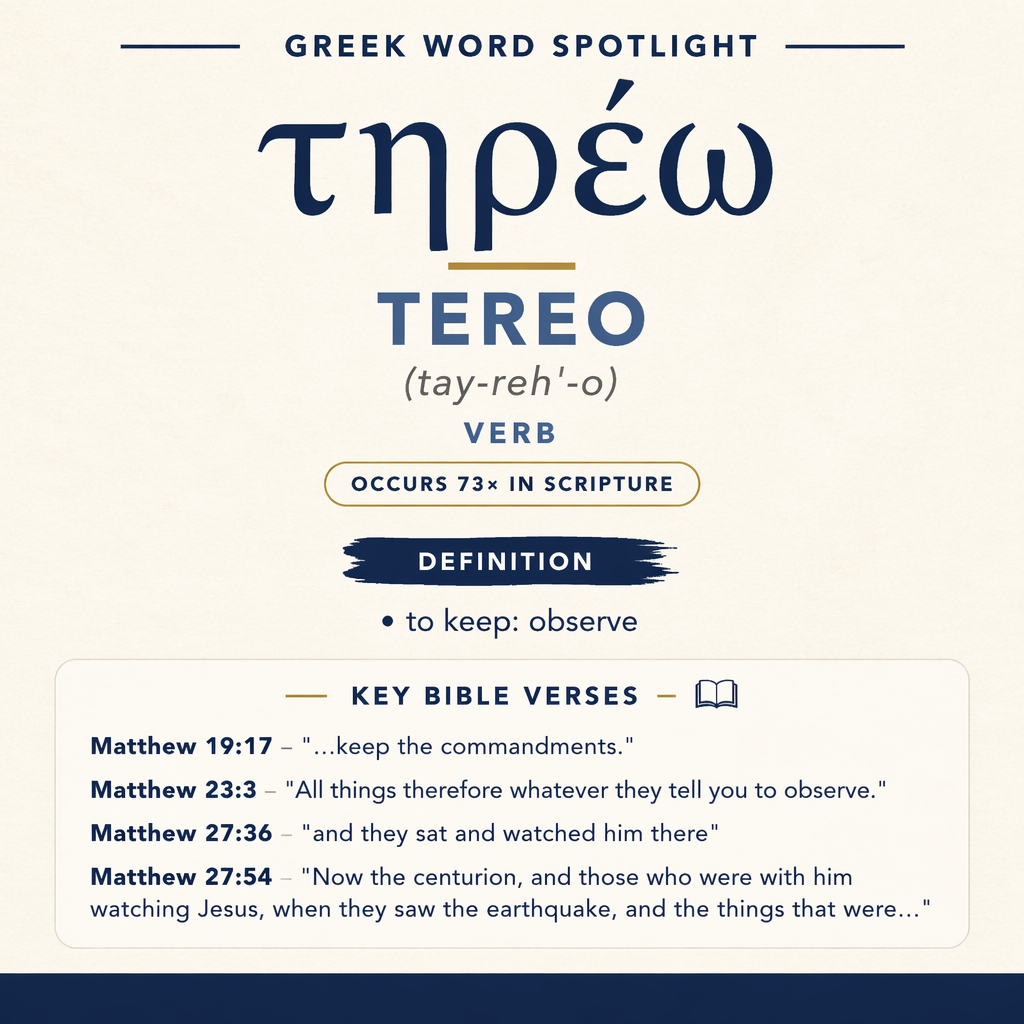
τηρέω (Tereo) means “to keep: observe” and occurs 73 times in Scripture, including Matthew 19:17, Matthew 28:20, and John 8:51.
Core Meaning
τηρέω means “to keep: observe.” It is used in contexts of keeping or observing what is commanded or spoken.
Learn More →Gospel Examples
In Matthew 19:17 and Matthew 28:20, it appears with the idea of keeping or observing commands. In John 8:51, it is used of keeping Jesus’ word.
Learn More →Occurrence Notes
τηρέω occurs 73 times in Scripture. Sample references provided include Matthew 23:3, Matthew 27:36, and Matthew 27:54.
Learn More →τηρέω means “to keep: observe,” and in these passages it ranges from keeping commands and words to keeping something in reserve and watching over a crucifixion scene. The occurrences gathered here show the verb working in instruction, dispute, and careful attention to events.
Occurrences
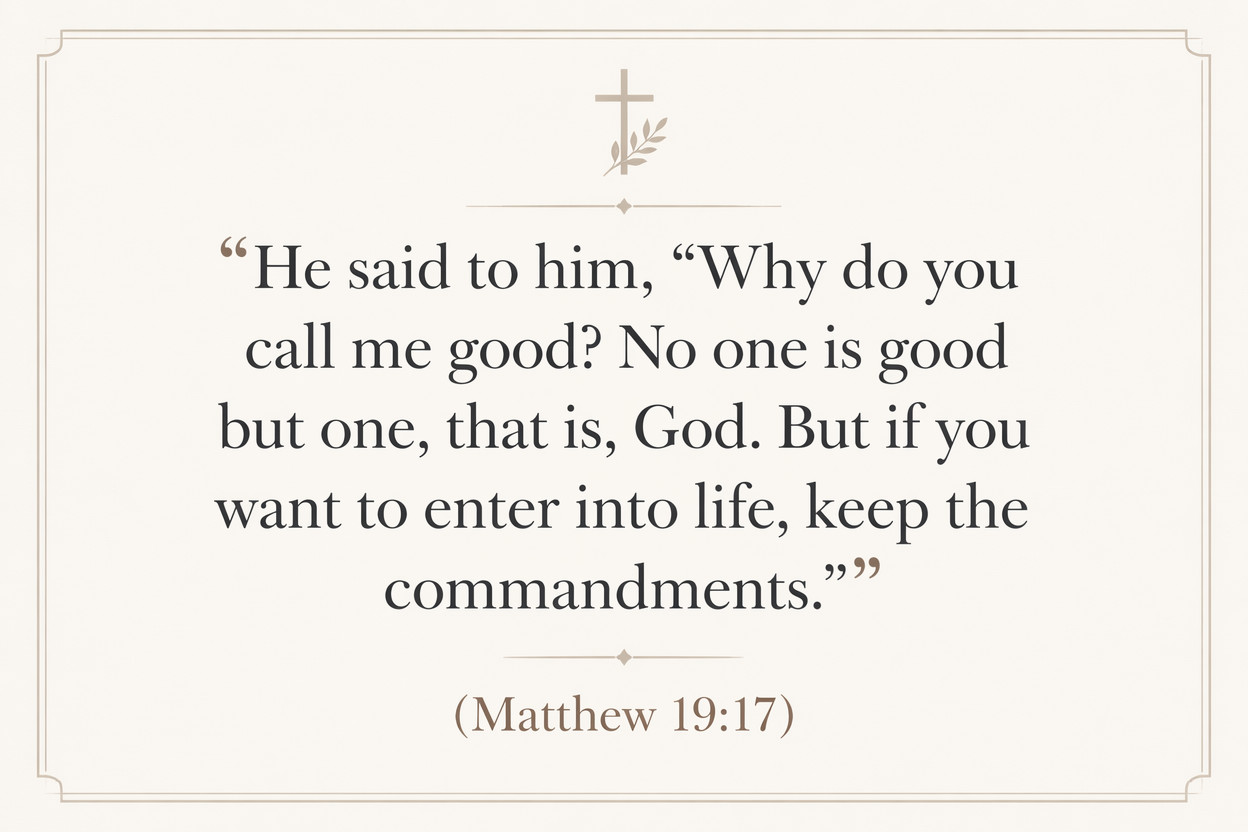
“He said to him, “Why do you call me good? No one is good but one, that is, God. But if you want to enter into life, keep the commandments.”” (Matthew 19:17)
Here τηρέω is tied directly to “the commandments.” The verb frames “enter into life” in terms of sustained obedience: not a single act but a settled practice of keeping what is commanded.
“All things therefore whatever they tell you to observe, observe and do, but don’t do their works; for they say, and don’t do.” (Matthew 23:3)
In this saying, the verb belongs to a paired instruction: “observe and do.” τηρέω supports the idea of attending to what is taught in a way that results in action, while the contrast (“they say, and don’t do”) shows that mere speech without keeping is a failure of the very “observe” being commanded.
“and they sat and watched him there.” (Matthew 27:36)
Here the word appears in a scene of custody and scrutiny: sitting and watching at the place where Jesus is. τηρέω expresses continuous attention—staying put to keep watch rather than passing by.
“Now the centurion, and those who were with him watching Jesus, when they saw the earthquake, and the things that were done, feared exceedingly, saying, “Truly this was the Son of God.”” (Matthew 27:54)
Again τηρέω is “watching,” but now it is explicitly “watching Jesus.” The verb anchors the centurion’s response: their keeping watch places them in the position of eyewitnesses who “saw the earthquake, and the things that were done,” leading to fear and a spoken conclusion about Jesus’ identity.
“For fear of him, the guards shook, and became like dead men.” (Matthew 28:4)
Within the resurrection narrative, this verse depicts the guards’ reaction. Read alongside the surrounding guard-and-watch context, τηρέω’s sphere here is the duty of guarding/keeping watch; the force of fear interrupts the steadiness that “keeping” requires, leaving the guards incapacitated.
“teaching them to observe all things that I commanded you. Behold, I am with you always, even to the end of the age.” Amen.” (Matthew 28:20)
Here τηρέω is placed at the heart of discipleship instruction: learners are to be taught “to observe all things” Jesus commanded. The verb points to comprehensive, ongoing faithfulness (“all things”), and its placement within teaching shows that observing is learned and practiced, not merely assumed.
“and said to him, “Everyone serves the good wine first, and when the guests have drunk freely, then that which is worse. You have kept the good wine until now!”” (John 2:10)
In the wedding scene, τηρέω describes holding something back: “kept the good wine until now.” The verb emphasizes deliberate preservation for a later moment, presenting “keeping” as purposeful timing rather than mere possession.
“Most certainly, I tell you, if a person keeps my word, he will never see death.”” (John 8:51)
Here τηρέω governs “my word,” and the result is expressed in stark terms: “he will never see death.” The verb frames the relationship to Jesus’ word as a guarded, maintained commitment—keeping it as something that shapes the person’s outcome.
“Then the Jews said to him, “Now we know that you have a demon. Abraham died, as did the prophets; and you say, ‘If a man keeps my word, he will never taste of death.’”” (John 8:52)
The same keeping of Jesus’ word becomes the point of controversy. The speakers repeat the claim with a slight shift of imagery (“never taste of death”), treating the promised consequence as unbelievable in light of death’s apparent universality; τηρέω thus sits at the center of a disputed promise.
“You have not known him, but I know him. If I said, ‘I don’t know him,’ I would be like you, a liar. But I know him and keep his word.” (John 8:55)
Here τηρέω is joined to “know”: “I know him and keep his word.” The verb describes fidelity that flows from genuine knowledge, and it is contrasted with lying—keeping the word belongs to truthful alignment rather than empty religious claim.
“Some therefore of the Pharisees said, “This man is not from God, because he doesn’t keep the Sabbath.” Others said, “How can a man who is a sinner do such signs?” There was division among them.” (John 9:16)
In this dispute, τηρέω is applied to Sabbath-keeping, and it becomes a test case for evaluating Jesus: “not from God, because he doesn’t keep the Sabbath.” The verb is used in an argument about observable practice; the counter-question about “signs” exposes a tension between strict criteria of keeping and the impact of what Jesus does.
“But Jesus said, “Leave her alone. She has kept this for the day of my burial.” (John 12:7)
Here τηρέω again carries the idea of keeping something for a specific time: “kept this for the day of my burial.” The verb presents the action as preservation oriented to an appointed day, giving the stored item a purpose tied to Jesus’ coming death.

Sense and Usage
Across these scenes, τηρέω consistently expresses “keeping” as careful adherence or watchful preservation, with the object determining the shape of the keeping. When the object is instructional (“the commandments,” “all things that I commanded you,” “my word,” “his word,” “the Sabbath”), keeping functions as observable compliance—what is taught is to be held and practiced. The pair “observe and do” (Matthew 23:3) clarifies that τηρέω is not satisfied with verbal agreement; it presses toward enacted faithfulness.
When the object is a thing to be held back (“the good wine,” “this for the day of my burial”), keeping takes the form of reserving and preserving until the right moment. John 2:10 and John 12:7 show that τηρέω can describe a hiddenness that is not neglect but intention: something is kept precisely so that it appears at the proper time.
When the object is a person under observation (“watched him there,” “watching Jesus”), the verb expresses sustained vigilance. In Matthew 27:36 and 27:54, keeping-watch places the watchers in a posture of continuous attention, and that attention becomes the pathway to perceiving “the earthquake, and the things that were done.” The guard context in Matthew 28:4 highlights how fragile such vigilance is when overwhelmed by fear: the guards’ reaction depicts the collapse of steadiness that watch-keeping assumes.
Several passages also show τηρέω as a boundary marker in argument. In John 9:16, “doesn’t keep the Sabbath” is deployed as a decisive charge. In John 8:51–52, keeping Jesus’ word is repeated by opponents as the crux of dispute, with the promised consequence framed in two closely related expressions (“never see death” / “never taste of death”). In John 8:55, keeping the word is paired with knowing God, making obedience a public expression of a truthful relationship rather than a mere claim.
Imagery and Texture
The passages give τηρέω a concrete feel: sitting and watching at a fixed place (Matthew 27:36), a group “watching Jesus” as the earth shakes (Matthew 27:54), and guards undone by fear (Matthew 28:4). Alongside that watchfulness stands the quiet, deliberate keeping of what is held for later—the “good wine until now” (John 2:10) and something kept “for the day of my burial” (John 12:7). In instruction, the imagery is moral rather than visual, yet still tangible: commandments and words are treated as things to be held fast and practiced, forming a life that can be described as “observe and do” (Matthew 23:3).
Sources: Lexical data from Strong’s Exhaustive Concordance and the Translators Brief Lexicon of Extended Strongs for Greek (STEPBible, CC BY). Occurrence data from the Translators Amalgamated Greek New Testament (STEPBible, CC BY). Scripture quotations from the World English Bible (public domain).