Exploring the Meaning of Tekton in Greek
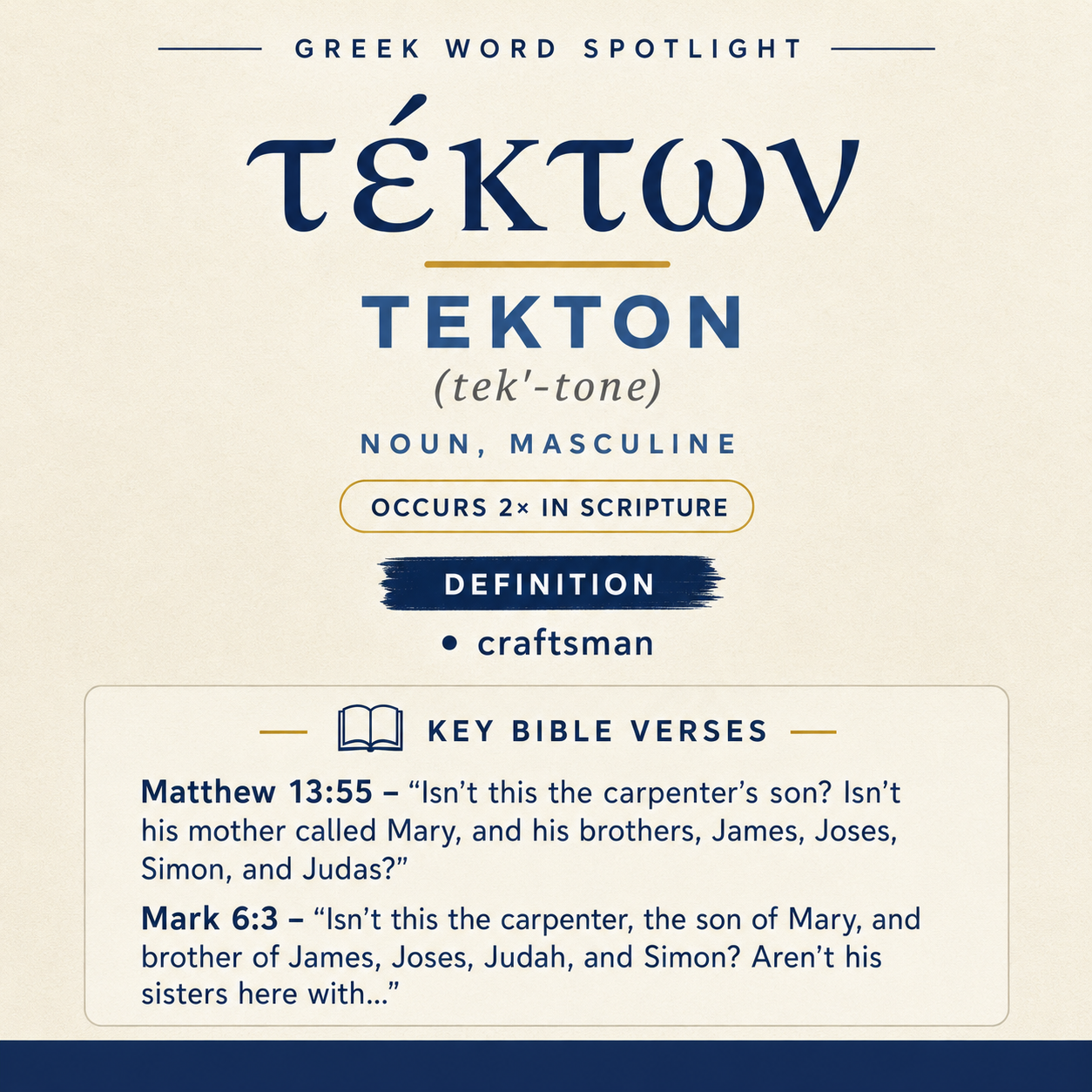
τέκτων (Tekton) means “craftsman” and appears twice in Scripture, in Matthew 13:55 and Mark 6:3.
Scripture Occurrences
This word occurs 2 times in Scripture. The occurrences are Matthew 13:55 and Mark 6:3.
Learn More →Gospel Context
In Matthew 13:55 it appears in the question, “Isn’t this the carpenter’s son?” In Mark 6:3 it appears in the question, “Isn’t this the carpenter…?”
Learn More →τέκτων is a term for a craftsman, appearing in two Gospel scenes where townspeople speak about Jesus in familiar, everyday categories. In one, it is used to locate him within his family; in the other, it is used directly of him and becomes part of a reaction of offense.
Root and Related Words
timoria (τιμωρία), “punishment” (Strong’s G5098), is listed as a related word.

Occurrences
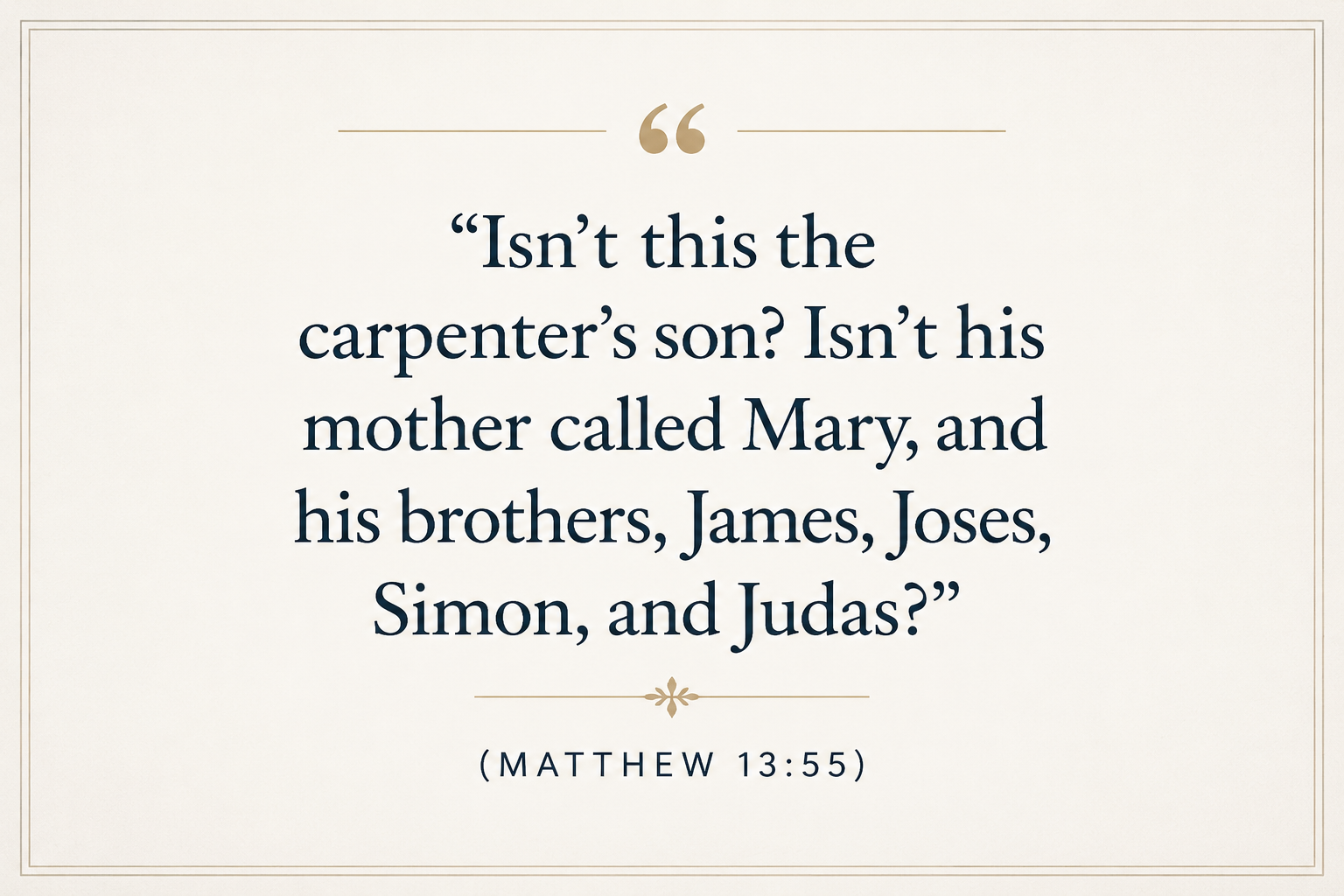
“Isn’t this the carpenter’s son? Isn’t his mother called Mary, and his brothers, James, Joses, Simon, and Judas?” (Matthew 13:55)
Here the word functions inside a question that frames Jesus through ordinary social identification: he is introduced not by a title, role, or public office, but by his household and by a father’s trade. The phrase “the carpenter’s son” ties him to a recognizable kind of work and to a known home, immediately followed by the naming of “his mother” and “his brothers.” The sequence matters: the speaker’s logic moves from a craft (“the carpenter”) to kinship (“son,” “mother,” “brothers”), treating these as the primary facts that define what can be expected of him. Within the quoted line, the craftsman’s identity is not explored as a set of skills; it is invoked as a marker of familiarity—something the community thinks it already understands—so that astonishment at Jesus is answered by recalling the simplest, most local categories: family and trade.
The effect is sharpened by the interrogative form: “Isn’t this…?” The word sits inside a rhetorical question meant to close down uncertainty. By appealing to the father as “the carpenter,” the speaker implies that Jesus’ background is common knowledge and that such knowledge should settle the question of who he is. The townspeople’s mention of Mary and the brothers immediately after the craft reference keeps the focus on the neighborhood-level visibility of the family. In this scene, the word’s contribution is thus social and narrative: it anchors Jesus within the expected world of ordinary labor and household identity.
“Isn’t this the carpenter, the son of Mary, and brother of James, Joses, Judah, and Simon? Aren’t his sisters here with us?” They were offended at him. (Mark 6:3)
In this second occurrence the term is applied directly: “this the carpenter.” The line again uses questions that presume agreement and shared memory. The word supplies the concrete label that, in the speaker’s mind, should adequately account for Jesus: he is categorized as a craftsman. That categorization is then reinforced by kinship identifiers—“the son of Mary,” “brother of…”—and by the proximity of “his sisters,” who are said to be “here with us.” The craft term is therefore part of a cluster of identifiers that stress closeness, ordinariness, and community access. The speaker’s point is not merely what kind of work Jesus does, but that he belongs to the familiar social fabric that the listeners can point to and verify.
The concluding sentence, “They were offended at him,” reveals the narrative force the word carries in this setting. The craftsman label is placed at the front of the question, before the family relationships, as though it is the most immediate, unembellished fact. The implication within the dialogue is that a person so well-known—known by trade, mother, siblings, and sisters—should not be the sort of figure who provokes astonishment or demands a new evaluation. The offense is not explained in psychological detail within the quote, but the arrangement of the questions shows how the townspeople use the craft identity as an argument: Jesus is “the carpenter,” so he fits a category that, in their reasoning, ought to limit or contain what they will accept about him.
In this verse the word also participates in a contrast between presence and perception: the community says his sisters are “here with us,” yet the response is alienation rather than recognition—“They were offended at him.” The craftsman designation belongs to the language of everyday belonging, but in the scene it becomes part of a mechanism of dismissal. The word thus bears narrative weight: it helps show how familiarity can be deployed as an objection, not only as a description.
Sense and Usage
Across these two sayings, the sense “craftsman” operates as a concrete vocational label that establishes social location. In Matthew’s phrasing, the craftsman is the father (“the carpenter’s son”); in Mark’s, the craftsman is Jesus himself (“the carpenter”). In both, the term is not introduced to highlight artistry, achievement, or workmanship for its own sake, but to place Jesus within an ordinary, known frame—work that people in the town can imagine, evaluate, and connect to a household.
The immediate collocation with family names and relationships shows how this vocational label functions as part of a web of public knowledge. A craftsman is someone whose identity can be spoken in a few words and confirmed by communal memory: mother, brothers, sisters “here with us.” The term therefore acts as a shorthand for knownness and nearness. Its presence supports the rhetorical posture of the speakers: they are not seeking information but asserting that they already possess it. “Isn’t this…?” assumes the answer is obvious, and the craftsman designation provides the obviousness: this is the person associated with a craft, from a family everyone can name.
At the same time, the two verses show that a craftsman label can be rhetorically elastic. In Matthew it is framed as lineage—Jesus is the son of a craftsman—and the statement aims to domesticate the surprising. In Mark it is framed as personal identity—Jesus is the craftsman—and it becomes part of a scandalized response: “They were offended at him.” The craft term itself remains stable, but its discourse function shifts slightly: from a way of naming someone through family association to a way of naming someone directly, as a boundary against claims or implications the speakers find unacceptable.
The wording in both passages also suggests that the term carries an implicit contrast between the everyday and the extraordinary. The speakers’ questions draw their force from the tension between what they think they know (a craftsman, a known family) and the situation that provokes the questions in the first place. The text does not need to spell out what surprised them; the repeated move back to trade and kinship shows how they attempt to resolve surprise by reasserting a familiar occupational identity. In this way, “craftsman” is not merely descriptive; it becomes part of how a community negotiates (and resists) the significance of someone they have known in ordinary terms.
Imagery
The imagery is domestic and workaday: a person identified by craft is imagined within the textures of village life, where family members can be named and sisters can be pointed out as “here with us.” In both verses the craftsman designation evokes a recognizable, grounded existence—an identity that others treat as sufficiently concrete to settle the question “Isn’t this…?” even when their reaction ends in offense.
Sources: Lexical data from Strong’s Exhaustive Concordance and the Translators Brief Lexicon of Extended Strongs for Greek (STEPBible, CC BY). Occurrence data from the Translators Amalgamated Greek New Testament (STEPBible, CC BY). Scripture quotations from the World English Bible (public domain).