
Exploring the Meaning of Teknotropheo in Greek
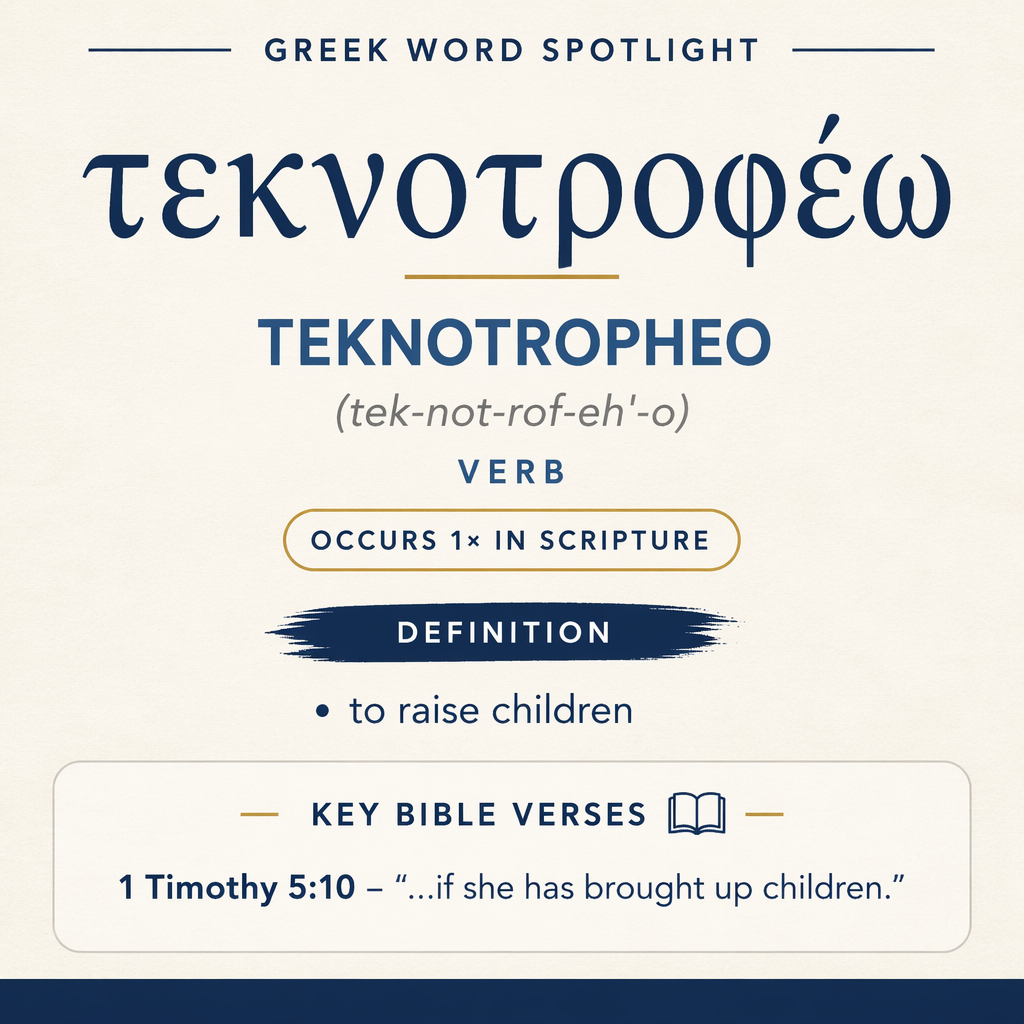
τεκνοτροφέω means “to raise children” and appears once in Scripture in 1 Timothy 5:10.
Scripture Occurrence
It occurs 1 time in Scripture. The occurrence is in 1 Timothy 5:10.
Learn More →Verse Context
In 1 Timothy 5:10 it appears in the phrase “has brought up children.” The verse lists this among good works.
Learn More →τεκνοτροφέω means “to raise children” and appears once in the New Testament, in Paul’s description of the kinds of proven good works associated with a widow’s reputation in 1 Timothy 5:10. In that setting the verb is part of a list of concrete, socially visible actions that demonstrate a life shaped by sustained care for others.
Root and Related Words
τεκνοτροφέω is formed from τέκνον (teknon), “child” (Strong’s G5043), and τρέφω (trepho), “to feed” (Strong’s G5142). Together these components anchor the verb in the sphere of child-related care and nourishment expressed as an active responsibility.

Occurrences
“being approved by good works, if she has brought up children, if she has been hospitable to strangers, if she has washed the saints’ feet, if she has relieved the afflicted, and if she has diligently followed every good work.” (1 Timothy 5:10)
Here τεκνοτροφέω stands within a chain of “if” clauses that identify patterns of conduct recognizable within a community. The phrase “has brought up children” places the raising of children alongside hospitality to strangers, humble service to believers (“washed the saints’ feet”), practical mercy (“relieved the afflicted”), and a steady commitment (“diligently followed every good work”). In this list, raising children is not presented as an isolated achievement but as one kind of long-term, embodied labor that can be “approved” because it produces observable fruit over time.
The surrounding actions clarify the kind of moral world in which the verb operates. The widow under discussion is known for work that meets real needs: opening the home to outsiders, taking up lowly tasks for fellow Christians, and acting decisively to bring relief to people who suffer. Within that same frame, “bringing up children” functions as a paradigmatic example of care that is neither momentary nor abstract. It implies a sustained pattern of attention that fits the overall rhythm of the verse: deeds that require time, patience, and willingness to serve.
The placement of the clause also matters. It is the first item in the sequence, which gives it prominence within the catalog of good works. Yet it is grammatically coordinated with the other clauses; the verse does not treat it as the only criterion, but as one member of a coherent cluster. As a result, τεκnoτροφέω contributes a particular kind of evidence—domestic and generational care—without separating that evidence from hospitality, service, and compassion. The verse’s structure treats these as mutually reinforcing indicators of a life characterized by consistent goodness.
Sense and Usage
The single attestation of τεκνοτροφέω supplies a focused picture of what “to raise children” looks like when it is evaluated as a “good work.” In 1 Timothy 5:10, the action is framed as something that can be spoken of retrospectively (“has brought up”), suggesting a completed or at least demonstrable history rather than a mere intention. The verb therefore functions as a marker of established reputation: it points to a track record of caregiving that others can recognize and confirm.
Because the verse sets raising children beside hospitality and the relieving of affliction, the sense of the verb is naturally heard within a broader ethic of practical care. Raising children is treated as a work that belongs to the same moral category as welcoming strangers and assisting the suffering—activities that involve giving resources, time, and personal attention. The word’s force in context is thus not merely biological or household description; it serves as a concrete example of active, ongoing responsibility toward vulnerable dependents.
The list also suggests that raising children, as envisioned here, harmonizes with community-oriented service. The widow’s deeds are not confined to one circle: children, strangers, “saints,” and “the afflicted” form a widening set of beneficiaries. Within that spread, τεκνοτροφέω names care at the close and daily level—work done where life is formed and sustained—while the other clauses name outward-facing expressions of the same disposition. The verse presents these not as competing callings but as complementary demonstrations of diligent goodness.
The final clause, “if she has diligently followed every good work,” gathers the preceding items into a unified portrayal. In that light, “has brought up children” is best read as one representative instance of a larger pattern: steady pursuit of actions that benefit others. The verb therefore carries an evaluative weight in this context. It is not simply a neutral description of an activity; it is an activity singled out as reputationally significant when assessing a person’s life of service.
Even with only one occurrence, the usage shows that τεκnoτροφέω can be treated as a recognizable, reportable contribution within the Christian community. It belongs to the sphere of works that can be publicly commended because they tangibly express care. The verse’s phrasing assumes that such child-raising is meaningful enough to be mentioned among other widely respected deeds—deeds that require humility, generosity, and perseverance.
Imagery
The imagery carried by τεκnoτροφέω in 1 Timothy 5:10 is domestic and concrete: the steady, often unseen labor through which children are “brought up” over time. In the same breath the verse evokes a home open to strangers, feet washed in humble service, and afflicted people receiving relief. Taken together, these images place child-raising within a textured portrait of practical goodness—hands-on care expressed through ordinary acts that, accumulated across years, become a reputation for good works.
Sources: Lexical data from Strong’s Exhaustive Concordance and the Translators Brief Lexicon of Extended Strongs for Greek (STEPBible, CC BY). Occurrence data from the Translators Amalgamated Greek New Testament (STEPBible, CC BY). Scripture quotations from the World English Bible (public domain).





