Exploring the Meaning of Talantiaios in Greek
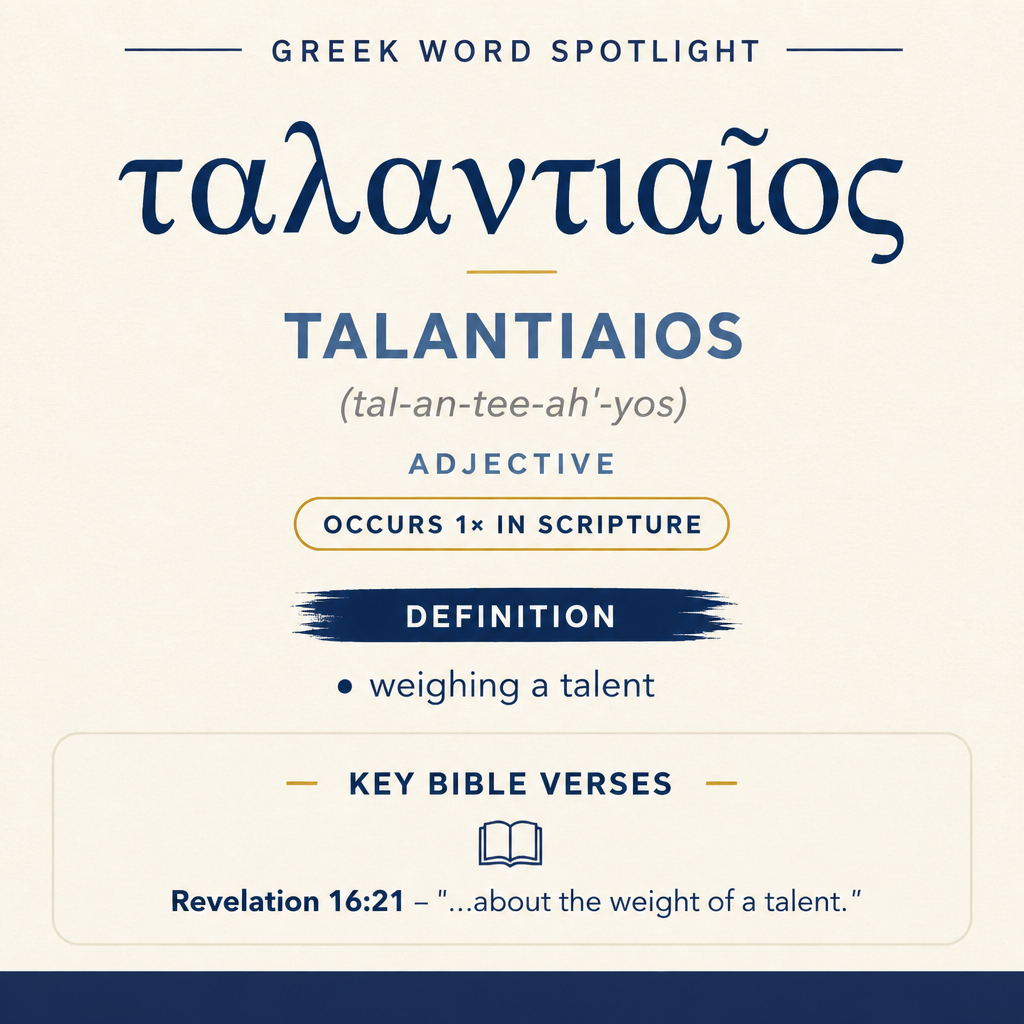
ταλαντιαῖος means “weighing a talent” and appears once in Scripture in Revelation 16:21.
Scripture Occurrence
It occurs 1 time in Scripture. The occurrence is in Revelation 16:21.
Learn More →Context Snapshot
In Revelation 16:21, great hailstones are described as about the weight of a talent. The verse reports people blasphemed God because of the plague.
Learn More →ταλαντιαῖος describes something as “weighing a talent,” and it appears in the climactic plague imagery of Revelation 16:21. In that scene it specifies the extraordinary mass of the hailstones that fall from the sky.
Root and Related Words
ταλαντιαῖος is related to talanton (τάλαντον), “talent” (Strong’s G5007), from which it derives.

Occurrences
“Great hailstones, about the weight of a talent, came down out of the sky on people. People blasphemed God because of the plague of the hail, for this plague is exceedingly severe.” (Revelation 16:21)
Here ταλαντιαῖος functions as a weight descriptor within a vivid report of a catastrophic storm. The line “about the weight of a talent” does more than supply a measurement; it frames the hailstones as objects whose heaviness matches a recognized unit of weight, marking them as unnaturally burdensome for hail. The verse places these massive stones in motion—“came down out of the sky on people”—so the adjective contributes directly to the reader’s sense of impact: the hazard is not only that hail falls, but that what falls is heavy on an extreme scale.
The weight description also shapes the logic of the people’s reaction in the same sentence cluster. The text links the event to an evaluative conclusion: “for this plague is exceedingly severe.” By specifying the hailstones as “about the weight of a talent,” ταλαντιαῖος supplies concrete content for that severity. The word anchors the phrase “exceedingly severe” in a physical reality that can be imagined and feared: hailstones heavy enough to be compared to a talent. In the narrative flow, this physical extremity becomes part of the setting in which “People blasphemed God because of the plague of the hail,” tying the heaviness of the stones to the intensity of the affliction and the hostility of the response.
Sense and Usage
The sense “weighing a talent” is realized in Revelation 16:21 as an attributive descriptor applied to hailstones, specifying their approximate mass (“about the weight of a talent”). The adjective therefore operates within the semantic domain of measurable heaviness: it characterizes an object by its weight, not by its shape, composition, or source. The phrase is built to communicate scale in a way that is both concrete and comparative—an object in the scene is presented as matching the heft associated with a “talent.”
Two features of the usage stand out in this context. First, the adjective is paired with an approximation (“about”), which keeps the statement in the register of observed effect rather than technical accounting. The point is not to produce a ledger-precise measurement but to convey an immense, credible magnitude in the middle of a dramatic judgment scene. Second, the adjective’s force is intensified by the object it modifies: hail is ordinarily associated with pellets or stones of ice, but this description pushes the reader to imagine individual “hailstones” as crushingly heavy. In that way, the word’s contribution is not abstract; it directly heightens the physical plausibility of harm and the experiential dread implied by a “plague.”
Because the adjective’s meaning is strictly weight-based, its rhetorical value in Revelation 16:21 lies in how weight can communicate severity without additional explanation. The verse already labels the event a “plague” and calls it “exceedingly severe.” By adding the note “about the weight of a talent,” the text presents severity as something measurable and bodily, not merely emotional or interpretive. The description makes the scene tactile: what falls from the sky is heavy enough to make the disaster immediately intelligible as overwhelming.
Imagery
In Revelation 16:21, ταλαντιαῖος participates in an image of judgment that is felt in the body: heavy hail descending “on people.” The adjective presses the reader to imagine weight as a weapon-like property of the storm—an encounter with mass from above. This contributes to the stark contrast within the verse between the extraordinary force of the plague and the human reaction that follows it: faced with hailstones described by talent-weight, “People blasphemed God,” a response portrayed as arising “because of the plague of the hail.”
Sources: Lexical data from Strong’s Exhaustive Concordance and the Translators Brief Lexicon of Extended Strongs for Greek (STEPBible, CC BY). Occurrence data from the Translators Amalgamated Greek New Testament (STEPBible, CC BY). Scripture quotations from the World English Bible (public domain).