
Exploring the Meaning of Talaiporos in Greek
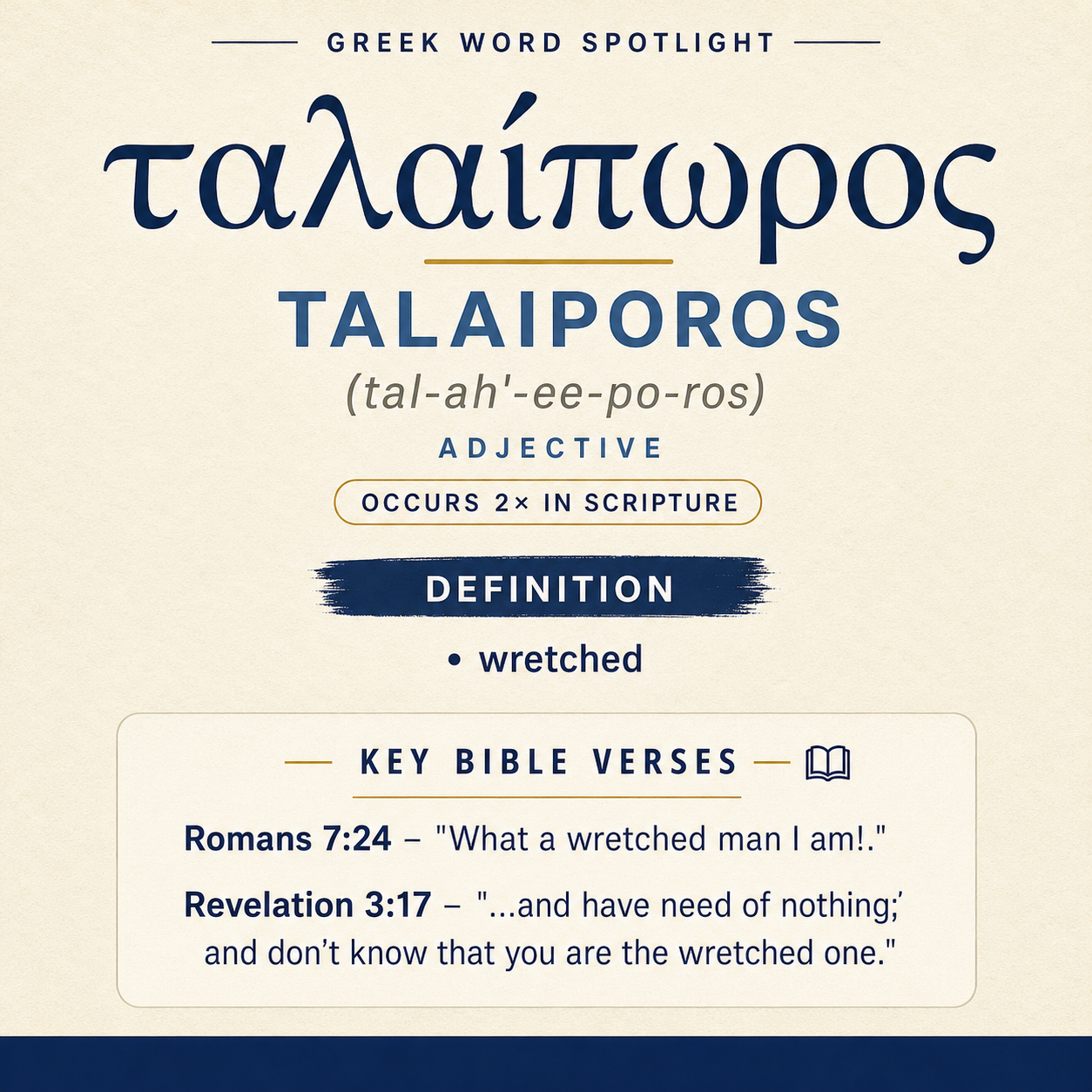
ταλαίπωρος means “wretched” and appears in Romans 7:24 and Revelation 3:17.
Scripture Occurrences
This word occurs 2 times in Scripture: Romans 7:24 and Revelation 3:17.
Learn More →Verse Context
In Romans 7:24 it expresses, “What a wretched man I am!” In Revelation 3:17 it identifies someone as “the wretched.”
Learn More →ταλαίπωρος expresses the condition of being “wretched.” It appears in Paul’s anguished self-description in Romans 7 and in Christ’s rebuke of a self-satisfied church in Revelation 3.
Root and Related Words
Strong’s associates ταλαίπωρος with πεῖρα (peira), “test” (Strong’s G3984), and τάλαντον (talanton), “talent” (Strong’s G5007).

Occurrences
“What a wretched man I am! Who will deliver me out of the body of this death?” (Romans 7:24)
Here ταλαίπωρος is a first-person cry: “What a wretched man I am!” The adjective functions as an unvarnished verdict on the speaker’s present state. It is not a detached label but an exclamation that frames the urgent question that follows: “Who will deliver me out of the body of this death?” The word’s force in this scene lies in how it names the speaker’s misery in a way that demands rescue; the “wretched” condition is pictured as bound up with “the body of this death,” so that deliverance is not merely improvement but liberation. In the verse’s compact structure, the self-assessment (“wretched”) and the plea (“Who will deliver me…?”) belong together: the adjective supplies the emotional and moral pressure that makes the question unavoidable.
“Because you say, ‘I am rich, and have gotten riches, and have need of nothing;’ and don’t know that you are the wretched one, miserable, poor, blind, and naked;” (Revelation 3:17)
In Revelation 3:17, ταλαίπωρος is part of a confrontation between what is claimed and what is real. The sentence begins with confident speech—“I am rich… and have need of nothing”—and then overturns that self-description: “and don’t know that you are the wretched one.” The adjective is not presented as a feeling the church admits; it is a condition they fail to recognize. This ignorance is emphasized: they “don’t know” what they truly are. The word is also set within a cluster of harsh descriptors—“miserable, poor, blind, and naked”—which intensifies the exposure of their true state. Within that list, “the wretched one” stands as a sweeping characterization that fits the overall rebuke: despite claiming sufficiency, they are in a condition of severe distress and deficiency. The definite phrasing, “the wretched one,” sharpens the indictment, as though their true identity in this moment is defined by that state rather than by their claims of wealth.
Sense and Usage
Across these two occurrences, “wretched” names a condition that is both serious and personal, but it is applied in two distinct rhetorical settings. In Romans 7:24, the speaker himself voices the diagnosis. The adjective is pressed into service as a confession that stands at the height of desperation: it is the word chosen to capture what life feels like when the question of deliverance becomes urgent and immediate. The surrounding language (“Who will deliver me…?”) shows that “wretched” is not a casual insult or a passing mood; it is the term that best fits a condition experienced as intolerable and in need of rescue.
In Revelation 3:17, “wretched” functions differently: it is a corrective designation spoken over those who are confident and complacent. The word operates as a revelation of hidden reality—“and don’t know that you are the wretched one.” The wretched condition is therefore compatible with self-deception; a person (or community) may assert strength and sufficiency while being truly “wretched.” The verse also displays how the term can summarize a larger picture of ruin, since it sits alongside “miserable, poor, blind, and naked.” In that context, “wretched” is not isolated; it gathers up multiple forms of need into a single blunt characterization.
Read together, the passages show that ταλαίπωρος can be used both as an inward cry (Romans) and as an outward diagnosis (Revelation). In the first, the wretched person knows it and pleads for deliverance; in the second, the wretched person does not know it and must be told. Yet in both places the word is tied to a decisive turning point: it either leads directly into the search for deliverance or it shatters a false sense of security. The adjective thus marks a condition that cannot be safely ignored—whether recognized with anguish or denied with confidence.
Imagery
The two verses frame “wretched” with vivid, bodily imagery. Romans 7:24 binds the condition to “the body of this death,” making wretchedness feel like something enclosing and oppressive, from which one must be “deliver[ed] out.” Revelation 3:17 places the wretched condition among images of exposure and lack—“blind, and naked”—so that wretchedness is pictured not as hidden strength but as uncovered need. Together these scenes give the adjective a sharp, concrete edge: it belongs to moments when reality is faced without softening, either by confession or by correction.
Sources: Lexical data from Strong’s Exhaustive Concordance and the Translators Brief Lexicon of Extended Strongs for Greek (STEPBible, CC BY). Occurrence data from the Translators Amalgamated Greek New Testament (STEPBible, CC BY). Scripture quotations from the World English Bible (public domain).





