Exploring the Meaning of Soma in Greek
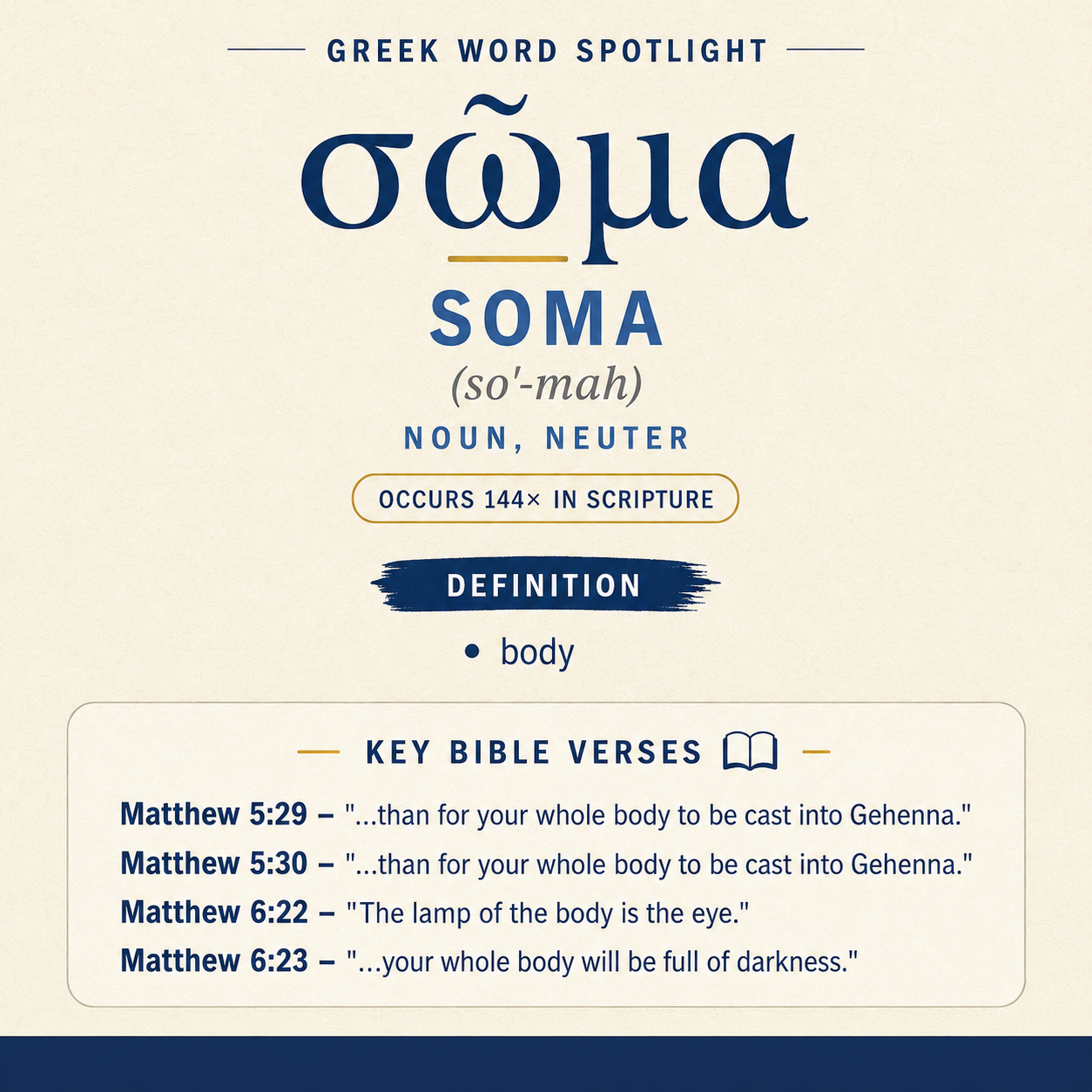
σῶμα means “body” in Greek and occurs 144 times in Scripture, including Matthew 5:29–30; 6:22–25; 10:28; 26:12, 26.
Scripture Frequency
It occurs 144 times in Scripture. The provided examples include multiple passages in Matthew.
Learn More →Matthew Examples
In Matthew 6:22–23 it appears in “the lamp of the body is the eye.” In Matthew 10:28 it contrasts killing the body with the soul.
Learn More →σῶμα means “body.” In the passages quoted here it names the physical body as a whole, whether in ethical warning, everyday concern, healing, death and burial, or resurrection.
Occurrences
Matthew 5:29: “If your right eye causes you to stumble, pluck it out and throw it away from you. For it is more profitable for you that one of your members should perish, than for your whole body to be cast into Gehenna.”
Here σῶμα marks the person’s bodily wholeness in contrast to “one of your members.” The saying weighs the loss of a part against the fate of “your whole body,” treating the body as a single, integrated reality that can be “cast into Gehenna.”
Matthew 5:30: “If your right hand causes you to stumble, cut it off, and throw it away from you. For it is more profitable for you that one of your members should perish, than for your whole body to be cast into Gehenna.”
σῶμα again stands for the complete body over against an offending member. The repetition with a different member (“right hand”) keeps the focus on the body as the total physical self that is at stake when “your whole body” is envisioned as subject to judgment.
Matthew 6:22: ““The lamp of the body is the eye. If therefore your eye is sound, your whole body will be full of light.”
In this image, σῶμα is the recipient of what the eye admits. The “whole body” being “full of light” presents the body as a unified sphere that can be filled—here, not with food or clothing, but with “light,” as the result of a “sound” eye.
Matthew 6:23: “But if your eye is evil, your whole body will be full of darkness. If therefore the light that is in you is darkness, how great is the darkness!”
σῶμα remains the same physical whole but is now described as “full of darkness.” The bodily image intensifies the contrast: what is wrong with the eye spreads its effect through the entire body, so that the body becomes the pictured location of “darkness.”
Matthew 6:25: “Therefore I tell you, don’t be anxious for your life: what you will eat, or what you will drink; nor yet for your body, what you will wear. Isn’t life more than food, and the body more than clothing?”
σῶμα is the body considered in ordinary human needs, specifically “what you will wear.” The verse sets “your life” alongside “your body,” and then contrasts “food” with “clothing,” treating the body as what is clothed and cared for in daily living.
Matthew 10:28: “Don’t be afraid of those who kill the body, but are not able to kill the soul. Rather, fear him who is able to destroy both soul and body in Gehenna.”
σῶμα is what human opponents can “kill,” distinguishing bodily death from what happens to “the soul.” The pairing “both soul and body” presents the body as one aspect of the human person that can be subjected to destruction, and it anchors the warning in the vulnerability of the physical body.
Matthew 26:12: “For in pouring this ointment on my body, she did it to prepare me for burial.”
σῶμα refers to Jesus’ body as the object of an anointing interpreted as preparation “for burial.” The body here is not a metaphorical container; it is the tangible body that will be buried, and the act of pouring ointment is directed toward it as such.
Matthew 26:26: “As they were eating, Jesus took bread, gave thanks for it, and broke it. He gave to the disciples, and said, “Take, eat; this is my body.””
σῶμα is spoken by Jesus in direct identification: “this is my body.” Within the meal setting—taking, giving thanks, breaking, giving—“my body” is the personal, bodily self of Jesus placed before the disciples in a solemn, concrete saying attached to the bread they are commanded to eat.
Matthew 27:52: “The tombs were opened, and many bodies of the saints who had fallen asleep were raised;”
σῶμα appears in the plural to name “many bodies” associated with “tombs” and with “saints who had fallen asleep.” The scene uses the body in its most physical sense: bodies are connected with burial places, and these bodies are “raised,” bringing the language of bodily death and bodily restoration into view.
Matthew 27:58: “This man went to Pilate, and asked for Jesus’ body. Then Pilate commanded the body to be given up.”
σῶμα designates Jesus’ body as something requested, granted, and transferred. The body is treated as an identifiable physical reality—“Jesus’ body”—that can be “given up” under authority, fitting the narrative moment after death when burial arrangements begin.
Matthew 27:59: “Joseph took the body, and wrapped it in a clean linen cloth,”
σῶμα is again the physical body handled for burial. The verbs “took” and “wrapped” and the mention of “a clean linen cloth” keep the reference concrete: the body is a corporeal object that can be prepared and covered.
Mark 5:29: “Immediately the flow of her blood was dried up, and she felt in her body that she was healed of her affliction.”
σῶμα refers to the woman’s own bodily experience of healing. The narrative emphasizes internal, physical awareness—she “felt in her body”—so the body is the site where the change is perceived and where the “affliction” had been borne.

Sense and Usage
Across these contexts, σῶμα consistently names the body as a whole—something more comprehensive than individual “members” (Matthew 5:29–30) and capable of being spoken of as “whole” (Matthew 6:22–23). This wholeness allows the word to function in warnings where bodily integrity is contrasted with bodily ruin, and in images where a single bodily part (the eye) affects the condition of the entire body.
σῶμα also appears in ordinary, practical speech about human life: the body is what is clothed (Matthew 6:25), and it is what can be killed (Matthew 10:28). In that same warning, “body” is set alongside “soul,” not to blur the body into something else, but to specify that bodily life can be ended by people and that the body is included in what God can “destroy… in Gehenna.” The word thus supports a realistic view of bodily vulnerability without redefining “body” away from its physical sense.
In the passion and burial scenes (Matthew 26:12; 27:58–59), σῶμα is the body as handled, prepared, requested, granted, and wrapped. The narrative treats the body as the tangible focus of burial customs: ointment is poured “on my body,” it is prepared “for burial,” and later it is taken and wrapped in linen. In this cluster, “body” carries the weight of mortality and the concrete aftermath of death.
Two passages expand the range of situations without changing the referent. In Mark 5:29, the body is the location of illness and the felt reality of healing—an embodied awareness that the affliction has ended. In Matthew 27:52, the plural “bodies” joins the body to tombs and to being “raised,” showing σῶμα used for bodies associated with death and then with restoration to life. The word remains firmly “body,” whether living, dying, buried, or raised.
Imagery
The quoted passages repeatedly picture the body as a single whole that can be filled (with “light” or “darkness”), clothed, killed, handled in burial, and raised from tombs. That concrete imagery gives σῶμα a vivid narrative profile: it can be the arena where moral seriousness is pressed (Matthew 5:29–30), where inner condition is pictured outwardly (Matthew 6:22–23), and where healing, death, and burial are experienced and enacted (Mark 5:29; Matthew 26:12; 27:58–59).
Sources: Lexical data from Strong’s Exhaustive Concordance and the Translators Brief Lexicon of Extended Strongs for Greek (STEPBible, CC BY). Occurrence data from the Translators Amalgamated Greek New Testament (STEPBible, CC BY). Scripture quotations from the World English Bible (public domain).