Exploring the Meaning of Suntrimma in Greek
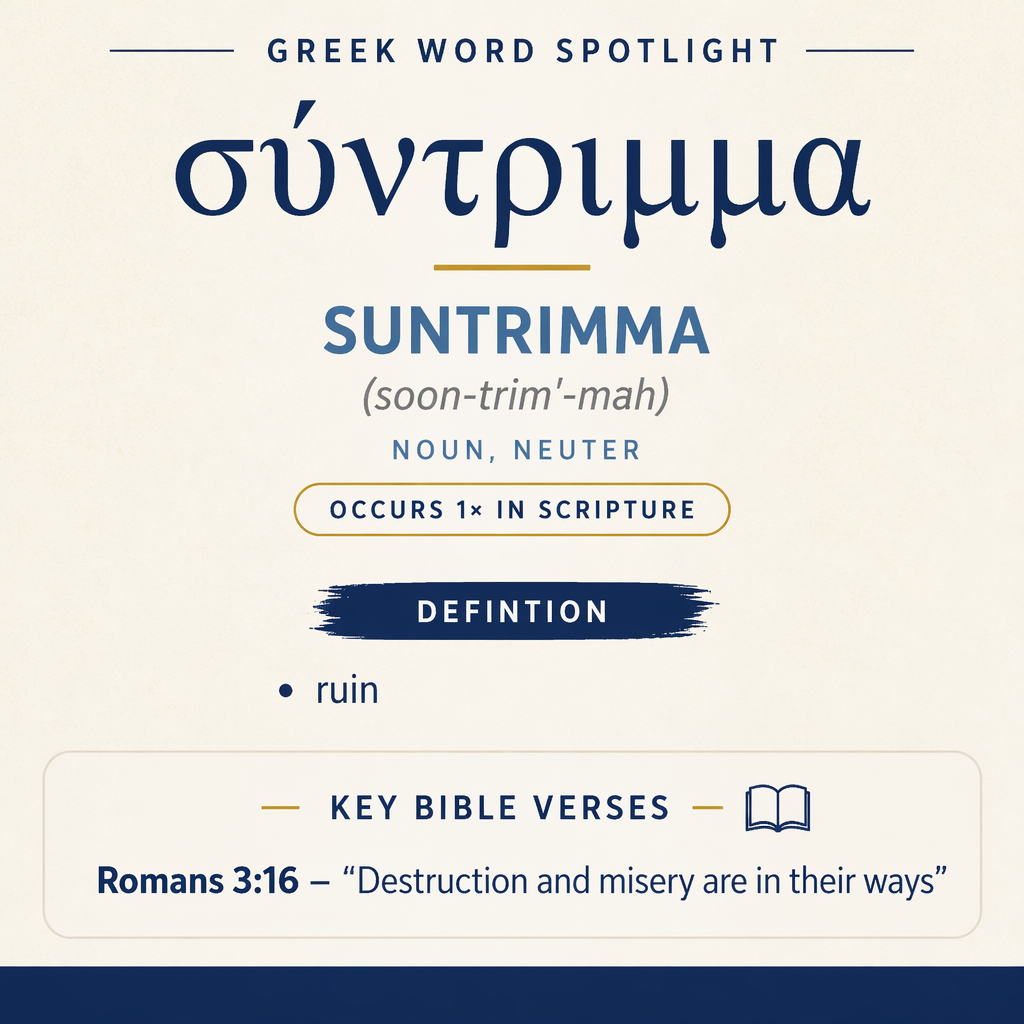
σύντριμμα (Suntrimma) means “ruin” and appears once in Scripture, in Romans 3:16.
Scripture Occurrence
It occurs 1 time in Scripture. The occurrence is in Romans 3:16.
Learn More →Verse Context
In Romans 3:16 it appears in the line, “Destruction and misery are in their ways.”
Learn More →σύντριμμα means “ruin” and appears in the New Testament in Paul’s description of the human path and its results in Romans 3:16. In that line it stands alongside “misery,” portraying the outcome found “in their ways.”
Root and Related Words
σύντριμμα is derived from the verb syntribō (συντρίβω), “to break.” The noun form presents the result of breaking as a condition that can be encountered or left behind in a person’s course of life.

Occurrences
“Destruction and misery are in their ways.” (Romans 3:16)
In Romans 3:16, σύντριμμα contributes the idea of ruin as something located “in their ways”—that is, embedded in the paths people take and the manner in which they move through life. The statement is not framed as a distant possibility but as a present feature of those ways: ruin is “in” them, as if the road itself carries it. Paired with “misery,” the term helps depict a course of action that produces not only inner pain but also outward wreckage, a trail marked by damage as one proceeds.
The placement of ruin before misery gives the line a grim concreteness: the “ways” are characterized by the kind of harm that can leave things shattered and spoiled. The wording also treats ruin as something that can be found wherever those ways are found, suggesting that it is not an isolated incident but a recurrent accompaniment of the path described.
Sense and Usage
The definition “ruin” in this context functions as more than a label for an end-state; it depicts the quality of the route itself. The phrase “are in their ways” expresses ruin as a resident feature of a pattern of living, not merely the eventual destination of that pattern. As a result, σύντριμμα here carries the sense of tangible wreckage—harm that leaves what it touches in a ruined condition—while remaining broad enough to cover the varied forms such ruin may take wherever those “ways” run.
Its association with syntribō (“to break”) fits the verse’s portrayal of a path that brings breaking in its wake. Without requiring the reader to picture a specific object, the noun evokes the aftermath of force: what has been broken does not remain intact, and the condition that follows is ruin. In Romans 3:16 this aftermath is treated as an identifying mark of the “ways” in view, as though ruin is part of the environment created by those ways and encountered by those who walk them.
The coupling with “misery” also shapes how ruin is heard. The two terms together hold both the external and internal dimensions of a destructive course: ruin names the wrecking effect, while misery names the suffering that accompanies it. σύντριμμα therefore contributes a stark assessment of the effects of human conduct as Paul describes it—conduct that is not merely misguided but productive of ruin as a characteristic outcome.
Imagery
Even in a single occurrence, σύντριμμα carries a strong visual suggestion: a roadway marked by the signs of ruin. The verse’s simple structure—“Destruction and misery are in their ways”—invites the reader to imagine “ways” that are not safe or sound but littered with what ruin leaves behind: brokenness as a feature of the path itself (Romans 3:16).
Sources: Lexical data from Strong’s Exhaustive Concordance and the Translators Brief Lexicon of Extended Strongs for Greek (STEPBible, CC BY). Occurrence data from the Translators Amalgamated Greek New Testament (STEPBible, CC BY). Scripture quotations from the World English Bible (public domain).