
Exploring the Meaning of Suntribo in Greek
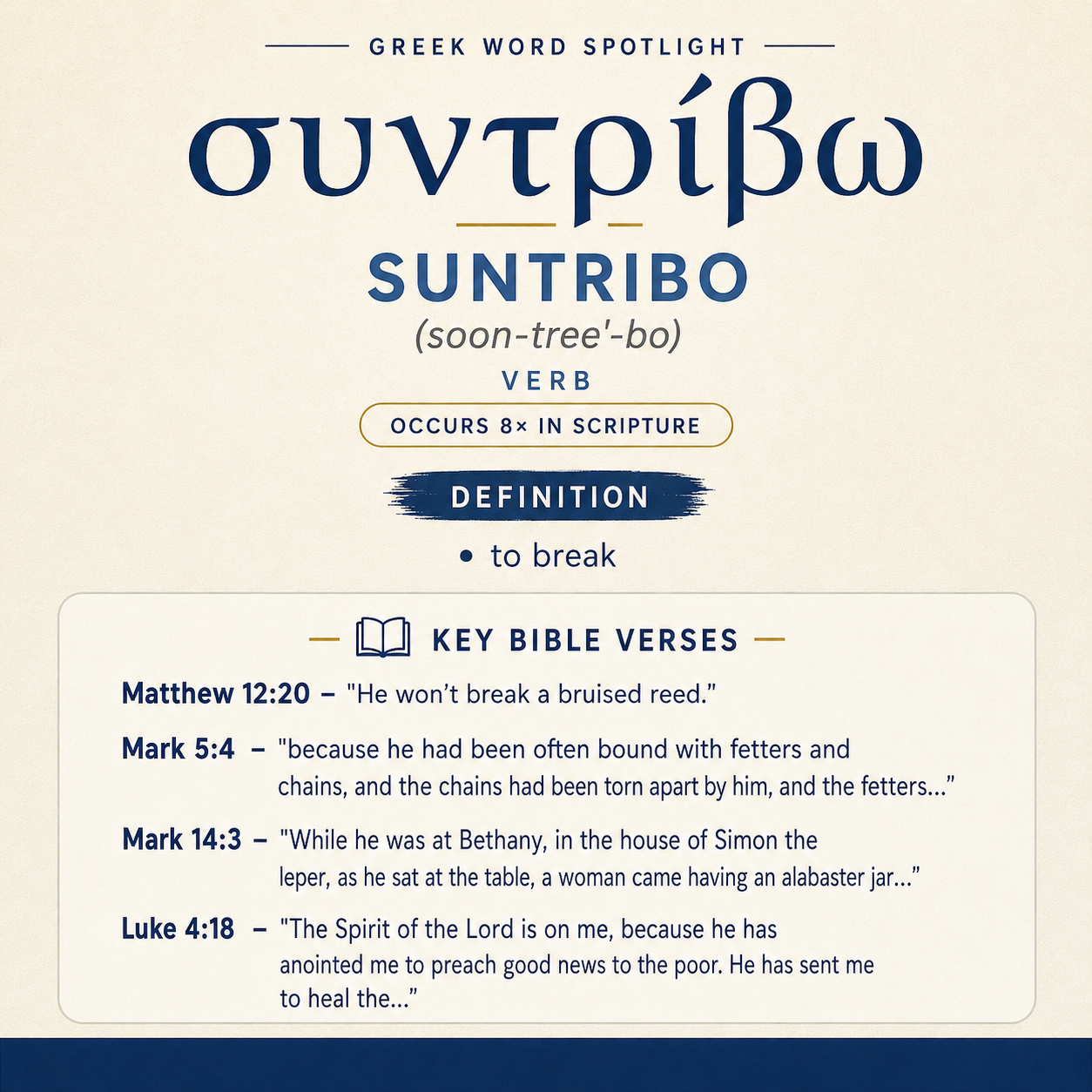
συντρίβω (Suntribo) means “to break” and occurs 8 times in Scripture, including Matthew 12:20, John 19:36, and Romans 16:20.
Core Meaning
συντρίβω means “to break.” In Romans 16:20 it is used for God quickly crushing Satan under believers’ feet.
Learn More →Gospel Occurrences
In Matthew 12:20, it describes not breaking a bruised reed. In John 19:36, it appears in the statement, “A bone of him will not be broken.”
Learn More →Other References
It appears in Mark 5:4, Mark 14:3, Luke 4:18, Luke 9:39, and Revelation 2:27. In Revelation 2:27, it describes shattering like clay pots.
Learn More →συντρίβω expresses the idea of breaking, and it appears across Gospel scenes, an apostolic promise, and an apocalyptic image. In these passages it ranges from literal fracture and shattering to the experience of being crushed and bruised.
Occurrences
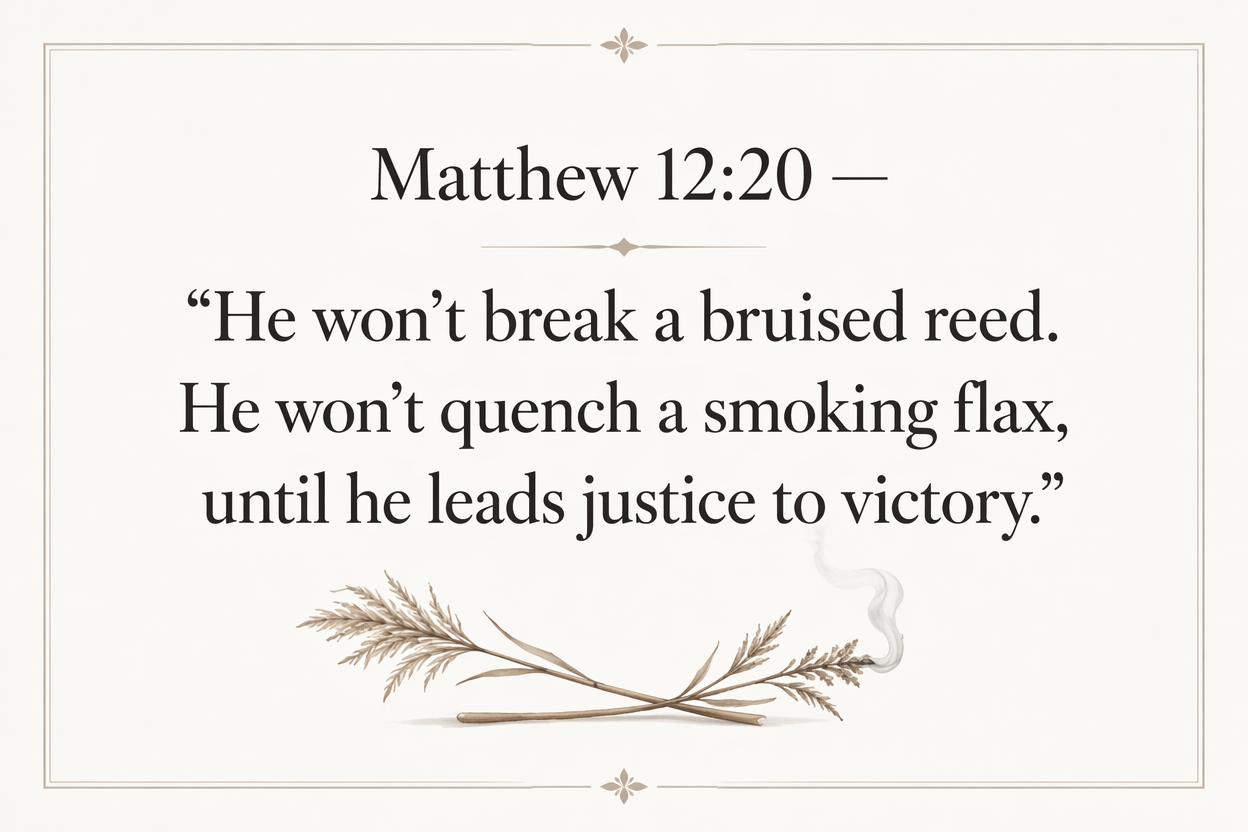
Matthew 12:20 — “He won’t break a bruised reed. He won’t quench a smoking flax, until he leads justice to victory.”
Here the verb is set in a picture of fragility: a “bruised reed” is already damaged, and the statement denies a further act of breaking. In the paired lines, the imagery moves from a plant stem to a “smoking flax,” both suggesting something weak and near to failure. Within this line, breaking would be the finishing blow; the sentence frames restraint—refusing to turn damage into destruction—while the broader clause looks toward “justice to victory,” so the refusal to break belongs to a purposeful, patient course rather than mere inaction.
Mark 5:4 — “because he had been often bound with fetters and chains, and the chains had been torn apart by him, and the fetters broken in pieces. Nobody had the strength to tame him.”
The breaking is concrete and forceful: “fetters” are “broken in pieces.” The scene stresses repeated attempts (“often bound”) and repeated failure, and the results are described in physical terms of restraints ruined and rendered useless. The final line—“Nobody had the strength to tame him”—interprets the broken restraints as evidence of overpowering strength and untamable violence, so the verb marks not a minor crack but a decisive failure of the chains’ function.
Mark 14:3 — “While he was at Bethany, in the house of Simon the leper, as he sat at the table, a woman came having an alabaster jar of ointment of pure nard—very costly. She broke the jar, and poured it over his head.”
Breaking is the enabling action that makes the pouring possible. The jar is described as “alabaster,” and the contents as “very costly,” which gives weight to the act: the container is not merely opened but broken, and the result is immediate outpouring “over his head.” The verb thus highlights a deliberate, irreversible action in a setting of hospitality (“sat at the table”), turning a valuable object into a means of lavish giving.
Luke 4:18 — ““The Spirit of the Lord is on me, because he has anointed me to preach good news to the poor. He has sent me to heal the broken hearted, to proclaim release to the captives, recovering of sight to the blind, to deliver those who are crushed,”
In this programmatic announcement, the breaking theme shifts from objects to people: “the broken hearted” are named among the poor, captives, and blind. The final phrase, “to deliver those who are crushed,” places crushing alongside captivity and blindness as a condition from which deliverance is needed. The verb’s force is felt as lived experience—people who have been pressed down—set within a mission characterized by preaching, healing, proclaiming release, and delivering.
Luke 9:39 — “Behold, a spirit takes him, he suddenly cries out, and it convulses him so that he foams, and it hardly departs from him, bruising him severely.”
The breaking idea appears here as bodily damage: the spirit’s assault leaves the boy “bruising him severely.” The description stacks violent verbs and effects—taken, sudden cry, convulsions, foaming—and then adds persistence (“it hardly departs from him”). In that sequence, bruising is not incidental; it is the continuing outcome of repeated convulsions, emphasizing the severity and relentlessness of the harm.
John 19:36 — “For these things happened that the Scripture might be fulfilled, “A bone of him will not be broken.””
This occurrence is framed as fulfillment, and the key claim is negative: “will not be broken.” The object is specific—“A bone”—which locates the verb in the realm of physical fracture. Within the sentence, the unbroken bone is not merely a medical detail but a sign-bearing detail (“that the Scripture might be fulfilled”), so the verb carries both concrete force and interpretive weight: the body is described in terms of what did not happen to it.
Romans 16:20 — “And the God of peace will quickly crush Satan under your feet. The grace of our Lord Jesus Christ be with you.”
Breaking becomes crushing in an image of decisive defeat: “crush Satan under your feet.” The subject is “the God of peace,” which creates a striking pairing of peace with an act of crushing, and the adverb “quickly” adds urgency and imminence. The spatial phrase “under your feet” evokes a downwards pressure and subjugation, presenting crushing as the completion of victory, followed immediately by a benediction of grace.
Revelation 2:27 — “He will rule them with a rod of iron, shattering them like clay pots; as I also have received of my Father:”
This line joins authority (“He will rule them”) with violent breakage (“shattering them like clay pots”). The “rod of iron” supplies the instrument of rule and the means of shattering, and the comparison to “clay pots” emphasizes brittleness and the ease with which such objects can be smashed. The verb here is not about accidental damage but about a ruling action expressed through forceful fragmentation.
Sense and Usage
Across these passages, breaking can be either refused, inflicted, or employed as a purposeful act. In Matthew 12:20, the point is restraint toward what is already “bruised,” where breaking would complete the ruin of something fragile. In Mark 5:4 and Revelation 2:27, breaking describes overpowering strength directed at restraints or opponents: fetters are reduced “in pieces,” and clay pots are shattered under an iron rod. John 19:36 reverses the expectation by specifying that a bone “will not be broken,” using the same concrete domain of fracture while emphasizing preservation.
Other texts apply the breaking imagery to persons and their condition. Luke 4:18 speaks of “the broken hearted” and “those who are crushed,” placing brokenness and crushing among the conditions met by preaching, healing, release, and deliverance. Luke 9:39 portrays severe bruising as the bodily result of an oppressive force that convulses and scarcely departs; breaking is experienced as damage that accumulates. Even when the act is not described as a visible fracture, the word’s force is consistent: it names the kind of harm that leaves what is struck diminished, damaged, or pressed down.
Mark 14:3 shows a distinct, constructive use: breaking the alabaster jar is the decisive action that releases what is “very costly” so it can be poured out. The verb therefore can mark an intentional rupture that enables an outcome—here, the outpouring of ointment—rather than merely describing injury or defeat. Taken together, the occurrences show the word operating in both literal and figurative scenes, but consistently carrying the weight of force that changes the state of what is acted upon.
Imagery
The passages cluster around vivid, tactile images: a bruised reed that is not snapped, metal restraints broken apart, a brittle jar shattered to release perfume, bodies bruised, and clay pots smashed by iron. Even the promise of crushing “under your feet” and the insistence that a bone “will not be broken” keep the language anchored in physical pressure and fracture, making breakage a concrete way to speak about harm, restraint, deliverance, and rule.
Sources: Lexical data from Strong’s Exhaustive Concordance and the Translators Brief Lexicon of Extended Strongs for Greek (STEPBible, CC BY). Occurrence data from the Translators Amalgamated Greek New Testament (STEPBible, CC BY). Scripture quotations from the World English Bible (public domain).





