
Exploring the Meaning of Suntemno in Greek
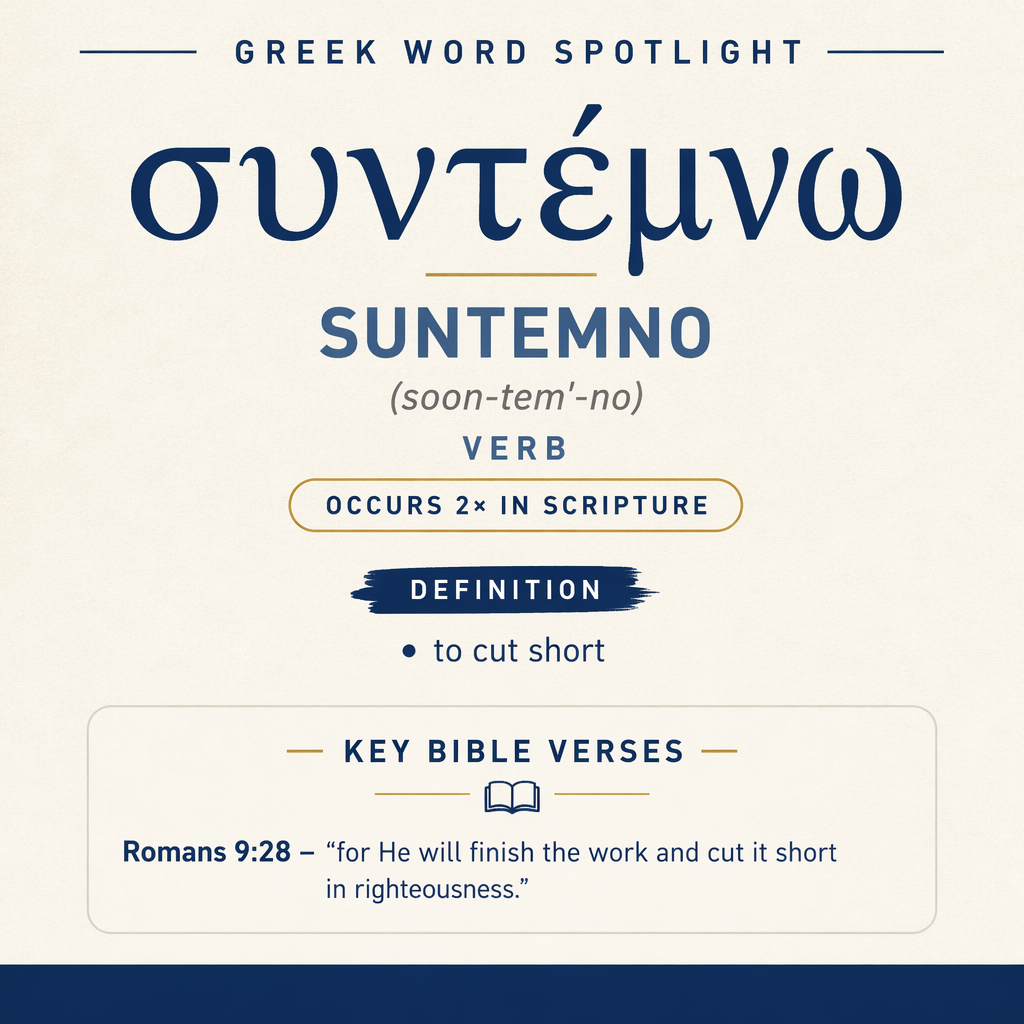
συντέμνω means “to cut short” and occurs in Scripture in Romans 9:28.
Scripture Occurrence
This word occurs 2 times in Scripture. One occurrence is in Romans 9:28.
Learn More →Romans 9:28
In Romans 9:28, it describes the LORD cutting the work short in righteousness.
Learn More →συντέμνω expresses the idea of bringing something to an earlier end—cutting it short. In the New Testament it appears in Paul’s argument in Romans, where God’s action is portrayed as decisive and swift within the scope of His righteous purposes.
Root and Related Words
συντέμνω (Suntemno) is presented with the elements syn (σύν), “with” (Strong’s G4862), and tomoteros (τομώτερος), “sharper” (Strong’s G5114). Together these related terms keep the imagery close to cutting: something done “with” an edge that is “sharper,” yielding an outcome that is not extended but abbreviated.

Occurrences
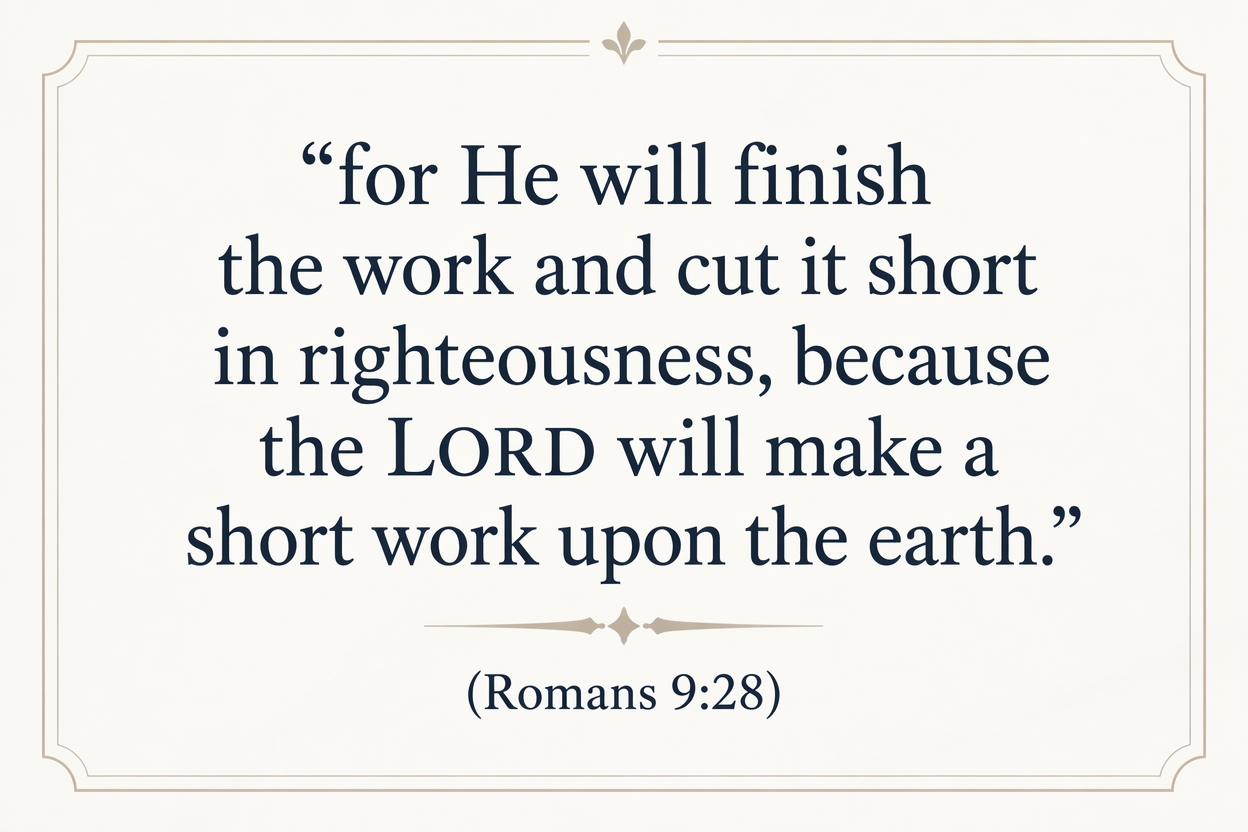
“for He will finish the work and cut it short in righteousness, because the LORD will make a short work upon the earth.” (Romans 9:28)
Here συντέμνω occurs in a tightly packed sequence of actions attributed to God: “finish the work” and “cut it short.” The two verbs sit side by side, so “cut it short” does not describe an abandoned task but one brought to completion without delay or excess. The phrase “in righteousness” frames this shortening as consistent with God’s righteous character and purpose; it is not a hasty mistake but a morally governed decision about duration and extent.
The second clause reinforces the same idea with a doubled emphasis: “because the LORD will make a short work upon the earth.” In this setting, the verb’s contribution is not primarily about the method of judgment or the details of what the “work” consists of, but about its measured length. The “work” is pictured as something that could be prolonged, yet the LORD instead brings it to a concise execution—something done fully, but without protracted process. The scope “upon the earth” places the action in the broad arena of human history and the world’s stage, so the shortening is not merely private or local; it is the Lord’s decisive management of an earthward matter.
Sense and Usage
The core sense of συντέμνω (“to cut short”) is concrete in imagery but applied to an abstract object: “the work.” The verb treats the duration or extent of that work as something that can be trimmed down, like a length of material reduced by cutting. In Romans 9:28 the shortening is neither random nor merely pragmatic; it is explicitly tethered to righteousness (“cut it short in righteousness”). That connection makes the verb function as a theological description of pace and limit: the Lord sets a boundary, ends the matter sooner, and does so in a way that accords with what is right.
The immediate parallel wording—“finish the work and cut it short”—also clarifies how “cut short” operates here. It is not the opposite of finishing; it is a way of finishing. The “work” reaches its intended endpoint, but the endpoint arrives in a compressed timeframe or reduced span. This keeps the verb from suggesting incompleteness in this context; its emphasis is on a curtailed process rather than an unfinished result.
Finally, the repetition of the idea (“cut it short” … “make a short work”) shows that the text uses shortening as a way to stress decisiveness. The LORD’s action is portrayed as one that does not linger. Where an outcome might be drawn out, the LORD brings it to conclusion in a shortened course, and that brevity itself becomes part of the message: the LORD’s righteous work is not only sure, but also unextended beyond what He determines.
Imagery
Even in a figurative setting, συντέμνω keeps the visual force of cutting. Romans 9:28 speaks of “work” as though it were a length that can be trimmed: an undertaking measured, brought to its endpoint, and reduced to what is required. The verse’s paired phrases—“finish the work” and “make a short work”—leave the reader with the picture of an act completed cleanly and quickly, with the LORD Himself setting the limit of its duration “upon the earth.”
Sources: Lexical data from Strong’s Exhaustive Concordance and the Translators Brief Lexicon of Extended Strongs for Greek (STEPBible, CC BY). Occurrence data from the Translators Amalgamated Greek New Testament (STEPBible, CC BY). Scripture quotations from the World English Bible (public domain).




