
Exploring the Meaning of Sunthlao in Greek
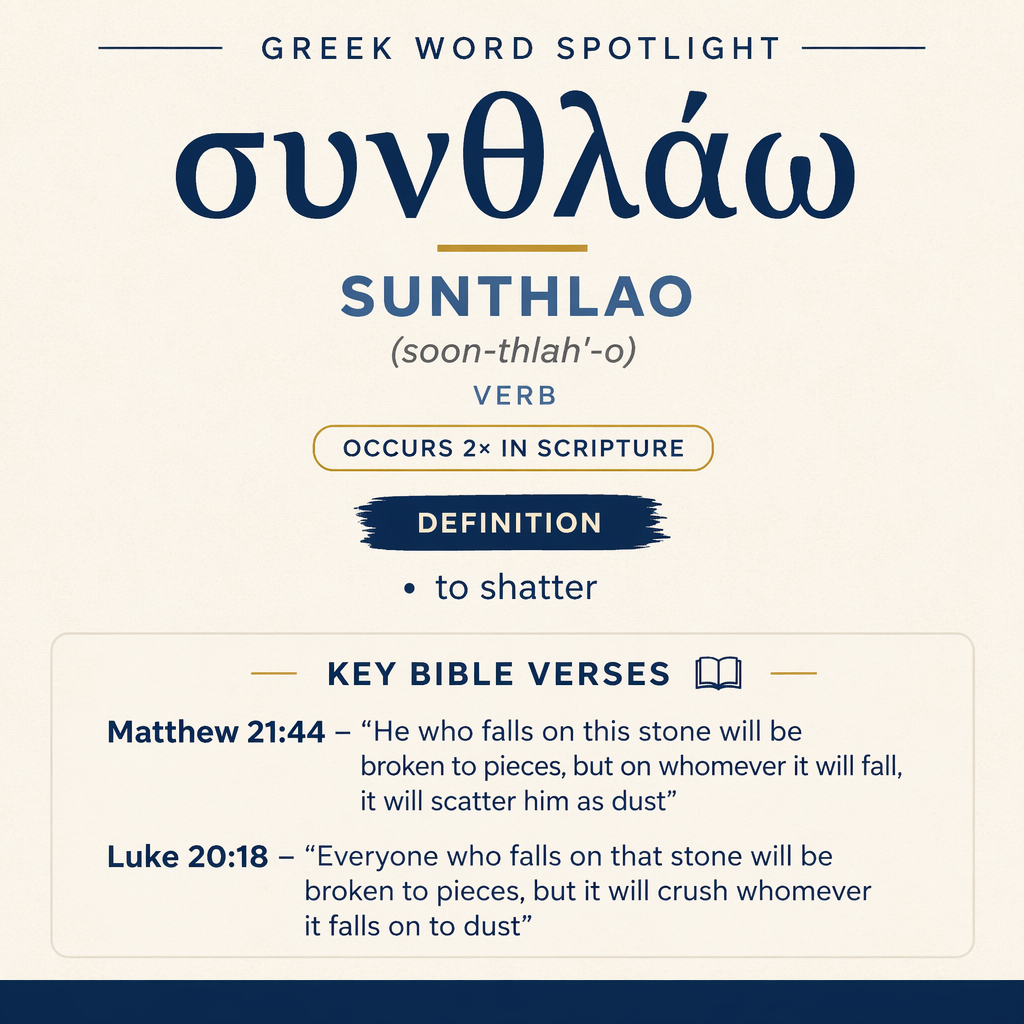
συνθλάω means “to shatter” and occurs twice in Scripture, in Matthew 21:44 and Luke 20:18.
Verse Context
In both verses, it describes being broken to pieces in relation to a stone’s impact.
Learn More →συνθλάω means “to shatter” and appears in two parallel sayings about a stone and the people who encounter it. In both, the verb supplies violent, totalizing imagery of destruction tied to impact and collapse.
Root and Related Words
συνθλάω is derived from syn (σύν), “with” (Strong’s G4862). The prefixed element frames the action as occurring “with” something else—an event characterized by contact, collision, or accompanying force in the scenes where the verb appears.

Occurrences
“He who falls on this stone will be broken to pieces, but on whomever it will fall, it will scatter him as dust.” (Matthew 21:44)
Here the saying sets out two directions of impact involving “this stone.” In the first, a person falls on the stone; the result is that the person “will be broken to pieces.” The stone is fixed in place, and the human body’s collision with it brings the shattering effect. The clause is blunt and concrete: the fall is not merely injurious but disintegrating, turning a single person into fragments.
The second clause reverses the motion: the stone falls on someone. That outcome is described with different wording (“it will scatter him as dust”), but the two clauses are intentionally paired. The first half uses the shattering verb to present bodily ruin as the immediate consequence of striking the stone; the second half intensifies the same picture by imagining the stone as the moving agent and the person as the object overwhelmed. In this verse, the shattering effect is part of a warning framed in simple physical terms—falling, impact, breakage, and the finality of being reduced beyond recovery.
“Everyone who falls on that stone will be broken to pieces, but it will crush whomever it falls on to dust.” (Luke 20:18)
This parallel saying extends the same two-part scenario, beginning with a universal subject: “Everyone who falls on that stone.” The verb again supplies the consequence of the fall: the one who strikes the stone “will be broken to pieces.” The scene does not linger on emotion or motive; it presents the action and its result with the inevitability of a physical law. The stone functions as a hard, immovable point against which a human collision ends in shattering.
The second half again reverses the direction of motion, describing the stone falling on someone. Luke’s version expresses the result with a different verb (“it will crush…to dust”), yet the pairing makes the first outcome (“broken to pieces”) stand as one aspect of a larger, two-sided warning. The shattering verb, placed at the front of the saying, gives the initial image its sharpness: the first contact with the stone is already enough to break a person into pieces, even before the more overpowering picture of the stone’s falling weight is introduced.
Sense and Usage
Across these two occurrences, “to shatter” is applied to a person rather than to an object such as pottery or stone. The verb therefore functions as a figurative extension of bodily harm that has moved beyond ordinary injury into the realm of disintegration. In both sayings, the shattering is the immediate, inevitable result of an encounter characterized by sudden impact—“falls on…stone.” The word conveys not a gradual weakening but a decisive break that turns a unified whole into “pieces.”
The parallelism between the two clauses in each verse also clarifies what “to shatter” contributes. The first clause in both passages depicts the outcome of a person’s motion toward the stone; the second clause depicts the outcome of the stone’s motion toward a person. The shattering verb belongs to the first scenario, where the human initiative or misstep (“falls on”) leads to breaking apart. This placement makes the verb a warning about what happens when the human meets the stone on the stone’s terms: even the person’s own fall is sufficient to bring ruin.
At the same time, the sayings do not treat shattering as a minor consequence contrasted with a more severe one, but as part of a single field of imagery: impact with the stone results in irreversible destruction. Matthew’s second clause (“scatter him as dust”) and Luke’s (“crush…to dust”) intensify the image in a different way, but both stand adjacent to the first clause where the shattering verb already signals catastrophic loss. In effect, the word stakes out the seriousness of the first encounter: the fall does not leave a person intact, capable of simply rising and continuing, but broken up.
The phrase “broken to pieces” in both verses also shows how the shattering is conceptualized: the emphasis lies on fragmentation. The person is not merely struck; the person becomes multiple “pieces.” This reinforces the sense of completeness in the destruction. In these contexts, the verb is not used for a crack or partial break, but for a forceful action that produces a scattered result—an image consistent with the wider language of pieces and dust found alongside it in each saying.
Imagery
In Matthew 21:44 and Luke 20:18, σύνθλαω belongs to a stark physical picture: a hard stone and a falling body. The word lends the first impact its audible, tactile force—collision ending in shattering—so that the warning is felt as much as understood. The surrounding images of “pieces” and “dust” keep the focus on the end state: what meets the stone is not merely stopped, but reduced.
Sources: Lexical data from Strong’s Exhaustive Concordance and the Translators Brief Lexicon of Extended Strongs for Greek (STEPBible, CC BY). Occurrence data from the Translators Amalgamated Greek New Testament (STEPBible, CC BY). Scripture quotations from the World English Bible (public domain).





