
Exploring the Meaning of Sundoulos in Greek
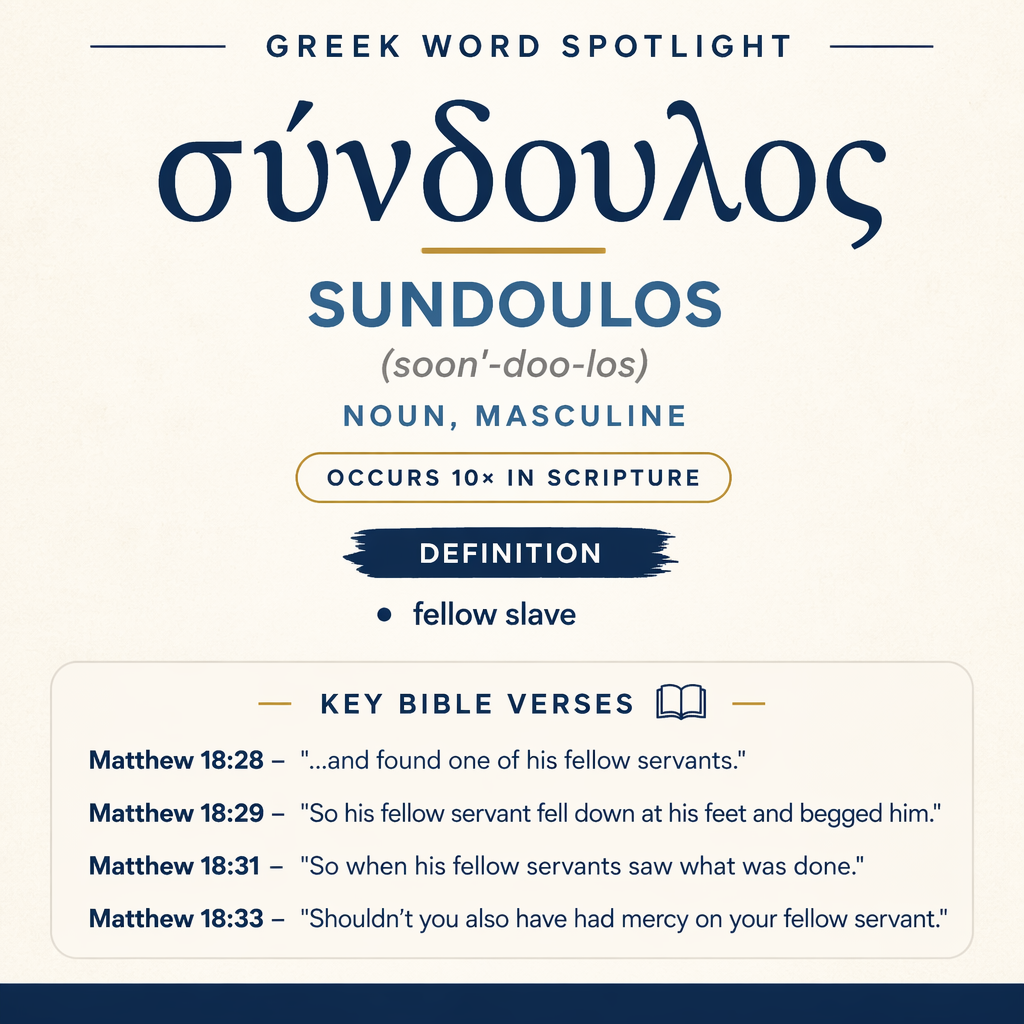
σύνδουλος means “fellow slave” and appears 10 times in Scripture, including Matthew 18; Matthew 24:49; Colossians 1:7; Colossians 4:7; and Revelation 6:11.
Core Meaning
σύνδουλος is defined as “fellow slave.” It denotes someone who shares the same servile status as another.
Learn More →Gospel Context
In Matthew 18:28–33 it describes “fellow servants” within Jesus’ parable. In Matthew 24:49 it appears in a warning about mistreating “fellow servants.”
Learn More →Church & Vision
Paul uses it for Epaphras (Colossians 1:7) and for Tychicus (Colossians 4:7). Revelation 6:11 uses it for the “fellow servants” of the martyrs.
Learn More →σύνδουλος expresses the relationship of a “fellow slave,” someone who shares the same condition and belongs under the same authority. In the New Testament it appears in Jesus’ teaching about servants and accountability, in Paul’s descriptions of co-workers in ministry, and in Revelation’s scenes where heavenly instruction frames faithful witness and suffering.
Occurrences
“But that servant went out, and found one of his fellow servants, who owed him one hundred denarii, and he grabbed him, and took him by the throat, saying, ‘Pay me what you owe!’” (Matthew 18:28)
Here σύνδουλος marks the man who is pursued as not an outsider but a peer within the same servant community. The aggressor’s violence (“grabbed him,” “took him by the throat”) lands with added force because it is done to a fellow slave, someone who stands on the same level of dependence and vulnerability. The shared status intensifies the mismatch between the debt (“one hundred denarii”) and the harsh demand.
“So his fellow servant fell down at his feet and begged him, saying, ‘Have patience with me, and I will repay you!’” (Matthew 18:29)
σύνδουλος again highlights that the one pleading is a peer. The posture (“fell down at his feet”) and the appeal (“Have patience with me”) show a fellow slave reduced to urgent supplication before another fellow slave. The word keeps the focus on a shared condition: the request for patience comes from within the same household reality rather than across a social divide.
“So when his fellow servants saw what was done, they were exceedingly sorry, and came and told their lord all that was done.” (Matthew 18:31)
In this verse σύνδουλος is plural, widening the lens to the servant body who witnesses the event. They are “exceedingly sorry,” and their response is communal: they “came and told their lord all that was done.” As fellow slaves, they function as moral observers and as members of the same household who recognize that what happens among peers matters to the lord who stands above them all.
“Shouldn’t you also have had mercy on your fellow servant, even as I had mercy on you?’” (Matthew 18:33)
σύνδουλος becomes the hinge of the rebuke: mercy was expected specifically toward a fellow slave. The comparison (“even as I had mercy on you”) does not introduce a new status for the offender; it presses the point that the recipient of the demanded mercy was a peer. The term frames the failure as a breakdown of solidarity within shared servitude.
“and begins to beat his fellow servants, and eat and drink with the drunkards,” (Matthew 24:49)
σύνδουλος identifies the targets of abuse within a servant group. The wrongdoing is not merely general brutality; it is violence directed toward fellow slaves—those who should have been treated as companions in the same work and waiting. The contrast in the sentence sharpens the misconduct: he “begins to beat his fellow servants” while he chooses companionship with “the drunkards,” signaling a deliberate betrayal of proper relations inside the household.
“even as you learned of Epaphras our beloved fellow servant, who is a faithful servant of Christ on your behalf,” (Colossians 1:7)
Here σύνδουλος is applied to Epaphras as a title of shared service. Calling him a fellow slave places Paul and Epaphras on the same footing of service while still allowing Epaphras to be singled out as “beloved” and “faithful.” The phrase “of Christ” and “on your behalf” situate this fellow-servant relationship within Christ’s service and for the Colossians’ benefit.
“All my affairs will be made known to you by Tychicus, the beloved brother, faithful servant, and fellow bondservant in the Lord.” (Colossians 4:7)
σύνδουλος appears in a cluster of relational terms: “beloved brother,” “faithful servant,” and “fellow bondservant in the Lord.” The word contributes the idea of shared servitude specifically “in the Lord,” tying the fellowship of slavery to a defined sphere of allegiance. In this context, σύνδουλος supports trust: the one who will report “all my affairs” is not merely a messenger but someone bound in the same service.
“A long white robe was given to each of them. They were told that they should rest yet for a while, until their fellow servants and their brothers, who would also be killed even as they were, should complete their course.” (Revelation 6:11)
In this apocalyptic setting, σύνδουλος links the already-suffering group to others who share the same servile identity. The word stands beside “their brothers,” binding together two ways of describing belonging. The line “who would also be killed even as they were” gives σύνδουλος a stark communal horizon: fellow slaves are those whose path may mirror the same lethal outcome, and whose “course” must be “complete” before the instructed rest reaches its appointed limit.
“I fell down before his feet to worship him. He said to me, “Look! Don’t do it! I am a fellow bondservant with you and with your brothers who hold the testimony of Jesus. Worship God, for the testimony of Jesus is the Spirit of Prophecy.”” (Revelation 19:10)
σύνδουλος functions as a corrective to misplaced worship. The speaker refuses the act by defining himself as a fellow slave “with you and with your brothers who hold the testimony of Jesus.” By choosing this term, he places himself alongside John and the witnessing community rather than above them as an object of worship. The command “Worship God” is reinforced by the shared-servant identity: a fellow slave is not to be worshiped.
“He said to me, “See you don’t do it! I am a fellow bondservant with you and with your brothers, the prophets, and with those who keep the words of this book. Worship God.”” (Revelation 22:9)
σύνδουλος again prevents worship of the messenger. The fellowship is expanded and specified: “with your brothers, the prophets,” and also “with those who keep the words of this book.” The term gathers diverse roles—John, prophets, and keepers of the book’s words—under a single shared status of servitude, and once more it underwrites the single proper direction of worship: “Worship God.”
Sense and Usage
Across these passages σύνδουλος consistently identifies a person who stands within the same servant status as another—neither master nor outsider, but a peer under the same overarching lordship. In Matthew 18 the term sharpens the moral logic of the scene: the conflict is not between a master and a servant but between fellow servants, making the violence, refusal of patience, and refusal of mercy appear as failures within a shared condition. The repeated use in the parable keeps drawing attention back to the plain fact that the offended party is a fellow slave, which intensifies the expectation of mercy and the shock of cruelty.
In Matthew 24:49 σύνδουλος carries a similar force but in a different scenario: the wrongdoing is abuse directed inward, toward those who should have been companions in service. The term focuses the reader on the relational betrayal—beating fellow slaves—while the offender chooses a different social alignment (“eat and drink with the drunkards”).
In Colossians σύνδουλος becomes a warm designation of shared labor. It does not diminish the distinct roles of Epaphras and Tychicus—Epaphras is “faithful” and acts “on your behalf,” and Tychicus is entrusted to make known “all my affairs”—but it frames those roles as expressions of the same servile commitment. The collocation with “faithful servant” and the qualifier “in the Lord” locate this fellowship of servitude inside devotion and reliability, not merely in social station.
In Revelation σύνδουλος helps map spiritual community in moments charged with worship and suffering. In 6:11 it ties the destiny of one group to another: fellow servants are those whose course is yet to run, even to the point of being “killed even as they were.” In 19:10 and 22:9 it serves as a boundary marker around worship: the speaker refuses worship because he is a fellow slave alongside human witnesses, prophets, and those who keep the book’s words. The repeated imperative “Worship God” gains clarity from this shared status—fellow slaves stand together as worshipers, not as rivals for worship.
Imagery and Resonance
σύνδουλος carries the imagery of a household or community where multiple servants stand under one higher authority. In Jesus’ teaching it exposes how quickly shared servitude can become the setting for grasping, choking, and beating—wrong done not across hierarchy but within companionship. In the letters it becomes a dignifying label for trustworthy co-workers whose service binds them together. In Revelation it reaches a solemn fullness: fellow slaves are linked in endurance and witness, and the designation itself becomes a reason to refuse worship and direct it to God alone.
Sources: Lexical data from Strong’s Exhaustive Concordance and the Translators Brief Lexicon of Extended Strongs for Greek (STEPBible, CC BY). Occurrence data from the Translators Amalgamated Greek New Testament (STEPBible, CC BY). Scripture quotations from the World English Bible (public domain).




