
Exploring the Meaning of Sugkatabaino in Greek
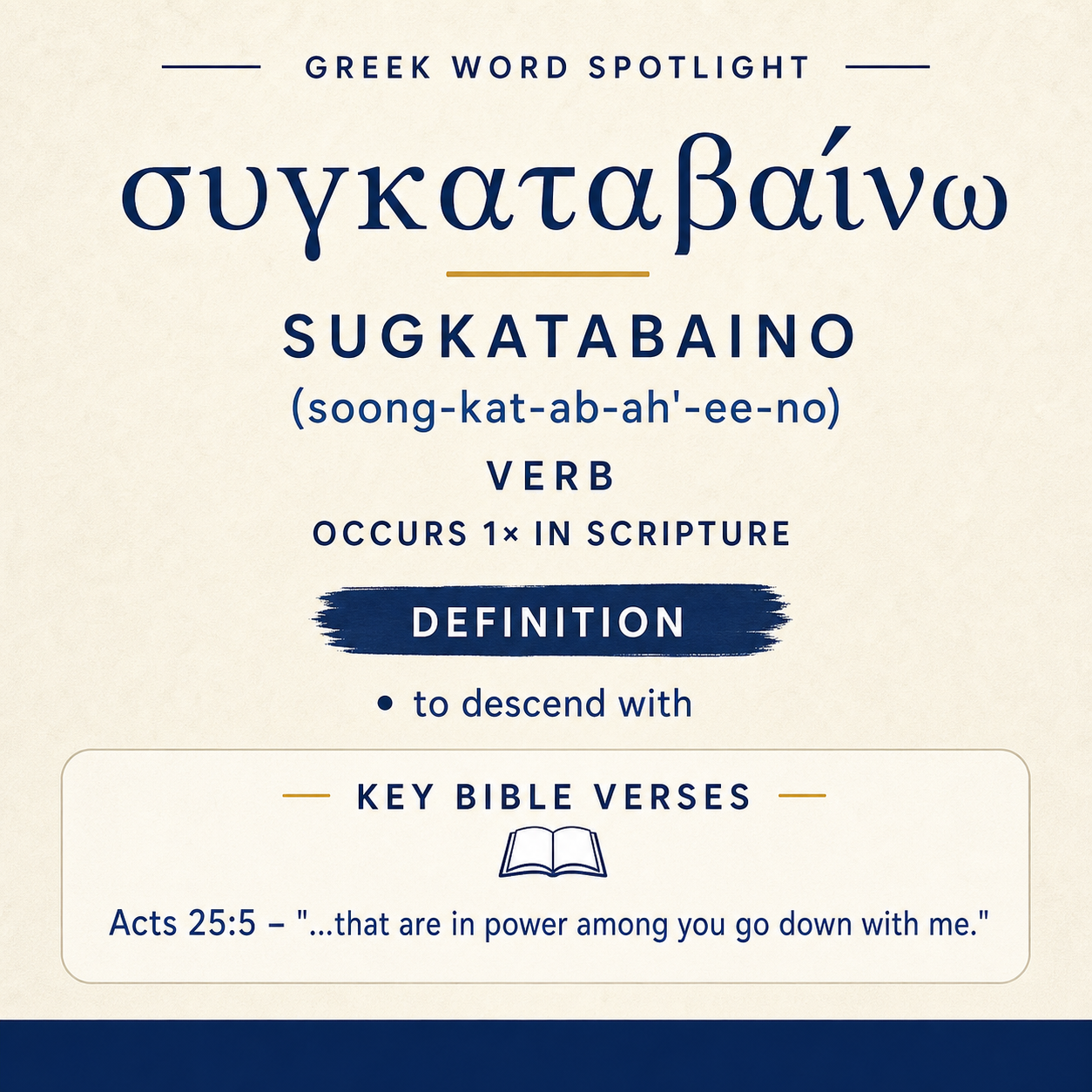
συγκαταβαίνω means “to descend with” and appears once in Scripture, in Acts 25:5.
Scripture Occurrence
It occurs one time in Scripture. The occurrence is in Acts 25:5.
Learn More →συγκαταβαίνω means “to descend with.” It appears once in the New Testament, in the judicial travel setting of Acts 25:5.
Root and Related Words
συγκαταβαίνω is built from syn (σύν), “with,” and katabaino (καταβαίνω), “to come/go down.” The combination presents a single motion expressed as shared movement: going down in company rather than alone.

Occurrences
“Let them therefore”, he said, “that are in power among you go down with me, and if there is anything wrong in the man, let them accuse him.” (Acts 25:5)
In this scene, the speaker proposes a concrete course of action for handling an accusation: those “in power” are to “go down with me,” and only then, “if there is anything wrong in the man,” they are to “accuse him.” The verb frames the proposed next step as shared travel. The movement is not merely a change of location; it is an accompaniment that binds the authorities to the process. By calling for them to descend with him, the speaker folds them into the same journey that will set the stage for evaluating the charge.
The phrase “go down with me” also serves a procedural purpose in the sentence. The journey is linked to accountability: the ones who have standing (“in power”) are summoned to make the descent alongside the leader who is speaking, and the accusation is presented as conditional on what can be established—“if there is anything wrong in the man.” The descent “with” creates a setting in which the accusers and the official presence converge in the same place, rather than attempting to press charges at a distance or through hearsay. Within the logic of the line, accompanying descent is the means by which an allegation is to be tested and, if warranted, voiced.
Sense and Usage
The sense “to descend with” expresses a downward journey undertaken together. In Acts 25:5, the word’s force comes from pairing direction (“go down”) with association (“with me”). The movement is presented as purposeful and coordinated: the influential parties are to make the descent in the company of the one directing the proceedings.
Because the request is addressed to those “in power,” the shared descent is not casual companionship. It implies an escorted or officially accompanied movement: the speaker does not simply invite participation; he instructs that those with authority accompany him as part of the handling of the case. The word therefore contributes an image of governance in motion—officials traveling together as the prelude to formal accusation (“let them accuse him”). The descent is, in the verse’s own structure, the bridge between status (“in power”) and action (testing whether “anything [is] wrong” and bringing an accusation).
In this occurrence, the “with” component is essential. The speaker could have envisioned others traveling independently, but the wording insists on joint movement: the officials are to be present with him as they go down. This shared travel aligns responsibility and presence—those who may accuse are urged to accompany the process from the start, not merely to send charges ahead. The verb thus ties accompaniment to due action: descending together precedes accusing, and the sentence makes the journey part of how a claim is to be brought.
Imagery
The verb carries the simple but concrete picture of a descent taken in company. In Acts 25:5 the imagery is administrative rather than poetic: an official summons other officials to go down with him so that any wrongdoing can be addressed and any accusation can be made in the proper setting. The downward movement, joined to the idea of accompaniment, turns travel itself into a visible step of public procedure.
Sources: Lexical data from Strong’s Exhaustive Concordance and the Translators Brief Lexicon of Extended Strongs for Greek (STEPBible, CC BY). Occurrence data from the Translators Amalgamated Greek New Testament (STEPBible, CC BY). Scripture quotations from the World English Bible (public domain).




