Exploring the Meaning of Stratologeo in Greek
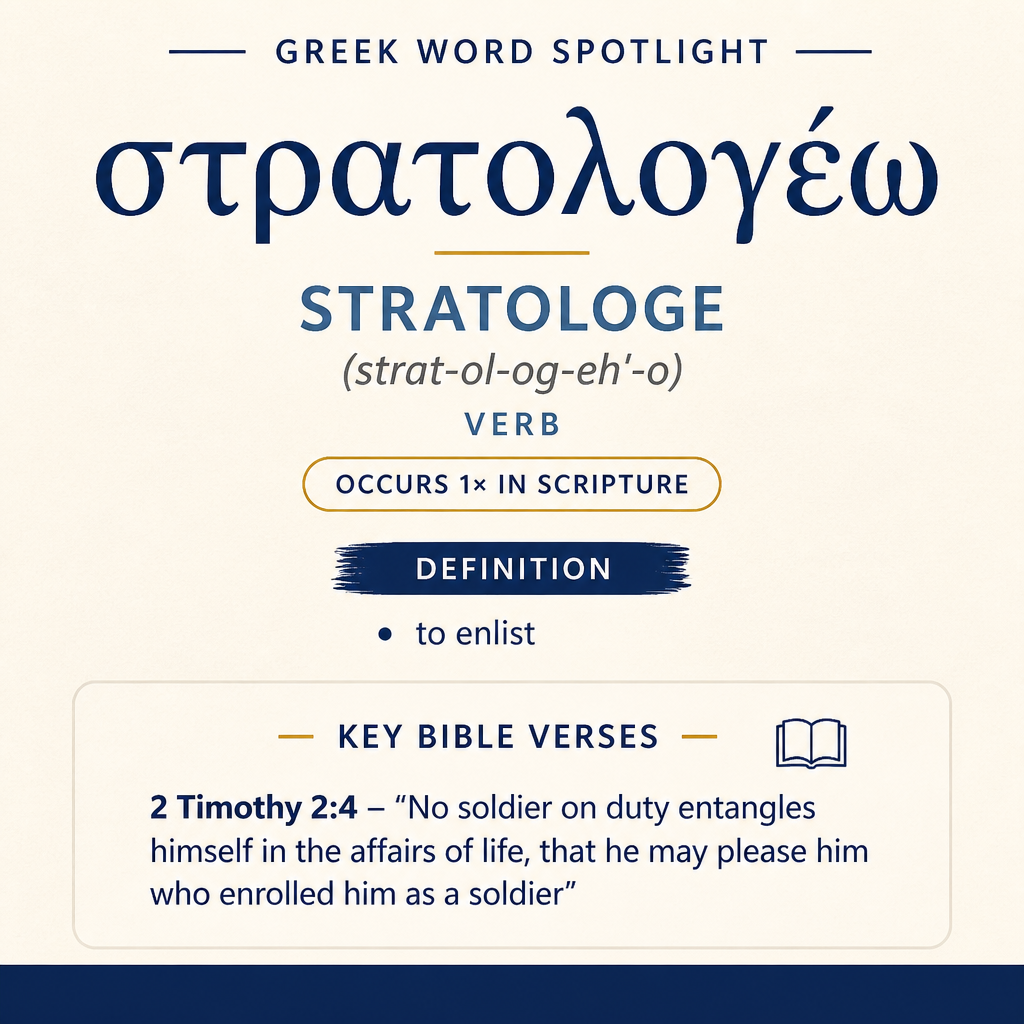
στρατολογέω means “to enlist” and appears once in Scripture, in 2 Timothy 2:4.
Core Meaning
στρατολογέω means “to enlist.” In 2 Timothy 2:4 it describes someone being enrolled as a soldier.
Learn More →Biblical Occurrence
This verb occurs one time in Scripture. Its single occurrence is 2 Timothy 2:4.
Learn More →Verse Context
2 Timothy 2:4 contrasts a soldier’s duty with entanglement in the affairs of life. The goal is to please the one who enrolled him as a soldier.
Learn More →στρατολογέω means “to enlist” and appears in the New Testament in an image drawn from military life. Its single occurrence frames the soldier’s duties in terms of loyalty to the one who enlisted him.
Root and Related Words
στρατολογέω is associated with στρατιά (stratia), “army” (Strong’s G4756), and with λέγω (lego), “to say” (Strong’s G3004).

Occurrences
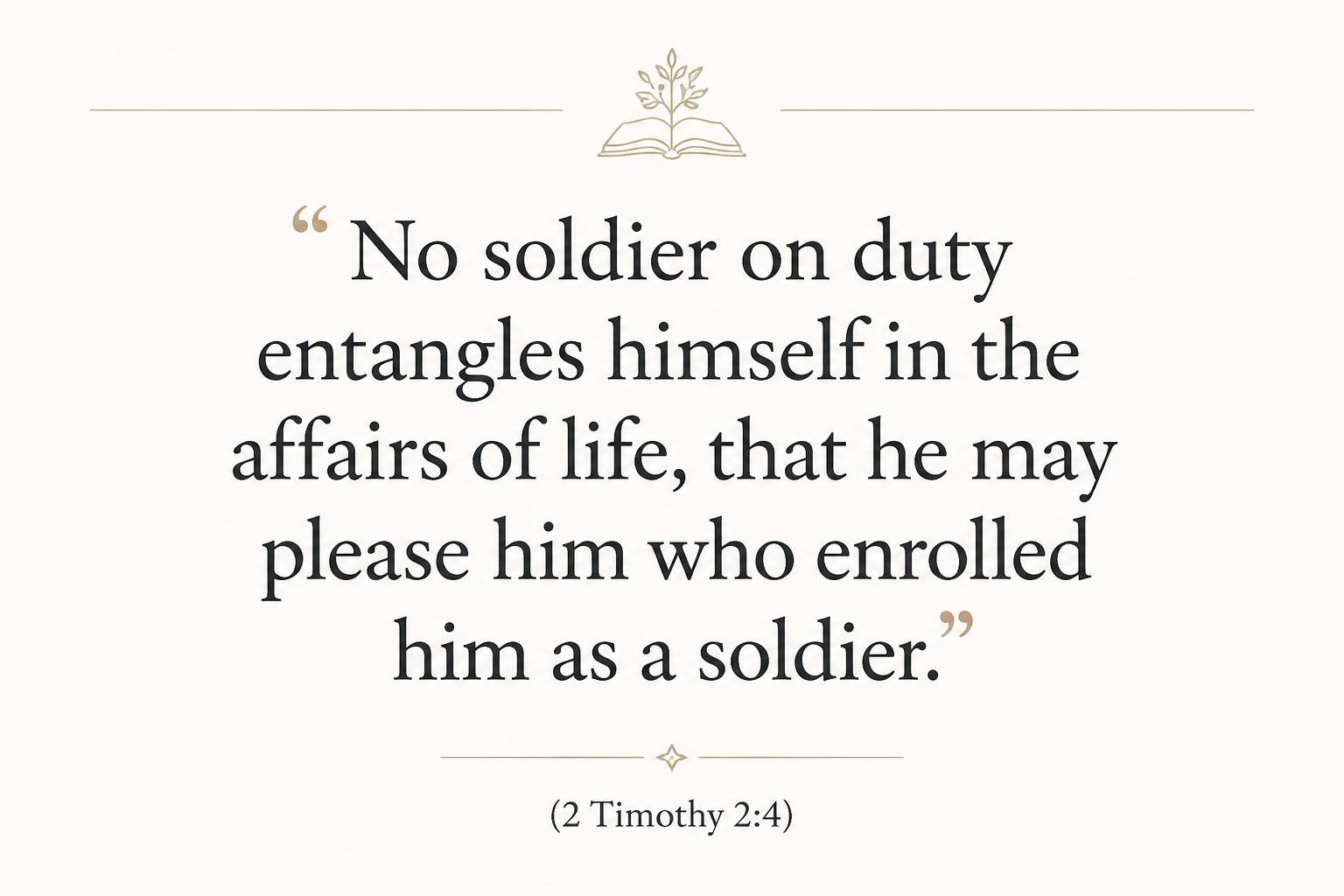
“No soldier on duty entangles himself in the affairs of life, that he may please him who enrolled him as a soldier.” (2 Timothy 2:4)
Here στρατολογέω stands behind the clause “him who enrolled him as a soldier,” placing the soldier’s present conduct (“on duty”) under the prior act of enlistment. The verse sets up a contrast: a soldier may “entangle” himself in “the affairs of life,” or he may live with a single aim—“that he may please” the one who enlisted him. The enlistment creates a relationship in which the soldier’s choices are evaluated in reference to another person’s decision and authority. In this sentence, enlistment is not a general idea of joining up, but a specific act done by a particular “him,” and the soldier’s daily freedom is portrayed as constrained by the purpose of pleasing that enlisting party.
The wording also makes the soldier’s identity practical rather than merely nominal. The soldier is “on duty,” and the enlistment is the reason his life has a different set of priorities. The verb thus contributes an institutional and personal element: someone has taken the initiative to enroll the soldier, and the soldier’s proper response is measured in terms of undivided focus. The implied logic is straightforward within the verse: enlistment leads to duty; duty requires avoiding entanglements; avoidance of entanglements serves the goal of pleasing the enroller.
Sense and Usage
With the definition “to enlist,” στρατολογέω evokes the formal act that places a person into military service, and the passage uses that act to define what kind of life fits someone “on duty.” The verse does not treat enlistment as an inner feeling or a self-chosen label; it is presented as an objective enrollment carried out by another—“him who enrolled him as a soldier.” That phrasing presses the enlistment into the foreground as a decisive boundary line: after such enrollment, the soldier is expected to live in a way oriented toward the enroller’s approval.
In 2 Timothy 2:4, the force of “to enlist” is therefore relational and purposive. Relationally, it binds the soldier to “him” with an implied chain of responsibility, so that the soldier’s central aim is “to please” that person. Purposively, it explains why “the affairs of life” become a threat: they are depicted as entanglements, competing commitments that can distract from the single-minded obligation that enlistment entails. The verb contributes a sense of being claimed for service, which makes the admonition in the first clause (“No soldier on duty entangles himself…”) more than a general proverb about focus; it is a consequence of being enrolled into a defined role.
Because στρατολογέω occurs here in a context that contrasts entanglement with pleasing, the enlistment is not simply an entry point into an “army” as a collective; it is also the establishment of a duty structure. The soldier’s choices are evaluated by whether they serve the purpose named at the end of the verse. Thus, within this passage, “to enlist” functions as a compact way of introducing obligation, accountability, and a clear hierarchy of priorities without separately describing the administrative process of enlistment.
Imagery
The imagery attached to στρατολογέω in this verse is concrete: a “soldier on duty” whose life can be “entangle[d]” by everyday concerns. Enlistment stands as the moment that makes such a soldier answerable to another’s satisfaction—“that he may please him who enrolled him as a soldier”—so the picture is of a person whose service is defined by the one who enrolled him and whose path must remain free from competing ties.
Sources: Lexical data from Strong’s Exhaustive Concordance and the Translators Brief Lexicon of Extended Strongs for Greek (STEPBible, CC BY). Occurrence data from the Translators Amalgamated Greek New Testament (STEPBible, CC BY). Scripture quotations from the World English Bible (public domain).