Exploring the Meaning of Stratiotes in Greek
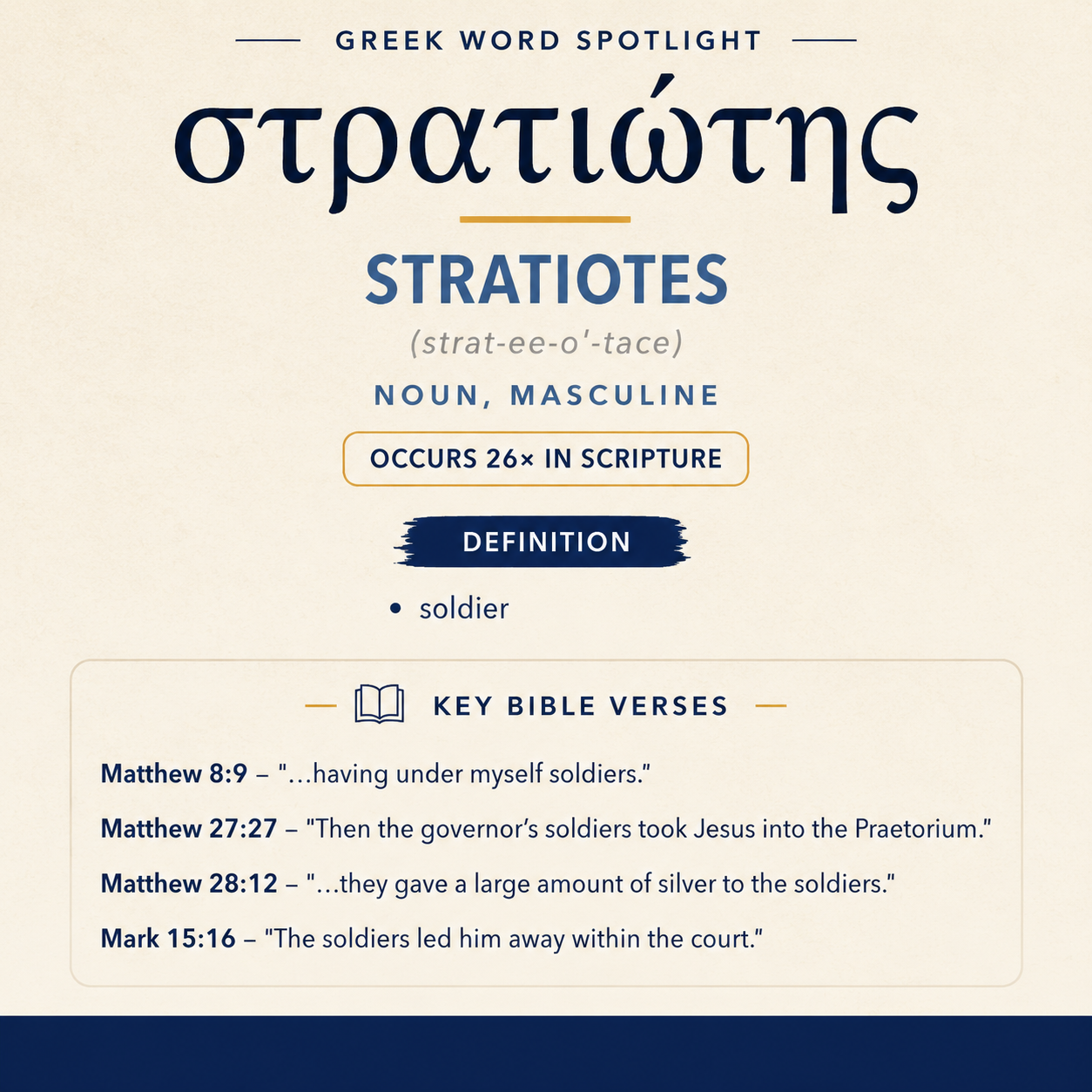
στρατιώτης means “soldier” in Greek and occurs 26 times in Scripture, including Matthew 8:9; 27:27; 28:12; Mark 15:16; Luke 7:8; 23:36; John 19:2; 19:23.
Core Meaning
στρατιώτης is defined as “soldier.” It refers to individual soldiers in narrative contexts.
Learn More →Authority Scenes
In Matthew 8:9 and Luke 7:8, soldiers appear under a chain of command, obeying orders to go or come. The speaker describes having soldiers under himself while also being under authority.
Learn More →Passion Narrative
In Matthew 27:27, Mark 15:16, Luke 23:36, and John 19:2, soldiers are involved in Jesus’ mockery and custody. In John 19:23, they divide Jesus’ garments, with a portion for each soldier.
Learn More →στρατιώτης refers to a soldier. In the passages below it appears in scenes of command and obedience, public violence surrounding Jesus, and the household of a centurion whose service reaches into his daily life.
Occurrences
Matthew 8:9 — “For I am also a man under authority, having under myself soldiers. I tell this one, ‘Go,’ and he goes; and tell another, ‘Come,’ and he comes; and tell my servant, ‘Do this,’ and he does it.”
Here soldiers are used to illustrate a chain of command. The speaker’s point depends on soldiers as people who respond predictably to orders (“Go,” “Come,” “Do this”), making “soldiers” a concrete example of disciplined obedience within authority.
Matthew 27:27 — “Then the governor’s soldiers took Jesus into the Praetorium, and gathered the whole garrison together against him.”
In this scene soldiers act as the governor’s agents. The term marks them as an organized force (“gathered the whole garrison together”) whose collective presence is turned “against him,” emphasizing coordinated official power directed at Jesus inside the Praetorium.
Matthew 28:12 — “When they were assembled with the elders, and had taken counsel, they gave a large amount of silver to the soldiers,”
Soldiers appear as recipients of money within a decision-making setting (“assembled with the elders,” “taken counsel”). The word identifies the group being paid, framing soldiers not as combatants here but as people whose actions or testimony can be influenced by a “large amount of silver.”
Mark 15:16 — “The soldiers led him away within the court, which is the Praetorium; and they called together the whole cohort.”
Soldiers are again depicted as a body with internal organization. They physically control movement (“led him away”) and mobilize a larger unit (“the whole cohort”), so the term carries the weight of coordinated force operating in a military setting (“the Praetorium”).
Luke 7:8 — “For I also am a man placed under authority, having under myself soldiers. I tell this one, ‘Go!’ and he goes; and to another, ‘Come!’ and he comes; and to my servant, ‘Do this,’ and he does it.”
As in Matthew 8:9, soldiers function as the clearest example of subordinate responsiveness. The speaker pairs soldiers with a servant, but the soldiers provide the public, structured image of authority: orders are issued and carried out without negotiation.
Luke 23:36 — “The soldiers also mocked him, coming to him and offering him vinegar,”
Here soldiers are not described in terms of command structure but in their conduct toward a prisoner. The term identifies the mockers as soldiers, and their actions are both hostile (“mocked him”) and physical (“coming to him,” “offering him vinegar”), placing military personnel at the center of public humiliation.
John 19:2 — “The soldiers twisted thorns into a crown, and put it on his head, and dressed him in a purple garment.”
Soldiers are shown actively producing and applying items used in ridicule and abuse. The word ties these deliberate actions—twisting a crown of thorns, placing it, dressing him—to soldiers as hands-on executors of the mistreatment.
John 19:23 — “Then the soldiers, when they had crucified Jesus, took his garments and made four parts, to every soldier a part; and also the coat. Now the coat was without seam, woven from the top throughout.”
This occurrence portrays soldiers as those who have carried out the execution (“when they had crucified Jesus”) and then divide property as a group. The distribution “to every soldier a part” depicts a set of individual soldiers acting within a shared procedure of allotment; the detail about the coat’s construction heightens the concreteness of what soldiers handle and claim.
John 19:24 — “Then they said to one another, “Let’s not tear it, but cast lots for it to decide whose it will be,” that the Scripture might be fulfilled, which says, “They parted my garments among them. For my cloak they cast lots.” Therefore the soldiers did these things.
The soldiers’ interaction is presented as deliberation (“they said to one another”) followed by a decision about what to do with the garment. The word identifies the group whose choice and action (“cast lots,” “did these things”) moves the scene from mere possession to an agreed method of distribution.
John 19:32 — “Therefore the soldiers came, and broke the legs of the first, and of the other who was crucified with him;”
Soldiers here perform a grim, methodical task at the crucifixion site. The term places responsibility on soldiers as the ones who “came” and carried out the leg-breaking on the two crucified beside Jesus, underscoring their role as enforcers in the execution process.
John 19:34 — “However one of the soldiers pierced his side with a spear, and immediately blood and water came out.”
The word narrows from a group to an individual: “one of the soldiers.” He uses a weapon (“a spear”) in a targeted action (“pierced his side”), and the narrative highlights the immediate physical result. “Soldier” thus marks the actor as part of the military personnel present, while distinguishing a single soldier’s decisive act.
Acts 10:7 — “When the angel who spoke to him had departed, Cornelius called two of his household servants and a devout soldier of those who waited on him continually.”
In Acts, soldier is set within a household rather than a public punishment scene. Cornelius summons “two of his household servants and a devout soldier,” and the description “of those who waited on him continually” portrays the soldier as attached to Cornelius’s personal service and daily operations, not merely as a distant figure of state force.

Sense and Usage
Across these occurrences, στρατιώτης consistently denotes a soldier, but the scenes reveal distinct facets of what a soldier represents in narrative context.
First, soldiers serve as a ready illustration of ordered obedience under authority (Matthew 8:9; Luke 7:8). In both sayings, the point does not depend on soldiers fighting or marching; it depends on the social reality that soldiers carry out commands. The repeated triad of imperatives and responses (“Go… Come… Do this…”) frames soldiers as reliable agents in a hierarchy. The parallel mention of “my servant” highlights that soldiers, in this usage, are the most publicly recognizable example of disciplined compliance.
Second, in the passion narratives soldiers are depicted as an organized body operating in official spaces and performing official violence (Matthew 27:27; Mark 15:16; Luke 23:36; John 19:2, 19:23–24, 19:32, 19:34). They “gather” as a garrison, “call together” a cohort, and act in the Praetorium—language that situates soldiers within a collective unit. Yet the term also comfortably applies to discrete individuals within that unit (“to every soldier a part,” “one of the soldiers”). This oscillation between group and individual gives the narrative precision: soldiers as a force can surround, lead, and mock; soldiers as individuals can receive a portion, cast lots, or wield a spear.
Third, soldiers appear as participants in transactions and counsel-adjacent decisions (Matthew 28:12; John 19:24). In Matthew 28:12 they are paid a large sum after a consultation among leaders, showing that soldiers can be the target of inducement. In John 19:24 they confer with each other about handling a garment and settle on casting lots, portraying soldiers as capable of internal agreement rather than mere silent instruments.
Finally, Acts 10:7 places a soldier in a different social frame: alongside household servants, characterized as “devout,” and included among those who “waited on him continually.” Without changing the core reference to a soldier, the term here evokes proximity and trust within a centurion’s immediate circle. The soldier is not portrayed in combat or coercion but as an attendant who can be called and sent like other household dependents.
Imagery
These passages repeatedly picture soldiers in motion and action: obeying spoken commands, assembling as a unit, escorting a prisoner, handling clothing, carrying out harsh tasks, and standing close enough to pierce with a spear. Even when soldiers are not fighting, the scenes lean on the tangible markers of soldierly presence—organized groups in official courts, weapons in hand, and the disciplined readiness to act when summoned.
Sources: Lexical data from Strong’s Exhaustive Concordance and the Translators Brief Lexicon of Extended Strongs for Greek (STEPBible, CC BY). Occurrence data from the Translators Amalgamated Greek New Testament (STEPBible, CC BY). Scripture quotations from the World English Bible (public domain).