
Exploring the Meaning of Stoibas in Greek
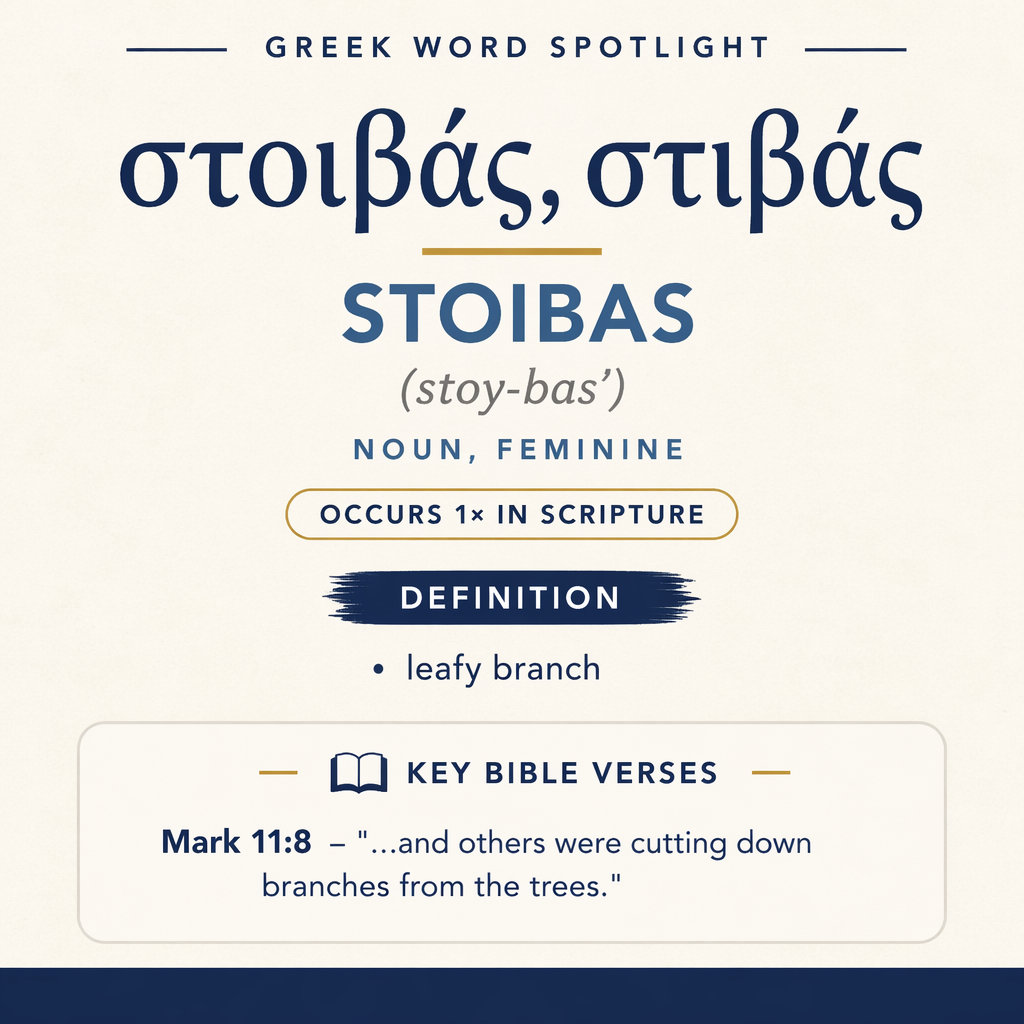
στοιβάς (στιβάς) means “leafy branch” and appears once in Scripture in Mark 11:8.
Scripture Occurrence
This word occurs 1 time in Scripture. Its single occurrence is in Mark 11:8.
Learn More →Mark 11 Context
In Mark 11:8, branches are cut down from trees and spread on the road. The term is used for these branches.
Learn More →στοιβάς, στιβάς means “leafy branch” and appears in the Gospel narrative of Jesus’ entry into Jerusalem. In its single New Testament use it belongs to a street-scene of public movement and improvised decoration.
Occurrences
“Many spread their garments on the way, and others were cutting down branches from the trees, and spreading them on the road.” (Mark 11:8)
Here στοιβάς, στιβάς refers to what “others” prepare as the crowd responds to Jesus’ approach. The verse presents two parallel actions: some people place “their garments on the way,” while others cut down “branches from the trees” and then spread them “on the road.” Within that pairing, the leafy branch functions as an additional, tangible layer laid over the traveled surface. It is not held aloft or waved in the quoted line; it is cut and placed, turning living growth from “the trees” into something that covers the ground. The word thus contributes material specificity: the crowd’s response is not only verbal or emotional but enacted through physical objects taken from their immediate surroundings and put to use along the route.
The syntax of the scene emphasizes sequence and effort. The people “were cutting down” before “spreading,” so the leafy branch is not a pre-made item but one produced on the spot. Because the branches are taken “from the trees,” the word brings into view the nearby landscape—trees close enough for cutting—and the quick transformation of foliage into a roadway covering. The phrase “spreading them on the road” frames the branches as numerous enough to be distributed, not a single token. In this way the leafy branch becomes part of a collective action, coordinated in effect even if not formally organized: garments and cut greenery alike are laid out in front of the procession as it moves “on the way.”

Sense and Usage
The sense “leafy branch” is concrete and visual. In Mark 11:8 the branches are defined by their foliage rather than by any particular species or by their use for building; the point is their fresh, spreading surface. The verse links the branch directly to trees (“cutting down branches from the trees”), so the word naturally evokes pliable, newly cut growth rather than dried sticks. That emphasis suits the action described: leafy material is well-suited to be “spread” across a roadway, creating a temporary covering that changes how the road looks and feels underfoot.
Within this single context, the word’s value lies in how it marks a specific kind of object among other objects in the crowd’s hands. Garments are personal possessions brought from home or worn; leafy branches are gathered from the environment at the moment. The two together show a range of offerings: what belongs to the individual and what can be taken from the surrounding trees. The leafy branch, then, represents an impromptu contribution that anyone near the trees could make, and it introduces a natural element into a scene otherwise dominated by the “way” and “road” of human travel.
The usage also highlights motion and direction. The branches are spread “on the road,” the same surface down which Jesus is traveling, so the leafy branch is oriented toward the path ahead, not merely laid down behind. The act of spreading implies an attempt to cover a length of road, not just to deposit debris. Even without further description, the reader can infer that the branches are arranged intentionally as part of the crowd’s response. In this verse the leafy branch is defined not only by what it is, but by what is done with it: it is cut down and placed so that the road becomes the site of display.
Because the branches are presented as one of two ways people respond (“Many… and others…”), the word also helps characterize the crowd’s diversity of participation. Some contribute textiles; others contribute vegetation. The leafy branch is therefore a communal resource—readily available where trees are present—used to make a public way look different for a moment. The word’s concreteness keeps the scene grounded: the response is not abstract ceremony but a roadway covered with actual fabric and actual greenery.
Imagery
Mark 11:8 places leafy branches directly onto a traveled road, so the imagery is of green cuttings scattered or layered along the route. The word draws attention to the contrast between the living source (“trees”) and the human-made surface (“road”), and to the sudden repurposing of fresh foliage into a temporary covering. The result is a vivid picture of a procession approached by a path newly dressed with garments and leafy branches.
Sources: Lexical data from Strong’s Exhaustive Concordance and the Translators Brief Lexicon of Extended Strongs for Greek (STEPBible, CC BY). Occurrence data from the Translators Amalgamated Greek New Testament (STEPBible, CC BY). Scripture quotations from the World English Bible (public domain).





