Exploring the Meaning of Stenazo in Greek
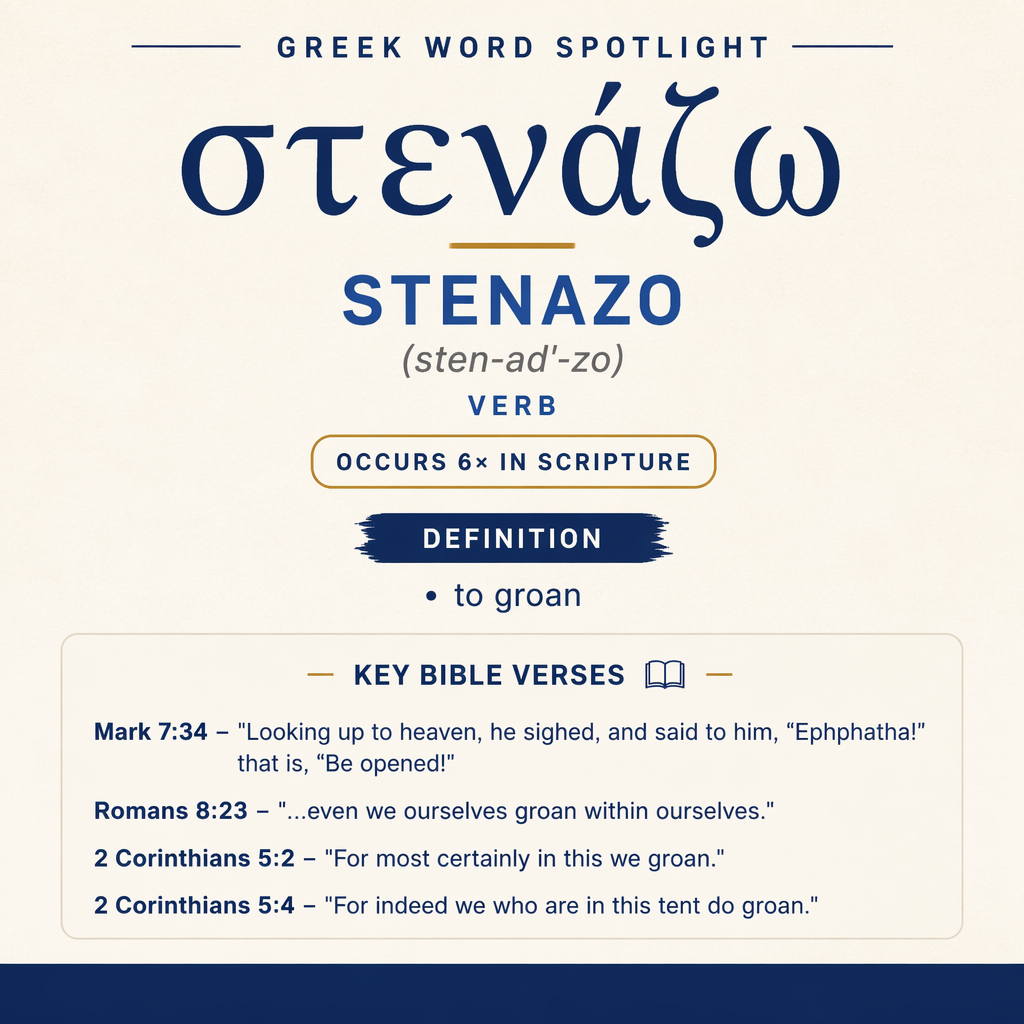
στενάζω means “to groan” and occurs 6 times in Scripture, including Mark 7:34; Romans 8:23; 2 Corinthians 5:2, 5:4; Hebrews 13:17; James 5:9.
Core Meaning
στενάζω is defined as “to groan.” It expresses groaning or grumbling in the listed passages.
Learn More →Where It Appears
It occurs 6 times in Scripture. References: Mark 7:34; Romans 8:23; 2 Corinthians 5:2, 5:4; Hebrews 13:17; James 5:9.
Learn More →Usage Examples
Mark 7:34 uses it for Jesus’ sigh. Romans 8:23 and 2 Corinthians 5:2, 5:4 describe believers groaning within themselves.
Learn More →στενάζω expresses the act of groaning. It appears in scenes that range from Jesus’ brief, bodily sigh to sustained inward longing and burden, and even to the social friction of communal life.
Occurrences
“Looking up to heaven, he sighed, and said to him, “Ephphatha!” that is, “Be opened!”” (Mark 7:34)
Here στενάζω is a single, visible action within a tightly described moment: Jesus looks upward and then “sighed” immediately before speaking a word of command. The groan is not reported as speech; it is presented as a physical expression that precedes and accompanies decisive action (“Be opened!”). Placed between the upward glance and the uttered command, the sigh functions as an audible, embodied response to the situation at hand, compressing emotion and effort into a brief sound.

“Not only so, but ourselves also, who have the first fruits of the Spirit, even we ourselves groan within ourselves, waiting for adoption, the redemption of our body.” (Romans 8:23)
In Romans, στενάζω is explicitly interior: “groan within ourselves.” The groaning is tied to a posture of waiting—“waiting for adoption, the redemption of our body”—so the word marks an inward strain that persists over time rather than a momentary exhalation. The verse also sets this groaning alongside possession (“have the first fruits of the Spirit”) and anticipation (“waiting”), placing the groan in the space between what is already held and what is still hoped for, and locating it in the body’s future “redemption.”
“For most certainly in this we groan, longing to be clothed with our habitation which is from heaven,” (2 Corinthians 5:2)
Here στενάζω is coupled with desire: “we groan, longing to be clothed.” The verse frames groaning as the sound of yearning, directed toward being “clothed” with a “habitation which is from heaven.” The groan is not random discomfort; it is oriented. The longing gives the groan its shape: it is an expression of an ache for a different condition than the present one, described with the concrete imagery of clothing and habitation.
“For indeed we who are in this tent do groan, being burdened, not that we desire to be unclothed, but that we desire to be clothed, that what is mortal may be swallowed up by life.” (2 Corinthians 5:4)
This occurrence expands the earlier thought by explaining what accompanies the groan: “being burdened.” The image “in this tent” underscores a present state experienced as weighty. Yet the verse carefully distinguishes what the groaning does and does not aim at: it is “not that we desire to be unclothed,” but rather a desire “to be clothed.” The groan thus belongs to a pressured, burdened condition, but it is also tethered to a preference for transformation over mere removal, with the goal stated in the final clause: “that what is mortal may be swallowed up by life.” Within this sentence, στενάζω voices the tension of mortality under load while leaning toward life.
“Obey your leaders and submit to them, for they watch on behalf of your souls, as those who will give account, that they may do this with joy, and not with groaning, for that would be unprofitable for you.” (Hebrews 13:17)
In Hebrews, στενάζω is placed in a relational and communal setting. The verse contrasts two ways leaders might carry out their watch: “with joy, and not with groaning.” Groaning here is the audible marker of a task performed under strain or distress, and the community is told that such an outcome “would be unprofitable for you.” Within the logic of the sentence, groaning is not a private lament but a response to the burdens of oversight; it is presented as an undesirable atmosphere for the shared life of obedience, submission, and spiritual care.
“Don’t grumble, brothers, against one another, so that you won’t be judged. Behold, the judge stands at the door.” (James 5:9)
In James, στενάζω appears in the sphere of speech and interpersonal conduct: “Don’t grumble… against one another.” The word is linked to the danger of judgment (“so that you won’t be judged”), and the warning is intensified by immediacy: “the judge stands at the door.” Groaning here is not depicted as an involuntary sound in suffering but as a directed expression “against” fellow believers. In this setting, the groan becomes a communal fault line—an inward displeasure voiced outwardly in a way that threatens unity and invites accountability.

Sense and Usage
Across these passages, στενάζω consistently names groaning, yet the texts present that groaning in several distinct registers.
First, groaning can be bodily and momentary. Mark 7:34 places it as a brief act—an audible sigh—nestled between an upward look and a spoken command. The verse gives no extended reflection; the force lies in its immediacy. Groaning here is an expression that fits within a single breath of narrative.
Second, groaning can be inward and sustained. Romans 8:23 emphasizes location (“within ourselves”) and duration (“waiting”), so the groan becomes the sound of an interior condition held over time. It is not merely emotional release; it is framed as the felt pressure of waiting for bodily “redemption.” This places groaning within a horizon of expectation: it is the present’s audible strain under an anticipated future.
Third, groaning can be teleological—aimed at a desired outcome. In 2 Corinthians 5:2 and 5:4, the groan is paired with longing and explained as burden. The metaphorical field of “clothed,” “habitation,” and “tent” gives the groaning a concrete texture: it rises from being in a certain state and reaches toward being in another. The careful “not… but…” in 5:4 shows that the groaning is compatible with wanting change, not negation; it is the sound of burden under a mortal condition while desiring a form of life in which mortality is overtaken.
Fourth, groaning can be socially consequential. Hebrews 13:17 speaks of groaning as the opposite of joy in the exercise of leadership. The word functions as a diagnostic sound: it reveals that the task is being carried with strain rather than gladness, and the verse claims this is “unprofitable” for the community. James 5:9 focuses on groaning as grumbling “against one another,” directly connecting it to judgment and the nearness of the judge. Together these uses show that groaning is not always framed as a neutral symptom of hardship; it can also describe a pattern of expression that shapes communal relationships and accountability.
These strands do not contradict each other; they map how groaning can be located in the body (a sigh), the inner person (“within ourselves”), the experience of burden (life in a “tent”), and the social world (leaders and brothers). In every case, στενάζω marks an audible pressure point: where weight, waiting, longing, or friction becomes perceptible.
Imagery
The word’s imagery is especially vivid where groaning is set beside concrete metaphors and clear contrasts. The “tent” and the desire to be “clothed” (2 Corinthians 5:4) cast groaning as what rises when the present condition feels weighty, while hope is described as being enveloped by life. Romans 8:23 holds the sound inside—“within ourselves”—and connects it to the body’s future, giving groaning the feel of a quiet, internal strain. Hebrews and James bring the sound into community life: groaning can either cloud the joy of watchful care (Hebrews 13:17) or turn into grumbling “against one another” under the shadow of imminent judgment (James 5:9). Mark’s brief sigh grounds all of these in a simple human action—breath released under pressure—set just before a word that changes the situation (Mark 7:34).
Sources: Lexical data from Strong’s Exhaustive Concordance and the Translators Brief Lexicon of Extended Strongs for Greek (STEPBible, CC BY). Occurrence data from the Translators Amalgamated Greek New Testament (STEPBible, CC BY). Scripture quotations from the World English Bible (public domain).