Exploring the Meaning of Spora in Greek
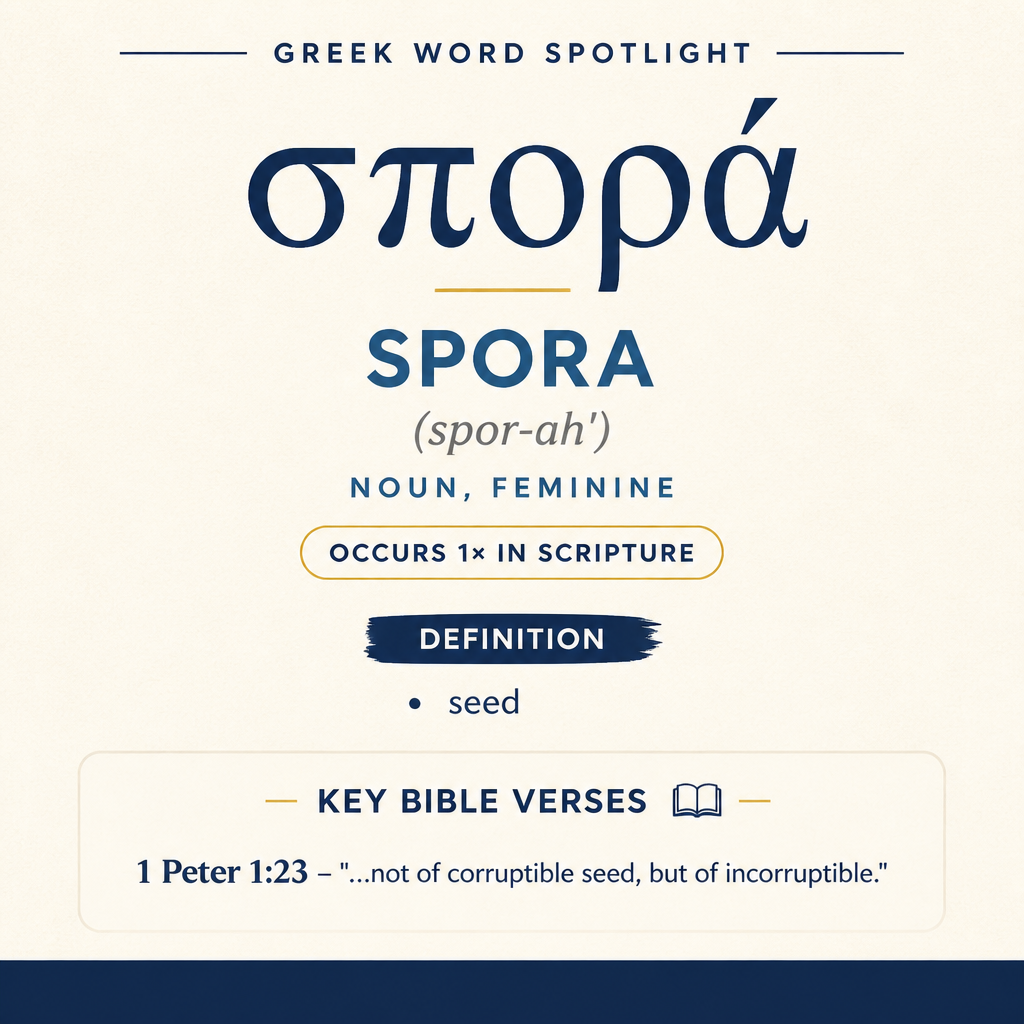
σπορά means “seed” and appears once in Scripture in 1 Peter 1:23.
Verse Context
In 1 Peter 1:23 it contrasts corruptible seed with incorruptible, through the living and remaining word of God.
Learn More →σπορά means “seed” and appears once in the New Testament, in 1 Peter 1:23. In that verse it helps express the contrast between what perishes and what endures, as the new birth is described in terms of a kind of seed.
Root and Related Words
σπορά relates to the verb speirō (σπείρω), “to sow” (Strong’s G4687). The imagery of sowing lies behind the noun’s use, setting “seed” within the wider field of planting and generating new life.

Occurrences
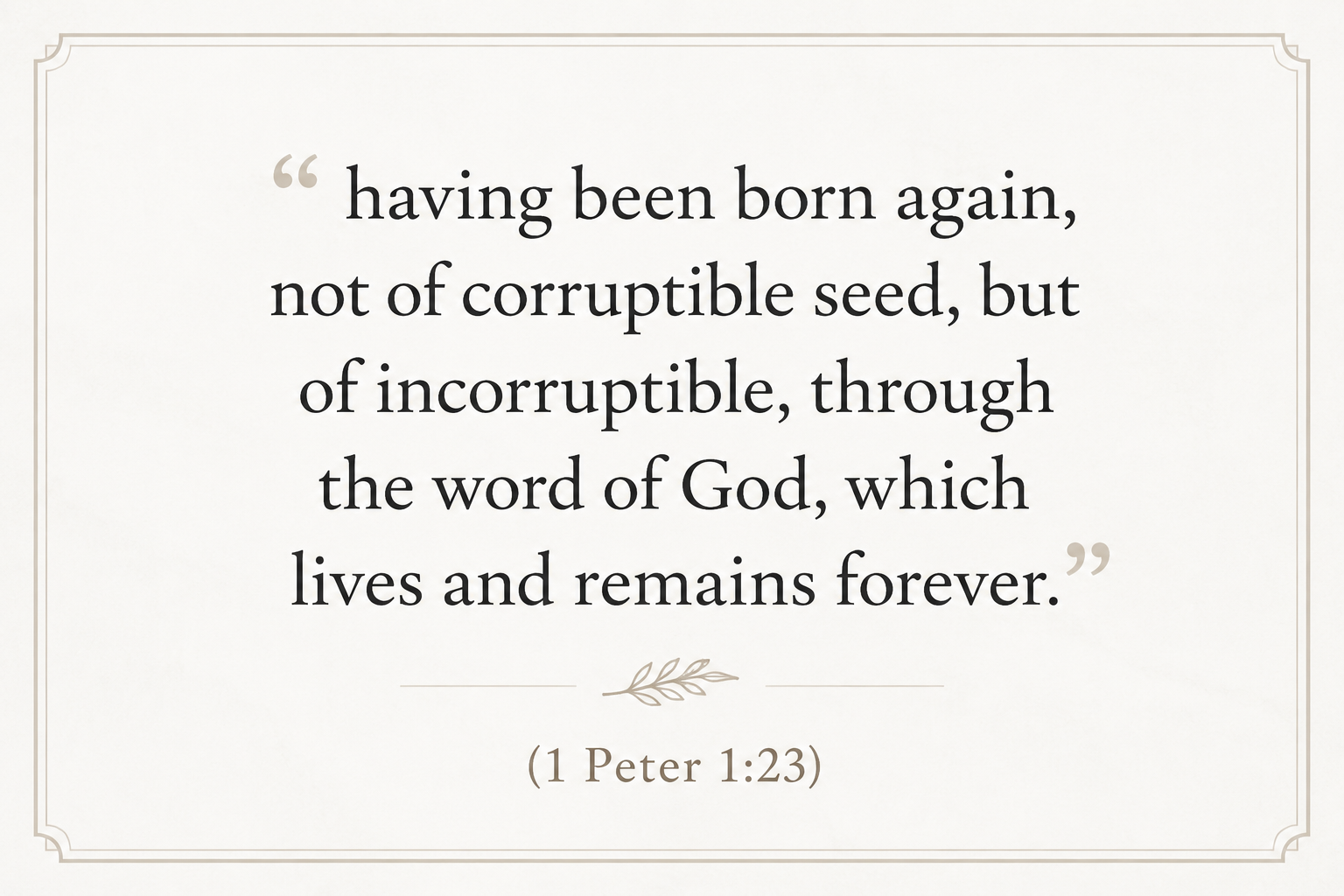
“having been born again, not of corruptible seed, but of incorruptible, through the word of God, which lives and remains forever.” (1 Peter 1:23)
In this sentence σπορά (“seed”) supplies the concrete, agricultural image that carries the logic of the comparison. The line “having been born again” frames the whole statement as an account of a new beginning, and “seed” is the chosen picture for the source from which that new beginning springs. The writer places “seed” under a twofold contrast: first, between “corruptible” and “incorruptible,” and second, between what is subject to decay and what “lives and remains forever.” Within the wording of the verse, “seed” is not presented as a thing the readers handle; it is the explanatory metaphor that gives the new birth a comprehensible origin: there is a kind of seed that produces perishable life and a kind that does not.
The immediate modifiers make the force of σπορά sharply evaluative. “Not of corruptible seed” denies one possible source; “but of incorruptible” asserts another. The word thus sits at the hinge of a negation and an affirmation, serving as the point of comparison by which the new birth is defined. The phrase “through the word of God” then specifies the channel by which this “incorruptible” reality comes about, and the final relative clause—“which lives and remains forever”—adds a reason for speaking this way: the enduring character of the “word of God” matches the “incorruptible” quality ascribed to the seed. In this single use, “seed” therefore functions as an image of generative origin whose character determines the outcome: corruptible origin yields what decays; incorruptible origin aligns with what endures.
Sense and Usage
The definition “seed” is straightforward, but in 1 Peter 1:23 it is put to work as a carefully bounded comparison rather than as a reference to literal grain. The verse does not discuss fields, harvests, or farming practices; instead, it borrows the simple, widely understood notion of seed as the beginning-point of life and uses it to speak about being “born again.” In this usage, “seed” carries the idea of a starting source that is small in itself yet decisive in what it produces. That is why the adjectives attached to it matter so much: the verse invites the reader to consider not merely that there is a beginning, but what kind of beginning it is—one that can be described as “corruptible” or “incorruptible.”
Within the grammar of the line, σπορά belongs to a pair of parallel prepositional phrases: “not of … seed” balanced by “but of ….” This structure makes “seed” the anchor term around which the contrast is built. The first phrase, “not of corruptible seed,” implicitly ties “seed” to the ordinary experience of decay: corruptible things do not last. The second, “but of incorruptible,” places “seed” under the opposite quality: what is incorruptible is not subject to the same end. The verse then brings “the word of God” into the picture, not as a second metaphor competing with “seed,” but as the means by which this incorruptible origin is conveyed—“through the word of God.” The closing description, “which lives and remains forever,” strengthens the connection between the seed-image and endurance: the seed that stands behind the new birth is characterized in a way that corresponds to the living and remaining word.
Because σπορά occurs here in a context of new birth, it highlights origin rather than process. The verse does not linger on sowing, growth stages, or the environment; it concentrates on what kind of seed stands at the beginning. The contrast between corruptible and incorruptible also points the reader away from merely biological life, which by its nature is perishable, and toward a life tied to something that “remains forever.” In this way the word “seed” keeps the statement from being purely abstract. “Born again” can be heard as an inward or spiritual claim, but “seed” gives it a tangible conceptual handle: new life has a source, and the durability of the life corresponds to the durability of that source.
Even in its single attested use, σπορά demonstrates how a simple noun can bear a dense load of meaning through its modifiers and setting. The verse’s argument moves from the event (“having been born again”), to the denial of one origin (“not of corruptible seed”), to the assertion of another (“but of incorruptible”), and finally to the instrument and ground (“through the word of God, which lives and remains forever”). “Seed” is the term that enables that movement to cohere: it provides the conceptual slot into which “corruptible” and “incorruptible” can be placed, and it makes the enduring word the fitting means of an enduring birth.
Imagery
The imagery of σπορά in 1 Peter 1:23 is deliberately elemental: seed as the hidden beginning of life. By pairing it with “corruptible” and “incorruptible,” the verse uses the ordinary expectation that seed produces life which eventually fades, and then overturns that expectation for the new birth by linking it to “the word of God, which lives and remains forever.” The picture is not of a flourishing field but of an origin that determines the lasting character of what is born.
Sources: Lexical data from Strong’s Exhaustive Concordance and the Translators Brief Lexicon of Extended Strongs for Greek (STEPBible, CC BY). Occurrence data from the Translators Amalgamated Greek New Testament (STEPBible, CC BY). Scripture quotations from the World English Bible (public domain).