Exploring the Meaning of Skia in Greek
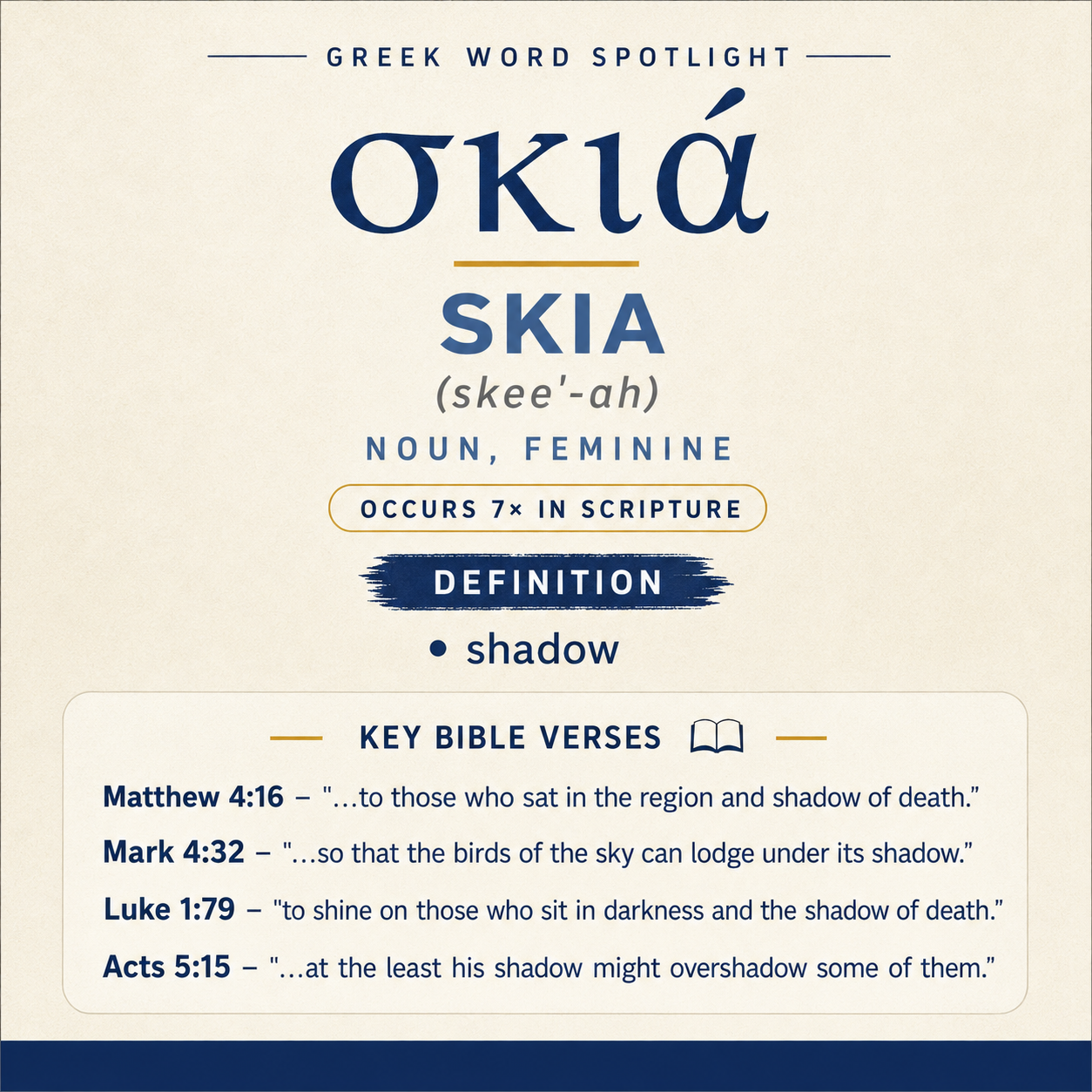
σκιά means “shadow” and occurs seven times in Scripture, including Matthew 4:16, Luke 1:79, Acts 5:15, Colossians 2:17, and Hebrews 8:5.
Gospel Contexts
It appears with the phrase “shadow of death” in Matthew 4:16 and Luke 1:79. In Mark 4:32 it refers to shade where birds can nest.
Learn More →Acts and Epistles
In Acts 5:15, Peter’s passing shadow is associated with the sick being laid out. In Colossians 2:17 and Hebrews 8:5; 10:1, “shadow” contrasts with greater realities to come.
Learn More →σκιά means “shadow,” appearing in passages that range from darkness described as the “shadow of death,” to the shade beneath a plant’s branches, to a person’s shadow falling across the sick, and to theological statements where a “shadow” relates to what is coming and to heavenly realities.
Occurrences
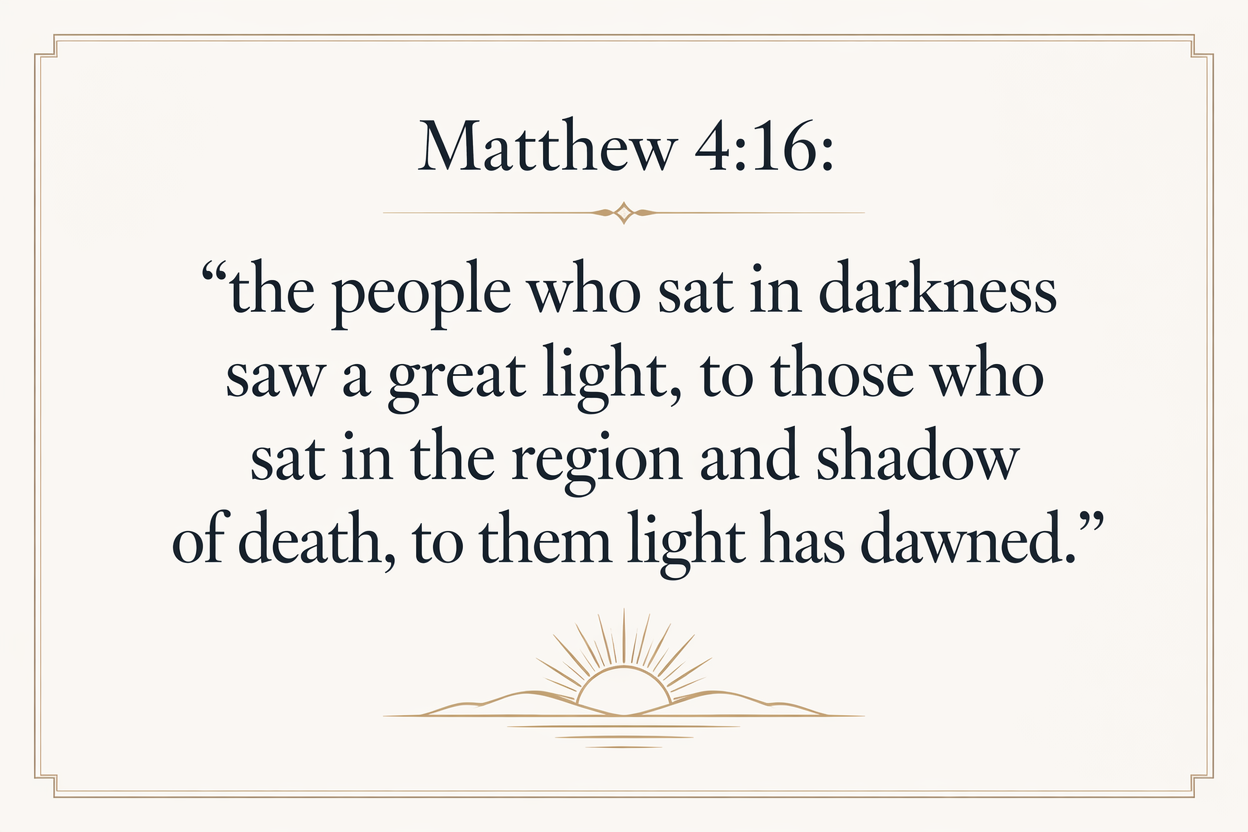
Matthew 4:16: “the people who sat in darkness saw a great light, to those who sat in the region and shadow of death, to them light has dawned.”
Here σκιά belongs to a clustered picture of darkness and illumination. The verse speaks of people who “sat in darkness” and then “saw a great light.” Within that setting, “shadow of death” functions as a location-like description (“the region and shadow of death”), portraying a condition of deep gloom that is dispelled when “light has dawned.” The word contributes the image of darkness cast over people, intensifying the contrast when light arrives.
Mark 4:32: “yet when it is sown, grows up, and becomes greater than all the herbs, and puts out great branches, so that the birds of the sky can lodge under its shadow.”
In this scene σκιά is concrete shade created by “great branches.” As the plant “grows up” and “puts out” branches, its shadow becomes a place where “the birds of the sky can lodge.” The word therefore marks the protective, sheltering effect of growth: the branches create a shaded space that can be inhabited. The shadow is not merely an absence of light but a feature of the plant’s maturity and usefulness.
Luke 1:79: “to shine on those who sit in darkness and the shadow of death; to guide our feet into the way of peace.”
As in Matthew, σκιά appears in the phrase “the shadow of death,” paired with “darkness.” The purpose clause “to shine on those who sit” depicts people settled in that darkness, and the coming shine brings direction: “to guide our feet into the way of peace.” σκιά supports the imagery of a heavy darkness that is more than momentary; it is a realm where people sit and from which they need guidance out into peace.
Acts 5:15: “They even carried out the sick into the streets, and laid them on cots and mattresses, so that as Peter came by, at the least his shadow might overshadow some of them.”
Here σκιά is the physical shadow cast by Peter as he “came by.” The crowd’s actions—bringing the sick into public space and arranging them “on cots and mattresses”—are driven by the hope that “at the least his shadow might overshadow some of them.” In this narrative description, the shadow is treated as something that can fall upon a person (“overshadow some of them”), a minimal point of contact compared with direct touch. σκιά thus contributes to the scene’s immediacy: movement through the streets, the sick positioned to receive even the passing shade of a person.
Colossians 2:17: “which are a shadow of the things to come; but the body is Christ’s.”
In this statement σκιά is used to characterize certain things as “a shadow of the things to come.” The wording sets “shadow” in contrast with “the body,” and the line “but the body is Christ’s” anchors the contrast in a single referent. Within the sentence, σκιά signals an insubstantial or derivative quality when set beside “body,” and it orients the reader forward—toward “the things to come.” The word therefore supports a way of speaking in which present realities are related to future realities by analogy: shadow now, something more substantial associated with Christ.
Hebrews 8:5: “who serve a copy and shadow of the heavenly things, even as Moses was warned by God when he was about to make the tabernacle, for he said, “See, you shall make everything according to the pattern that was shown to you on the mountain.”
Here σκιά appears alongside “copy,” forming a paired description: “a copy and shadow of the heavenly things.” The verse then illustrates the claim with the instruction to Moses about making “everything according to the pattern.” Within this context, σκιά marks the relation between earthly service and “the heavenly things”: what is served is connected to a higher reality and is shaped by a “pattern.” The word contributes the sense of representation: what is made and served has the contour of something else, as a shadow has the outline of what casts it.
Hebrews 10:1: “For the law, having a shadow of the good to come, not the very image of the things, can never with the same sacrifices year by year, which they offer continually, make perfect those who draw near.”
In this argument σκιά is part of a contrast drawn within a single sentence: “having a shadow of the good to come, not the very image of the things.” The verse goes on to state a consequence: the law “can never… make perfect those who draw near,” despite repeated sacrifices “year by year” offered “continually.” σκιά thus helps frame the law’s limitation in terms of its status relative to what is coming. The shadow is aligned with “the good to come,” while “the very image” is denied to it; the word supports the logic that what is only a shadow does not accomplish what something more complete would.

Sense and Usage
Across these passages, “shadow” functions in two main ways: as a literal phenomenon produced by bodies and branches, and as an explanatory image used in instruction and argument. The literal uses show σκιά as a spatial reality: something under which birds may lodge (Mark 4:32), and something that may fall upon people in the street as a person passes by (Acts 5:15). In both, the shadow is defined by its relation to something tangible—branches that “put out” broadly, or Peter who “came by”—and it is described in terms of its effect on others: providing a place “under” it, or “overshadow[ing]” those lying on cots and mattresses.
The paired phrase “darkness and the shadow of death” (Matthew 4:16; Luke 1:79) shows σκιά as part of an intensified portrait of gloom. The shadow is not merely incidental shade but is joined to “death” and combined with “darkness,” creating a heightened setting into which light shines. In both verses, people are described as sitting in this condition, and the arrival of light is depicted as dawning or shining. The shadow, then, belongs to a register of oppressive darkness that serves as the backdrop for illumination and guidance into peace.
The remaining uses place σκιά in reflective, theological reasoning. Colossians 2:17 aligns “shadow” with “the things to come” and opposes it to “the body,” with “the body” linked to Christ. Hebrews 8:5 connects “shadow” with “copy” and anchors the idea in the language of “pattern,” portraying a relationship between what is served and “the heavenly things.” Hebrews 10:1 uses “shadow” to characterize the law’s relationship to “the good to come,” contrasting it with “the very image,” and then draws a conclusion about the repeated sacrifices’ inability to bring perfection. In these contexts, σκιά works as a metaphor for a real but limited correspondence—something that derives its shape from another reality and points beyond itself.
Read together, these uses show that σκιά can be gentle and hospitable (shade beneath branches), incidental yet sought-after (a passing human shadow), bleak and foreboding (“shadow of death”), or conceptually precise (a term suited to distinguishing between a present form and what lies ahead, between earthly service and heavenly realities). The passages keep the imagery coherent: a shadow depends on something else, has an outline, and has an effect on those within it—whether that effect is shelter, contact, or a sense of darkness.
Imagery
The word’s imagery moves between two poles. On one side is sheltering shade: branches extend so that birds can “lodge under its shadow” (Mark 4:32), and a human shadow is hoped to “overshadow” the sick (Acts 5:15). On the other side is shadow as a marker of peril and deprivation: people sit in “darkness and the shadow of death” until light shines and guides them (Matthew 4:16; Luke 1:79). The same everyday phenomenon—shadow—also becomes a careful tool for speaking about what relates to greater realities still ahead or above, as when a “shadow of the things to come” is contrasted with “the body” (Colossians 2:17) or when “copy and shadow” is paired with “pattern” and “the heavenly things” (Hebrews 8:5).
Sources: Lexical data from Strong’s Exhaustive Concordance and the Translators Brief Lexicon of Extended Strongs for Greek (STEPBible, CC BY). Occurrence data from the Translators Amalgamated Greek New Testament (STEPBible, CC BY). Scripture quotations from the World English Bible (public domain).