
Exploring the Meaning of Skandalon in Greek
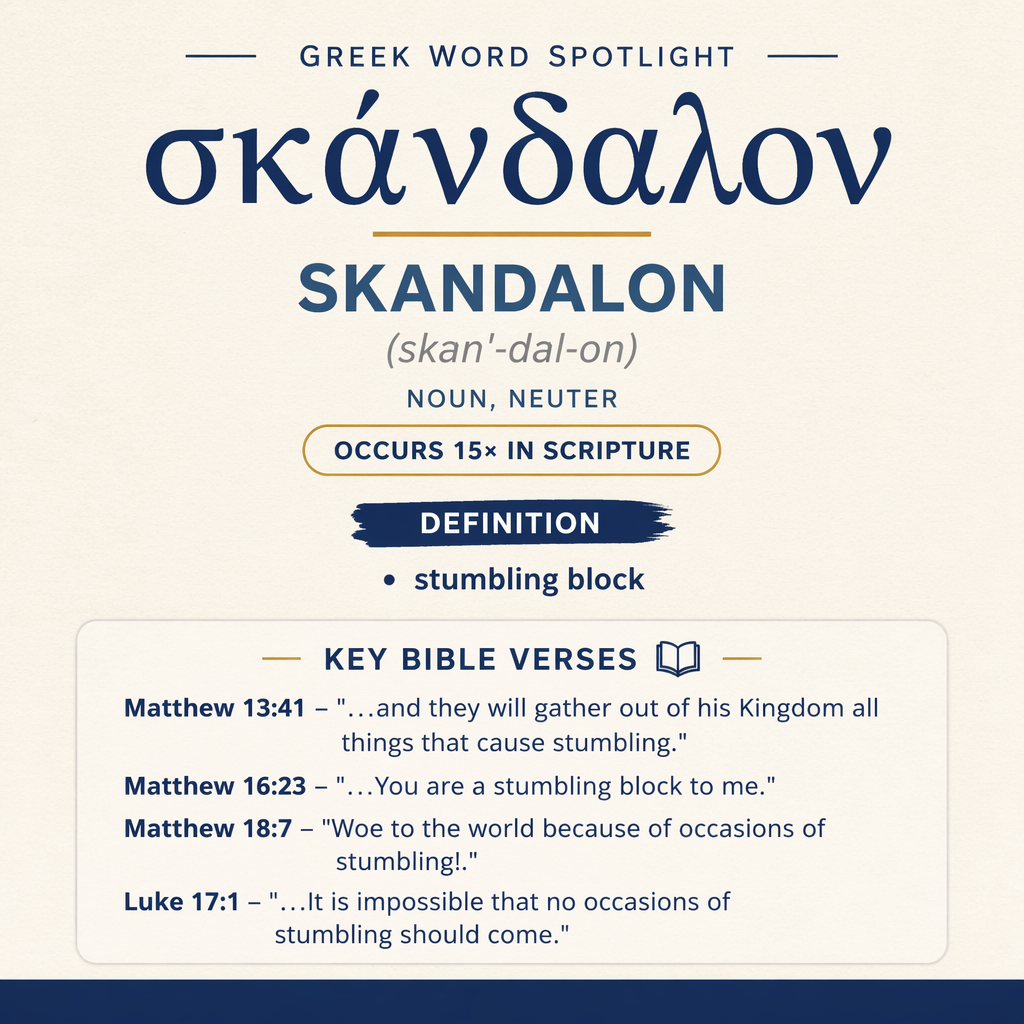
σκάνδαλον (Skandalon) means “stumbling block” and occurs 15 times in Scripture, including Matthew, Luke, and Romans.
Gospel Context
In Matthew 16:23 Jesus calls Peter “a stumbling block.” Matthew 13:41 and 18:7 also speak of “things” or “occasions” that cause stumbling.
Learn More →Romans Usage
Romans uses σκάνδαλον for a “stumbling stone” (Romans 9:33) and warns against placing a stumbling block in a brother’s way (Romans 14:13).
Learn More →σκάνδαλον names a “stumbling block”—something that causes stumbling or functions as an occasion for stumbling. In the New Testament passages where it appears here, it can describe what is removed from the kingdom, what a person becomes to another, what the world repeatedly encounters, and what some find in the message of Christ.
Occurrences
“The Son of Man will send out his angels, and they will gather out of his Kingdom all things that cause stumbling, and those who do iniquity,” (Matthew 13:41)
Here σκάνδαλον is plural in sense (“all things that cause stumbling”) and belongs to what is “gather[ed] out of his Kingdom.” The wording treats these stumbling-causes as realities that can be present within the kingdom’s realm and that are removed in a decisive act of sorting, set alongside “those who do iniquity.” The term functions broadly: not a single incident, but “all things” that trip others up.

“But he turned, and said to Peter, “Get behind me, Satan! You are a stumbling block to me, for you are not setting your mind on the things of God, but on the things of men.”” (Matthew 16:23)
σκάνδαλον is applied directly to a person: “You are a stumbling block to me.” The explanation immediately ties this stumbling-block function to a mindset: “not setting your mind on the things of God, but on the things of men.” In this scene, the word does not describe an object in the way; it names the obstructing effect Peter’s stance has on Jesus, an interference created by a misaligned focus.
““Woe to the world because of occasions of stumbling! For it must be that the occasions come, but woe to that person through whom the occasion comes!” (Matthew 18:7)
The verse frames σκάνδαλον as an “occasion of stumbling” that the world experiences repeatedly (“occasions,” plural). Two tensions are held together: the inevitability of such occasions (“it must be that the occasions come”) and the moral weight borne by the agent (“woe to that person through whom the occasion comes”). The term therefore carries both the idea of a stumbling-event and a responsibility for being its source.
“He said to the disciples, “It is impossible that no occasions of stumbling should come, but woe to him through whom they come!” (Luke 17:1)
Luke’s wording parallels Matthew’s emphasis on the inevitability of stumbling occasions while keeping the focus on accountability: “woe to him through whom they come.” Spoken “to the disciples,” σκάνδαλον belongs to the lived reality of community life where stumbling occasions arise, and where a person can be the channel through which they enter.
“even as it is written, “Behold, I lay in Zion a stumbling stone and a rock of offense; and no one who believes in him will be disappointed.”” (Romans 9:33)
σκάνδαλον appears in the phrase “a stumbling stone,” paired with “a rock of offense.” The image is concrete: a stone placed (“I lay in Zion”) that people can trip over. The second line introduces the contrasting outcome: “no one who believes in him will be disappointed.” Within the verse’s own framing, the stumbling-block imagery is set alongside believing, implying a division in response: some meet a stone they stumble over; believing leads to a different end.
“David says, “Let their table be made a snare, a trap, a stumbling block, and a retribution to them.” (Romans 11:9)
Here σκάνδαλον is one item in a cluster: “a snare, a trap, a stumbling block, and a retribution.” It is linked to “their table,” something normally associated with provision and fellowship. The term contributes the notion of something that causes falling in a setting that ought to sustain; the “table” becomes part of a sequence of hazards, ending in “retribution.”
“Therefore let’s not judge one another any more, but judge this rather, that no man put a stumbling block in his brother’s way, or an occasion for falling.” (Romans 14:13)
σκάνδαλον is something one person can “put…in his brother’s way.” The sentence turns from judging others to making a careful judgment about one’s own conduct. The phrase “in his brother’s way” pictures the stumbling block as placed along another’s path; the additional phrase “or an occasion for falling” makes the practical effect explicit: it can precipitate a fall. The word thus serves an ethical warning about causing spiritual harm within close relationships.
“Now I beg you, brothers, look out for those who are causing the divisions and occasions of stumbling, contrary to the doctrine which you learned, and turn away from them.” (Romans 16:17)
σκάνδαλον is paired with “divisions” as something certain people “are causing.” The verse locates these stumbling occasions “contrary to the doctrine which you learned,” and it gives a response: “look out” and “turn away from them.” In this setting, the stumbling-block idea is not accidental; it is tied to active disruption in the community and is presented as a recognizable pattern that warrants separation.
“but we preach Christ crucified: a stumbling block to Jews, and foolishness to Greeks,” (1 Corinthians 1:23)
σκάνδαλον names the reception of the apostolic message: “we preach Christ crucified,” and that proclamation becomes “a stumbling block to Jews.” The same preaching is also labeled “foolishness to Greeks,” but σκάνδαλον is the distinct way the message is experienced by one group: not merely rejected, but encountered as something that causes stumbling.
“But I, brothers, if I still preach circumcision, why am I still persecuted? Then the stumbling block of the cross has been removed.” (Galatians 5:11)
σκάνδαλον is attached to “the cross” (“the stumbling block of the cross”). Paul argues from consequences: if he preached “circumcision,” persecution would cease, and in that case “the stumbling block of the cross has been removed.” In this verse, σκάνδαλον is not a minor misunderstanding but a built-in offense-point bound to “the cross,” something that cannot be kept while simultaneously removing the persecution that accompanies it.
“and, “a stumbling stone and a rock of offense.” For they stumble at the word, being disobedient, to which also they were appointed.” (1 Peter 2:8)
The phrase “a stumbling stone and a rock of offense” reprises the stone imagery, then interprets the action: “they stumble at the word.” σκάνδαλον contributes the metaphor of a stone over which one trips; the verse connects that stumbling to a response of “being disobedient.” The wording keeps the focus on the act (“they stumble”) and its context (“at the word”).
“He who loves his brother remains in the light, and there is no occasion for stumbling in him.” (1 John 2:10)
σκάνδαλον appears negatively: “there is no occasion for stumbling in him.” The verse links this to relational love (“He who loves his brother”) and stability (“remains in the light”). The term therefore can describe an internal condition—whether someone, by their manner of life, contains an “occasion for stumbling” that trips others up or whether such an occasion is absent.

Sense and Usage
Across these passages, σκάνδαλον consistently functions as a cause of stumbling, but it operates at several levels. Sometimes it is presented as a thing to be removed from the kingdom’s sphere (Matthew 13:41), and sometimes as an influence embodied in a person (Matthew 16:23). It can name recurring realities in the world that are inevitable in appearance yet blameworthy in their origin (Matthew 18:7; Luke 17:1), keeping together the expectation that stumbling occasions will arise and the warning that bringing them about draws “woe.”
Paul’s letters show how the word can be used both for interpersonal ethics and for large-scale reactions. In Romans 14:13, the stumbling block is something one can deliberately or carelessly “put…in his brother’s way,” so the term sharpens the responsibility of believers to consider how their actions affect another’s walk. In Romans 16:17, stumbling occasions are tied to “divisions” and deviation “contrary to the doctrine,” so σκάνδαλον becomes a marker for destabilizing influences that fracture community life. Romans 11:9 places the stumbling-block idea inside a chain of images (“snare…trap…stumbling block…retribution”), emphasizing how what seems ordinary (“their table”) can become a setting where ruin is triggered.
Several texts attach σκάνδαλον to the proclamation centered on Christ and the cross. In 1 Corinthians 1:23, “Christ crucified” is described as “a stumbling block” for a defined audience, indicating that the message itself can function as the point where people trip. Galatians 5:11 speaks of “the stumbling block of the cross” as something that can be “removed” only by altering the preaching in a way that would eliminate persecution—so the stumbling-block quality belongs to the cross as preached, not merely to a miscommunication. Romans 9:33 and 1 Peter 2:8 express this using the image of a “stumbling stone,” a fixed obstacle over which some stumble; 1 Peter adds that the stumbling occurs “at the word” in the setting of disobedience.
Finally, 1 John 2:10 uses σκάνδαλον to describe what is absent in a person who loves his brother and remains in the light: no internal “occasion for stumbling.” That line complements the warnings elsewhere: stumbling blocks can be gathered out, avoided, refused, or—by a certain manner of life—simply not present within someone.
Imagery
The passages repeatedly picture σκάνδαλον as something encountered on a path: it can be “in his brother’s way” (Romans 14:13), it can be a “stumbling stone” laid in a specific place (Romans 9:33), and it can be the kind of obstacle over which people “stumble at the word” (1 Peter 2:8). Alongside this concrete imagery, the term also extends to social and relational realities—divisions and destabilizing influences (Romans 16:17), a mindset that obstructs God’s purposes (Matthew 16:23), and a life of love in which no such tripping-point exists (1 John 2:10).
Sources: Lexical data from Strong’s Exhaustive Concordance and the Translators Brief Lexicon of Extended Strongs for Greek (STEPBible, CC BY). Occurrence data from the Translators Amalgamated Greek New Testament (STEPBible, CC BY). Scripture quotations from the World English Bible (public domain).





