Exploring the Meaning of Samareites in Greek
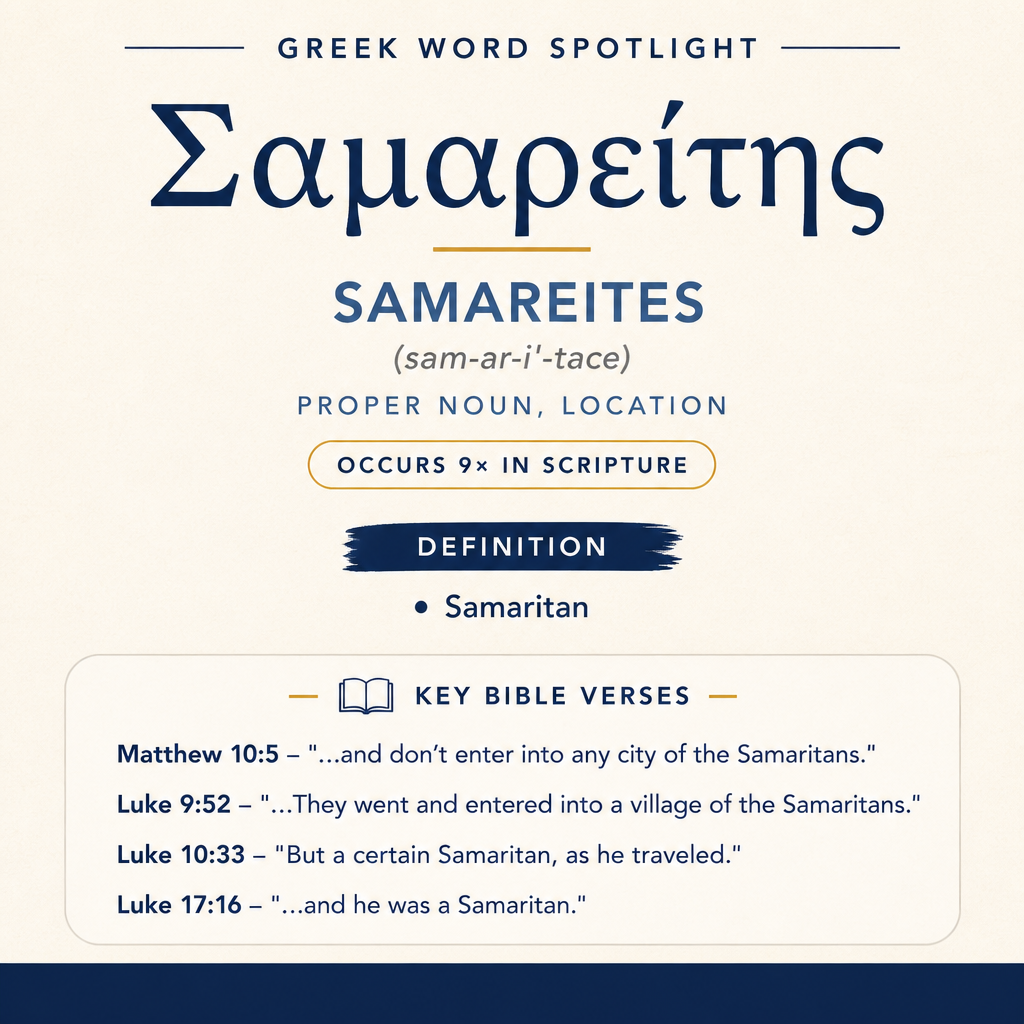
Σαμαρείτης (Samareites) means “Samaritan” and appears in Matthew, Luke, and John in nine New Testament occurrences.
Gospel Occurrences
It occurs in Matthew 10:5; Luke 9:52; 10:33; 17:16; and John 4:9, 4:39–40, 8:48.
Learn More →Context Highlights
The word identifies Samaritans in narratives, including a Samaritan traveler (Luke 10:33) and the Samaritan woman (John 4:9).
Learn More →Σαμαρείτης designates a “Samaritan,” appearing in Gospel narratives and in Acts in settings that range from travel instructions and village encounters to public dispute and the spread of the Good News. Across these scenes, the term marks people and places as Samaritan, and the designation often shapes how actions and responses are understood within each episode.
Occurrences
Matthew 10:5 — “Jesus sent these twelve out, and commanded them, saying, “Don’t go among the Gentiles, and don’t enter into any city of the Samaritans.”
Here Σαμαρείτης functions in a geographic frame: “any city of the Samaritans.” The command sets boundaries for the disciples’ initial movement, pairing “Gentiles” with “cities of the Samaritans” as routes not to be taken in this sending. The term therefore contributes a concrete territorial marker—cities characterized by their Samaritan identity—and helps define the scope of where the twelve are (and are not) to go.

Luke 9:52 — “and sent messengers before his face. They went and entered into a village of the Samaritans, so as to prepare for him.”
Σαμαρείτης again identifies a locale—“a village of the Samaritans”—but now in the context of advance preparation for Jesus’ arrival. The word places the travel narrative inside a Samaritan setting, establishing a particular social space into which the messengers enter. The focus is not on a single Samaritan individual but on a village defined by Samaritan inhabitants, which frames the hospitality and reception issues that surround such preparations.
Luke 10:33 — “But a certain Samaritan, as he traveled, came where he was. When he saw him, he was moved with compassion,”
In this line the designation is personal: “a certain Samaritan.” The term identifies the traveler’s social identity, and that identity is made significant by what follows—he “came where he was,” “saw him,” and “was moved with compassion.” The word contributes the character label that distinguishes this helper from others in the story’s sequence, while the sentence attaches to that label a decisive action: compassionate response upon seeing the injured man.
Luke 17:16 — “He fell on his face at Jesus’ feet, giving him thanks; and he was a Samaritan.”
Σαμαρείτης appears as a concluding identification: after depicting the man’s posture (“fell on his face at Jesus’ feet”) and his act (“giving him thanks”), the text adds, “and he was a Samaritan.” The term sharpens the scene by naming who this grateful person is. The designation does not change the visible actions described, but it frames their significance: the thanks and reverence are performed by someone explicitly identified as Samaritan.
John 4:9 — “The Samaritan woman therefore said to him, “How is it that you, being a Jew, ask for a drink from me, a Samaritan woman?” (For Jews have no dealings with Samaritans.)
Here the word is embedded in direct dialogue and self-identification: the speaker calls herself “a Samaritan woman” and contrasts that with Jesus “being a Jew.” The parenthetical comment (“For Jews have no dealings with Samaritans.”) makes the social tension explicit within the verse itself. Σαμαρείτης thus functions not merely as a label but as the basis for the woman’s question about the appropriateness of requesting a drink across a recognized boundary of interaction.
John 4:39 — “From that city many of the Samaritans believed in him because of the word of the woman, who testified, “He told me everything that I did.”
In this summary statement, Σαμαρείτης identifies a group response: “many of the Samaritans believed in him.” The term marks the collective identity of those who come to faith, and the verse links their belief causally to “the word of the woman” and her testimony. The designation helps the reader track the spread of belief within a Samaritan community associated with “that city,” emphasizing the communal reach of one person’s witness.
John 4:40 — “So when the Samaritans came to him, they begged him to stay with them. He stayed there two days.”
Σαμαρείτης again points to a group, now portrayed in motion and speech: “the Samaritans came to him” and “begged him to stay with them.” The label ties the request and resulting hospitality (“He stayed there two days”) to the Samaritan community. The term contributes a communal subject who initiates an invitation and receives an extended stay, placing Samaritan agency and welcome at the center of the verse.
John 8:48 — “Then the Jews answered him, “Don’t we say well that you are a Samaritan, and have a demon?””
In this dispute scene, Σαμαρείτης is used as an accusation: “you are a Samaritan.” The word functions rhetorically rather than descriptively; it is hurled in an antagonistic response and paired with a further charge (“and have a demon”). The designation’s contribution is therefore its role in verbal conflict, where naming someone “a Samaritan” becomes part of an attempt to discredit or insult.
Acts 8:25 — “They therefore, when they had testified and spoken the word of the Lord, returned to Jerusalem, and preached the Good News to many villages of the Samaritans.”
Σαμαρείτης returns to the geographic-communal sense: “many villages of the Samaritans.” The verse depicts outward proclamation during travel—after testifying, they return toward Jerusalem while preaching along the way. The term marks the destinations of this preaching as Samaritan villages, highlighting that the Good News is announced in a network of places characterized by Samaritan identity.

Sense and Usage
Across these passages, “Samaritan” serves as an identity marker that can attach either to a person (“a certain Samaritan,” “a Samaritan woman,” “he was a Samaritan”) or to a place defined by its inhabitants (“a village of the Samaritans,” “any city of the Samaritans,” “many villages of the Samaritans”). This flexibility allows the narratives to shift smoothly between individual encounters and larger community settings while keeping the Samaritan designation in view.
The term’s narrative weight varies with context. In Matthew 10:5 it helps draw a mission boundary by identifying locales not to be entered in that commission. In Luke 9:52 it locates the preparatory work for Jesus within Samaritan territory. In Acts 8:25 it names villages along a preaching route, so that Samaritan places become explicit fields of proclamation.
When applied to individuals, the designation often functions as a lens through which actions are perceived. Luke 10:33 places compassion explicitly in the frame of a Samaritan traveler’s response to need. Luke 17:16 highlights gratitude and reverence and then identifies the grateful person as Samaritan, letting the identity label color the reader’s understanding of the scene without altering its described gestures. John 4:9 places the term at the center of a social question: the woman points out the mismatch she perceives between “you, being a Jew” and “me, a Samaritan woman,” and the parenthetical comment grounds that question in a recognized pattern of non-association.
John’s Gospel also shows the term operating at the community level in the dynamics of belief and hospitality. John 4:39 depicts “many of the Samaritans” believing because of testimony, and John 4:40 portrays “the Samaritans” coming, asking Jesus to remain, and hosting him for “two days.” In these summaries, “Samaritans” is the collective subject of believing, approaching, and inviting—actions that shape the flow of the narrative and the time spent “there.”
At the same time, John 8:48 demonstrates that “Samaritan” can be used polemically. The charge “you are a Samaritan” appears as part of hostile speech, coupled with another accusation. In that moment, the term’s function is not to identify Jesus’ origin or residence within the story’s discourse, but to serve as a pointed label in an argument.
Imagery in Context
The passages provide recurring settings that give “Samaritan” a concrete feel: roads and travel (“as he traveled”), villages and cities (“a village of the Samaritans,” “any city of the Samaritans,” “many villages of the Samaritans”), and face-to-face encounters that pivot on ordinary acts—asking for “a drink,” being “moved with compassion,” falling at someone’s feet “giving him thanks,” and begging a visitor “to stay with them.” Within these scenes, the word consistently anchors the reader in a recognizable social and geographic identity that affects where people go, how they speak, and how they receive one another.
Sources: Lexical data from Strong’s Exhaustive Concordance and the Translators Brief Lexicon of Extended Strongs for Greek (STEPBible, CC BY). Occurrence data from the Translators Amalgamated Greek New Testament (STEPBible, CC BY). Scripture quotations from the World English Bible (public domain).