Exploring the Meaning of Salome in Greek
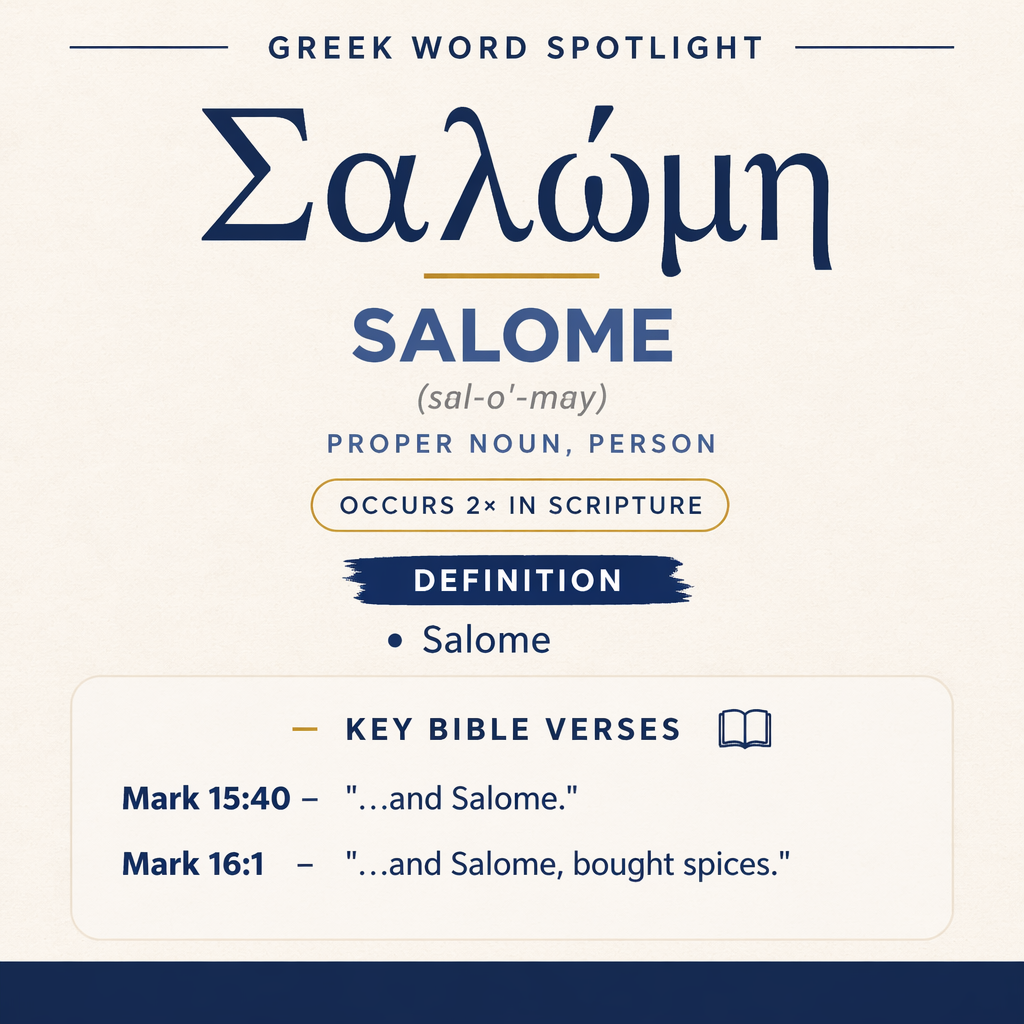
Σαλώμη means “Salome” and appears twice in Scripture, in Mark 15:40 and Mark 16:1.
Narrative Context
In Mark 16:1, Salome is named among those who bought spices to come.
Learn More →Σαλώμη (Salome) is a personal name, appearing in Mark’s passion-and-resurrection narrative. In its two appearances, it functions to identify one of the women present as a witness from a distance and as a participant in the post-Sabbath preparation to honor Jesus’ body.
Occurrences
Mark 15:40: “There were also women watching from afar, among whom were both Mary Magdalene, and Mary the mother of James the less and of Joses, and Salome;”
Here Σαλώμη is embedded in a list that marks out “women watching from afar.” The name works as an identifier within a group of observers, set alongside “Mary Magdalene” and “Mary the mother of James the less and of Joses.” The sentence frames the scene by distance (“from afar”) and by attentiveness (“watching”), and Σαλώμη contributes to that framing by anchoring the witness to a specific named individual rather than leaving the women anonymous. In a narrative moment where proximity is limited, the naming still supplies particularity: this is not an indistinct crowd, but a defined set of women, each designated by a personal name (or, in one case, by name plus maternal description). Within that list, Σαλώμη stands as a simple proper name, not expanded by a relational phrase, yet it still serves the same narrative purpose—marking an identifiable person among the observers.
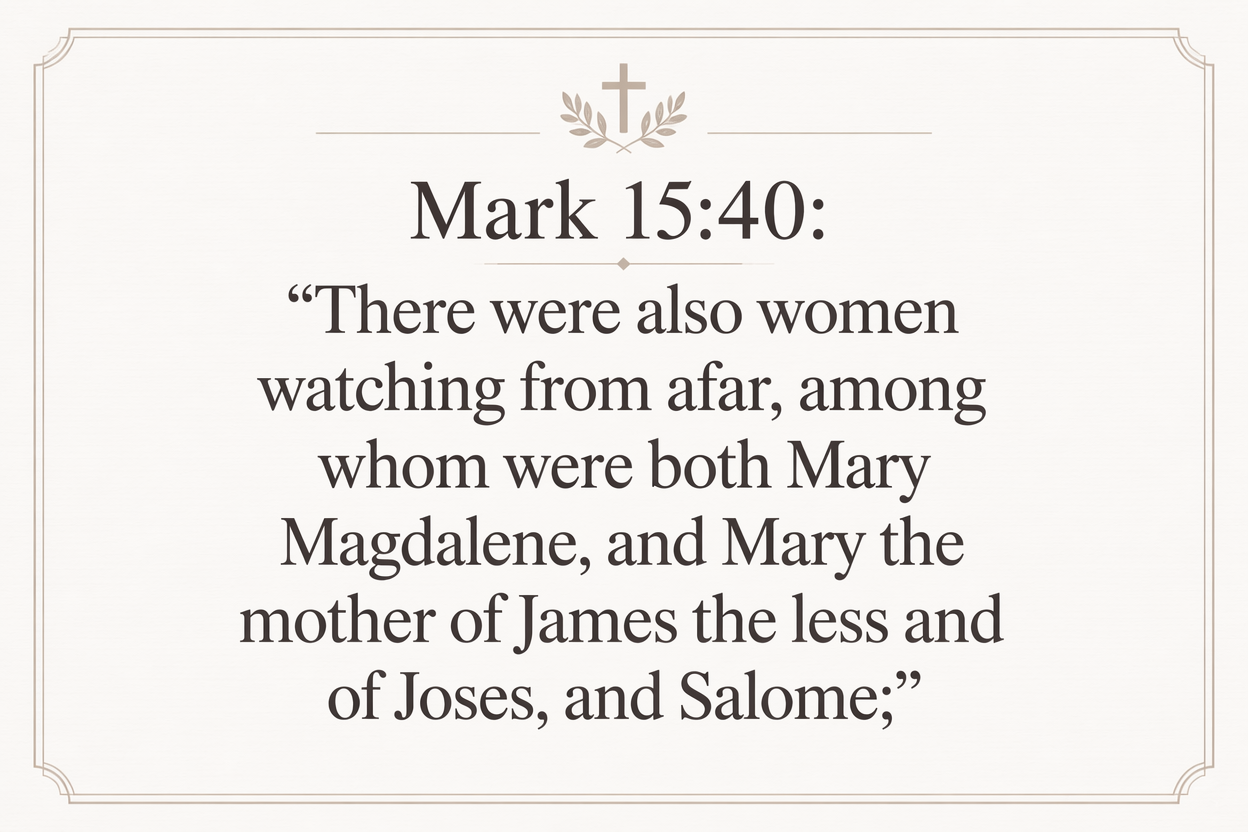
Mark 16:1: “When the Sabbath was past, Mary Magdalene, and Mary the mother of James, and Salome, bought spices, that they might come and anoint him.”
In this occurrence Σαλώμη again appears within a triad of women, but the activity has shifted from watching to acting. The time marker “When the Sabbath was past” places the scene after a period of required pause; the named women then “bought spices,” and the clause “that they might come and anoint him” states their intent. Σαλώμη’s name therefore functions not only to identify a person but also to locate that person within a deliberate, coordinated response: she is one of those who undertake preparation and plan a visit. The name links a particular individual to the concrete actions of purchasing and coming, emphasizing that the intention to anoint is carried by real people with names, not merely by a generalized group.

Sense and Usage
As a proper name, Σαλώμη designates an individual without adding descriptive content in the way common nouns do; its meaning in these passages is carried by reference rather than by lexical description. Across both scenes in Mark, the name is used consistently in coordination with other named women, and its narrative role is shaped by that coordination. In Mark 15:40, Σαλώμη is part of an observing group, defined by their posture of watching and their distance from events. In Mark 16:1, Σαλώμη is part of an acting group, defined by their purchase of spices and their purpose “to anoint him.” The two uses together show how a proper name can supply continuity across adjacent narrative moments: the same named person appears first as a witness and then as a participant in an intended act of care.
The phrasing in both verses also shows how names function within lists. Mark does not introduce Σαλώμη with a title, explanation, or role label; instead, the role is supplied by the verbs and clauses surrounding the list. In 15:40, the clause “women watching from afar” is the role-context into which Σαλώμη is placed. In 16:1, the verbs “bought” and “might come and anoint” provide the role-context. Thus Σαλώμη’s usage demonstrates how narrative can attribute significance to a named person chiefly by situating the name within actions and intentions rather than by appending biographical notes.
The list structure itself is slightly different in the two occurrences, and that difference affects the reader’s sense of the scene. In Mark 15:40, the listing occurs after a general statement (“There were also women watching from afar”), and then the women are specified “among whom were both” followed by the names, culminating in “and Salome;” This creates the effect of moving from a wider view to particular identification. In Mark 16:1, the names appear immediately after the time clause, then the action follows (“bought spices”), then the purpose (“that they might come and anoint him”). This ordering foregrounds the persons before describing their action, placing Σαλώμη at the front edge of the narrative movement. In both, the name gains its force from placement: the reader is guided to associate the action and intent of the clause with these specific individuals.
Because Σαλώμη appears only in these two tightly connected settings, its usage is bound to the themes present in the quoted lines: watchfulness under constraint (“from afar”), reverent attention to the dead (“bought spices”), and purposeful movement toward an act of anointing (“that they might come and anoint him”). Within those themes, the proper name contributes the human concreteness of witness and intention. The text does not leave the reader with an impersonal report that “some women” were present; Σαλώμη helps form a small, stable circle of named figures who remain engaged across the transition from Sabbath to the planned anointing.
Imagery in Mark
The name Σαλώμη is carried by the imagery of the scenes in which it appears. First there is the image of distant observation: “women watching from afar” (Mark 15:40), a picture of attention held at a remove. Then there is the image of preparation and purpose: “bought spices, that they might come and anoint him” (Mark 16:1), evoking tangible materials and a planned approach. In these verses, Σαλώμη stands within those images as one identifiable participant—present in the watching, and present in the intended act of honoring the body.
Sources: Lexical data from Strong’s Exhaustive Concordance and the Translators Brief Lexicon of Extended Strongs for Greek (STEPBible, CC BY). Occurrence data from the Translators Amalgamated Greek New Testament (STEPBible, CC BY). Scripture quotations from the World English Bible (public domain).