Exploring the Meaning of Salos in Greek
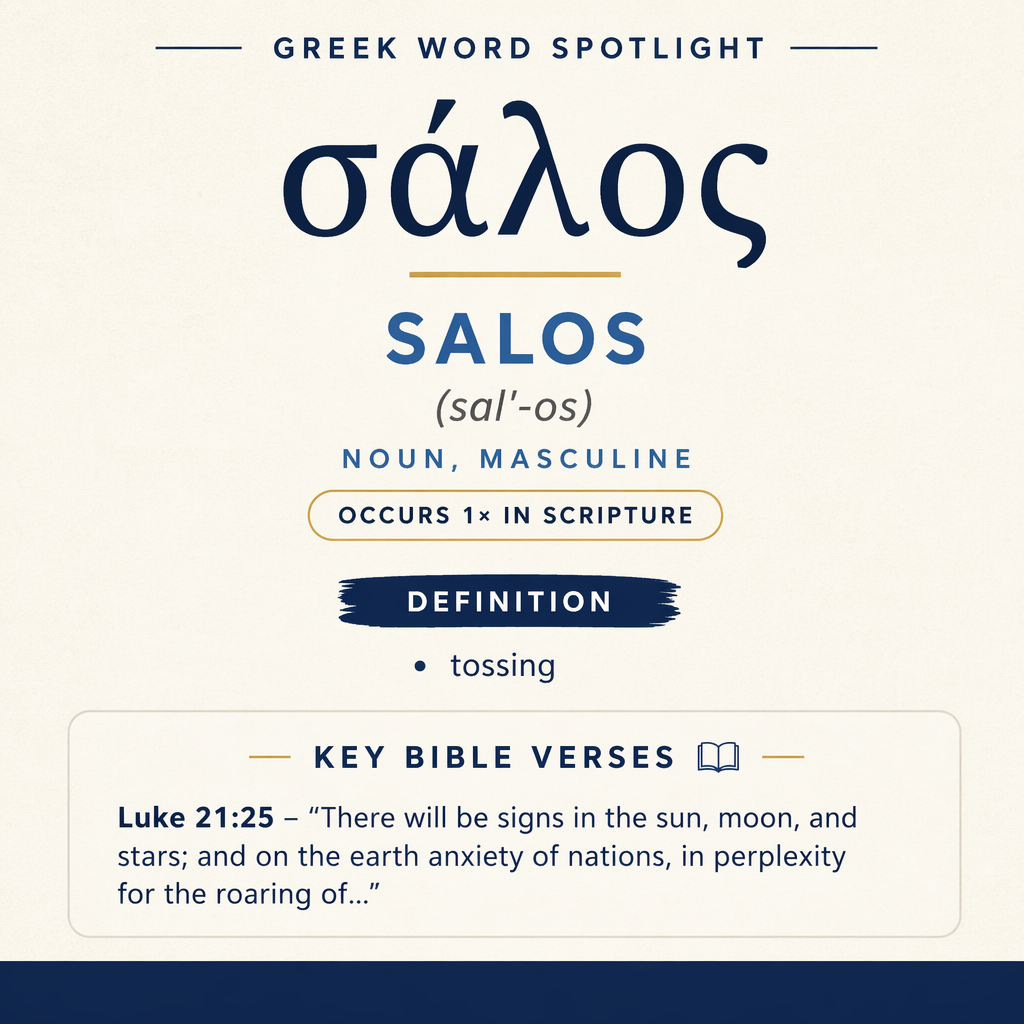
σάλος means “tossing” and appears once in Scripture, in Luke 21:25.
Scripture Occurrence
This word occurs 1 time in Scripture. Its single occurrence is in Luke 21:25.
Learn More →Verse Context
In Luke 21:25 it appears in a description of anxiety among nations. The verse mentions “the roaring of t...” in that setting.
Learn More →σάλος refers to “tossing,” and it appears once in the New Testament, in Jesus’ discourse about distress among the nations. In its single setting, it is bound to the restless motion and sound of the sea and its waves.
Root and Related Words
σάλος is connected with the verb sainō (σαίνω), “to shake” (Strong’s G4525). The relationship frames σάλος as language for motion that is produced by shaking, the kind of movement that is felt and observed rather than merely imagined.

Occurrences
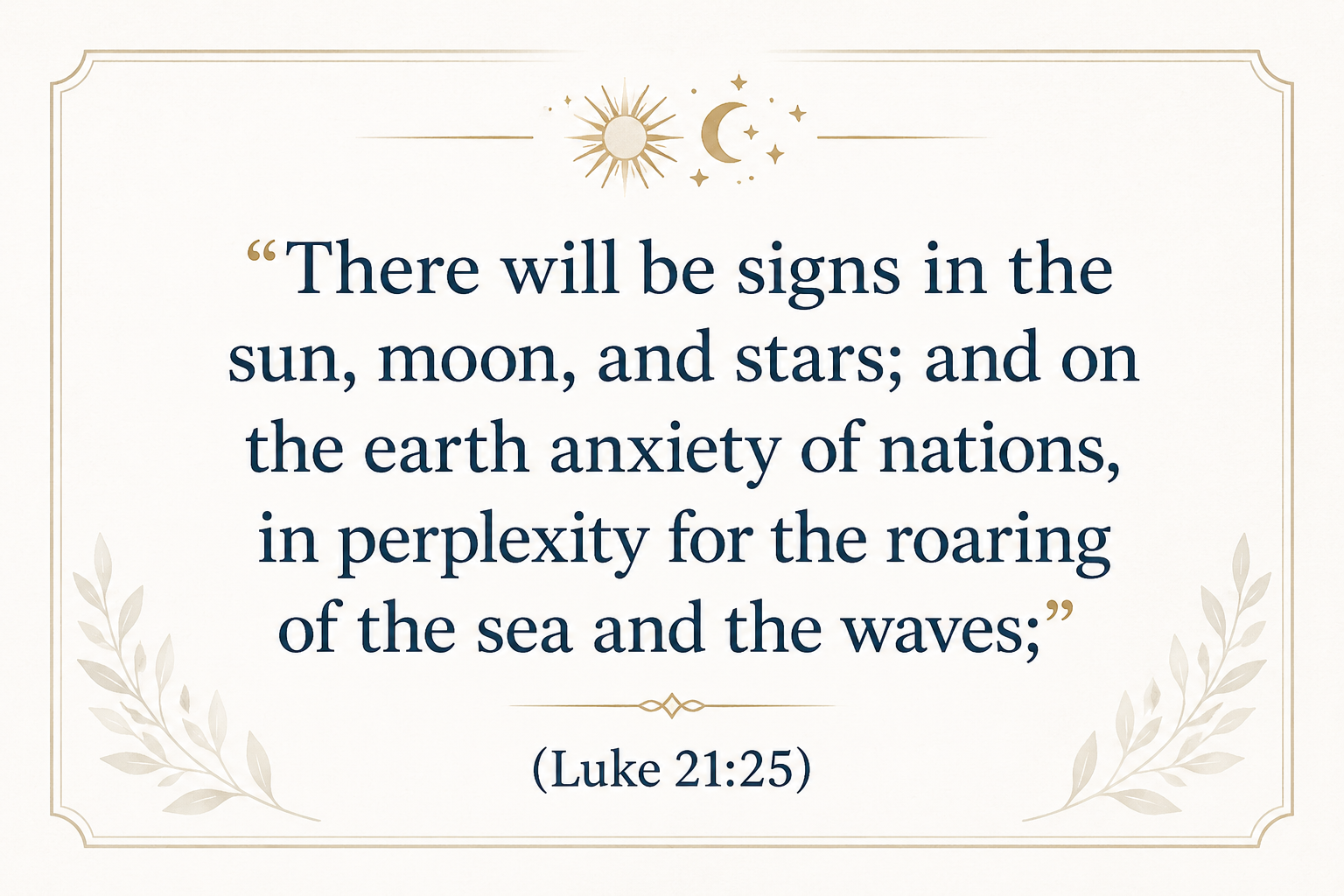
“There will be signs in the sun, moon, and stars; and on the earth anxiety of nations, in perplexity for the roaring of the sea and the waves;” (Luke 21:25)
In Luke 21:25 the word belongs to a tightly packed description of disturbance: “signs in the sun, moon, and stars” are matched by turmoil “on the earth,” specifically “anxiety of nations, in perplexity.” Within that rising tension, σάλος supplies the picture of physical agitation that helps the reader hear and feel what the nations are reacting to. The scene does not merely mention a sea that exists in the background; it describes “the roaring of the sea and the waves,” a phrasing that draws attention to loud, repeated, and overpowering motion. σάλος names the kind of movement that makes the sea appear unstable—an ongoing tossing rather than a single crash or a momentary surge.
The verse links the human response (“anxiety… perplexity”) to what is happening in the created order (“the roaring of the sea and the waves”). σάλος functions at the hinge between these two domains. By characterizing the sea in terms of tossing, it portrays the natural phenomenon as disorienting: it is not calm water with predictable rhythm, but water thrown into unsettled movement that produces “roaring.” In context, the tossing is not an incidental detail; it is the sensory cause that helps explain why nations experience “perplexity.” The word contributes a concrete image of instability that matches the emotional atmosphere the verse describes.
Sense and Usage
The definition “tossing” is inherently dynamic: it describes motion that continues, reverses, and repeats. In Luke 21:25, that dynamism is reinforced by the paired terms “sea” and “waves,” along with the auditory “roaring.” The verse does not portray a single event that quickly passes; instead it paints a condition of agitation that has enough duration and intensity to generate widespread “anxiety of nations.” Within this portrayal, σάλος serves as a noun that encapsulates the unstable motion underlying what is heard (“roaring”) and what is seen (the sea and its waves in disorder).
Because “tossing” is a kinetic image, it lends itself to describing situations where steadiness is lost and control is not apparent. Luke’s sentence places that image into a wider catalogue of “signs,” which includes the heavens (“sun, moon, and stars”) and the earth (“on the earth anxiety of nations”). The tossing of the sea thus becomes part of a coordinated picture of disturbance across multiple realms. In that literary setting, σάλος contributes more than a note of oceanography; it supplies a recognizable, physical analogue for the public mood named in the verse. The nations’ interior state is not described with medical or philosophical vocabulary, but with the social terms “anxiety” and “perplexity,” and the environment is depicted with a sensory scene. “Tossing” bridges these by presenting a world whose surfaces will not settle.
At the level of imagery, “tossing” suggests irregular motion: movement that does not travel smoothly from one point to another, but shifts, heaves, and throws. That kind of motion is especially apt for water, which can embody instability on a large scale. Luke 21:25 expresses this through the compounded phrase “the roaring of the sea and the waves,” in which the waves can be understood as the visible units of the sea’s agitation. σάλος, as “tossing,” gathers those visible motions into one conceptual whole: the sea is not merely made up of waves; it is in a state of being tossed. The result is a picture whose force lies in its immediacy—anyone who has witnessed turbulent water can imagine the noise and the uneasy motion that accompanies it.
The association with sainō (σαίνω), “to shake,” also clarifies the kind of motion conveyed: “tossing” is movement caused by shaking, as when something is jarred so that it cannot remain at rest. Luke’s phrasing makes that shaking perceptible through sound (“roaring”) and through the multiplying effect of “waves.” Together, these elements make the disturbance feel inescapable: the tossing does not stay contained within a private experience, but becomes a public sign that nations collectively confront.
Imagery
Luke 21:25 places σάλος in an auditory-visual tableau: a roaring sea, waves in motion, and nations responding with anxiety and perplexity. The word’s imagery is therefore not gentle or decorative; it is elemental and unsettling. In this passage, “tossing” becomes a way of describing a world whose rhythms seem disrupted, where the restless movement of the sea mirrors the unsettled state of those who watch and hear it.
Sources: Lexical data from Strong’s Exhaustive Concordance and the Translators Brief Lexicon of Extended Strongs for Greek (STEPBible, CC BY). Occurrence data from the Translators Amalgamated Greek New Testament (STEPBible, CC BY). Scripture quotations from the World English Bible (public domain).