Exploring the Meaning of Salathiel in Greek
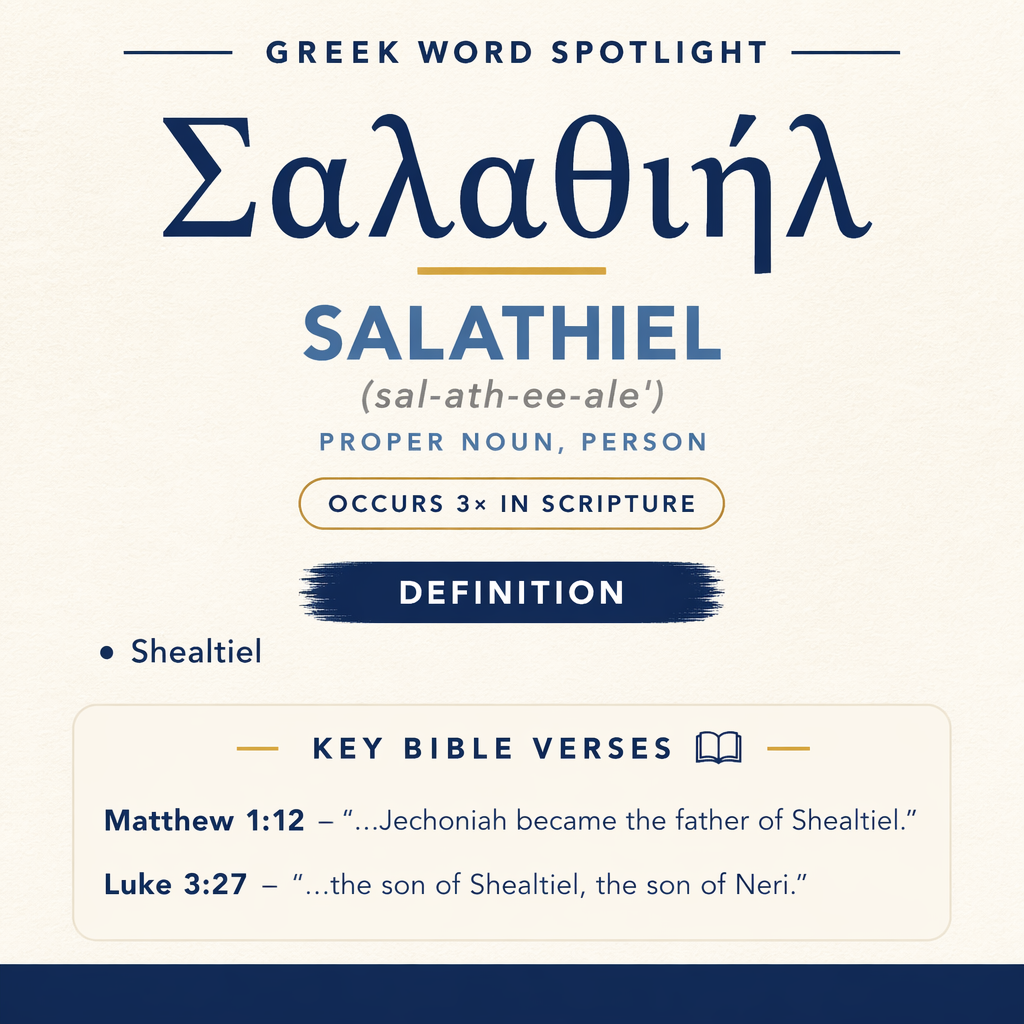
Σαλαθιήλ means Shealtiel and appears in the genealogies of Matthew 1:12 and Luke 3:27.
Gospel Genealogies
In Matthew 1:12, Shealtiel is listed as the father of Zerubbabel after the Babylonian exile.
Learn More →Luke Reference
In Luke 3:27, Shealtiel appears in a lineage that includes Zerubbabel and Neri.
Learn More →Σαλαθιήλ means “Shealtiel” and appears in the New Testament genealogies that trace family descent. In these lines, the name functions as a link in a sequence of fathers and sons, anchoring the lineage at a particular generation.
Occurrences
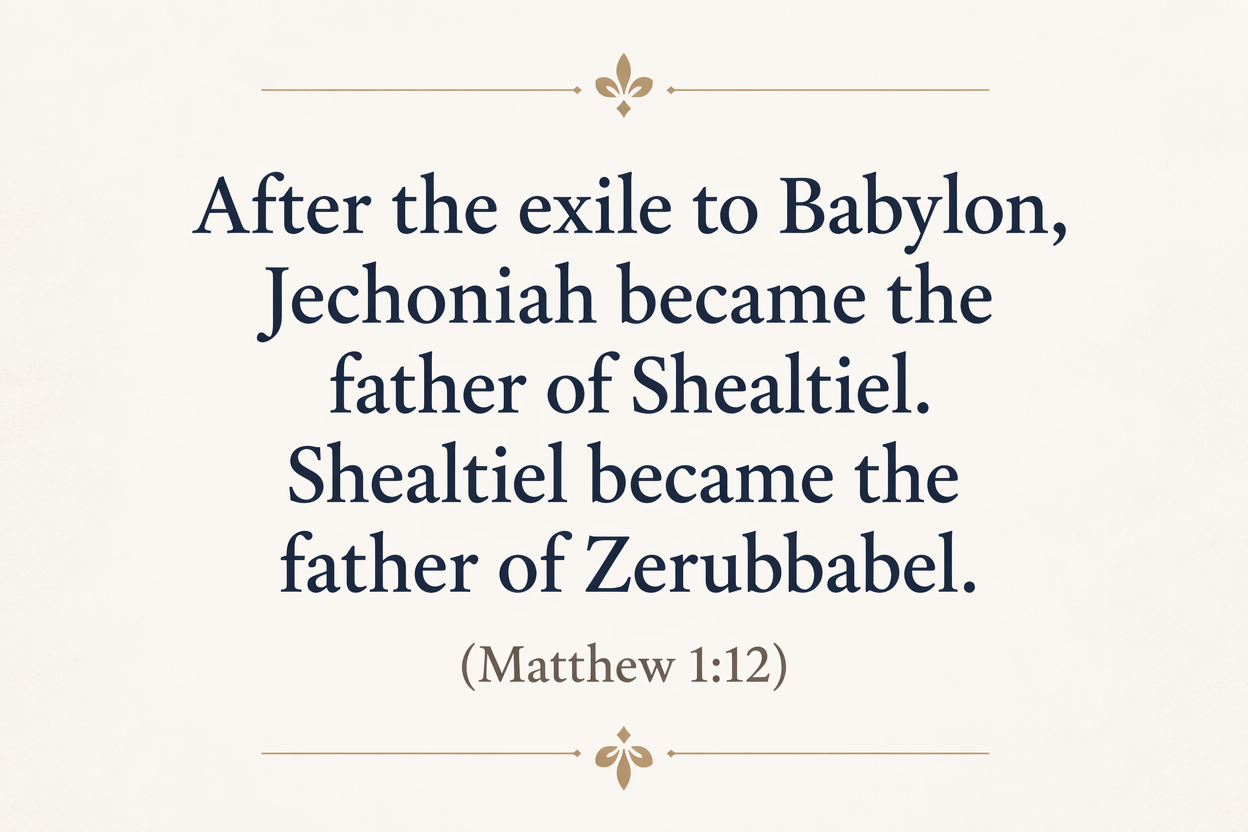
After the exile to Babylon, Jechoniah became the father of Shealtiel. Shealtiel became the father of Zerubbabel. (Matthew 1:12)
Here Σαλαθιήλ appears as a named generation marker within a tightly structured list of begettings. The verse places Shealtiel immediately after the note “After the exile to Babylon,” so the name is situated in a post-exile segment of the genealogy. Within the two short sentences, Shealtiel is framed in two directions at once: he is the son of Jechoniah (“Jechoniah became the father of Shealtiel”) and the father of Zerubbabel (“Shealtiel became the father of Zerubbabel”). The effect is not merely to mention an individual but to create continuity across the generational chain, with Σαλαθιήλ serving as the hinge between what precedes and what follows in the line.
The wording also makes the name carry narrative weight without telling a narrative. The exile reference sets a historical horizon, but the genealogy advances by naming relationships rather than recounting events. In that setting, “Shealtiel” functions as a stable identifier: the genealogy moves forward by attaching the next name to the previous one, and Σαλαθιήλ is one of those attachment points, securing Zerubbabel’s placement and preserving Jechoniah’s continuity into the next generation.
the son of Joanan, the son of Rhesa, the son of Zerubbabel, the son of Shealtiel, the son of Neri, (Luke 3:27)
In Luke’s genealogy, Σαλαθιήλ occurs within a chain built with repeated “the son of …” phrases. The verse presents several successive links, and Shealtiel is positioned between Zerubbabel and Neri: “the son of Zerubbabel, the son of Shealtiel, the son of Neri,”. This placement assigns Shealtiel a clear relational role—Zerubbabel is presented as his son, and he is presented as the son of Neri. The name thus serves as a connective node in Luke’s descending (or stepwise) pattern of ancestry, letting the list pass through one generation to the next without pause.
Because the verse strings together multiple names with the same syntactic pattern, the contribution of Σαλαθιήλ is primarily structural and identificatory. The genealogy’s cadence depends on each named person functioning as a link, and “Shealtiel” is one such link. The name also marks a shared point of contact with another genealogy that includes Zerubbabel and Shealtiel together, showing how the genealogical tradition can converge around certain recognizable pairings, even while the surrounding names and sequencing reflect the distinct presentation of each list.

Sense and Usage
As a proper name meaning “Shealtiel,” Σαλαθιήλ is used to designate a particular person within lines of descent. In both occurrences, the word’s sense is carried not by description but by relationship: the surrounding phrasing defines who Shealtiel is in terms of parentage and offspring. Matthew expresses this in the compact form “became the father of,” presenting Shealtiel as both recipient and source of the genealogical line in a two-step movement. Luke expresses it through the repeated “the son of” formula, embedding Shealtiel in a longer chain where each name has its force from its position between two others.
The two contexts together show how a personal name can operate as an organizing device. Neither verse offers titles, character traits, or actions for Shealtiel; instead, the name’s function is to secure the continuity of a family line by attaching adjacent generations. The repeated pairing with Zerubbabel in both quotations gives the name additional anchoring power in the list: Shealtiel is the identified father of Zerubbabel, and Zerubbabel is the identified son of Shealtiel. This repeated relational use makes Σαλαθιήλ a fixed point for the reader, a place where the genealogy can be checked and followed.
These passages also illustrate the way genealogies use names to handle large spans of time with minimal words. Matthew’s clause “After the exile to Babylon” places the naming of Shealtiel within a broad historical frame, but the genealogy itself progresses through simple kinship statements. Luke’s verse, by contrast, offers no historical marker in the line quoted; its emphasis is rhythmic continuity, where each name is meaningful chiefly because it transmits the line to the next. In both styles, Σαλαθιήλ functions as a bearer of lineage identity: the name signals the person through whom descent is reckoned at that point in the sequence.
Genealogical Imagery
Within these verses, Σαλαθιήλ carries the imagery of connection—one generation linked to another through a named father-son relationship. Matthew places that linkage against the backdrop phrase “After the exile to Babylon,” so the name stands at a juncture where the line continues beyond a major communal rupture. Luke places the same name inside a steady chain of “the son of” links, evoking an unbroken verbal line in which each name, including Shealtiel, is a necessary step in tracing descent.
Sources: Lexical data from Strong’s Exhaustive Concordance and the Translators Brief Lexicon of Extended Strongs for Greek (STEPBible, CC BY). Occurrence data from the Translators Amalgamated Greek New Testament (STEPBible, CC BY). Scripture quotations from the World English Bible (public domain).