Exploring the Meaning of Sabbatismos in Greek
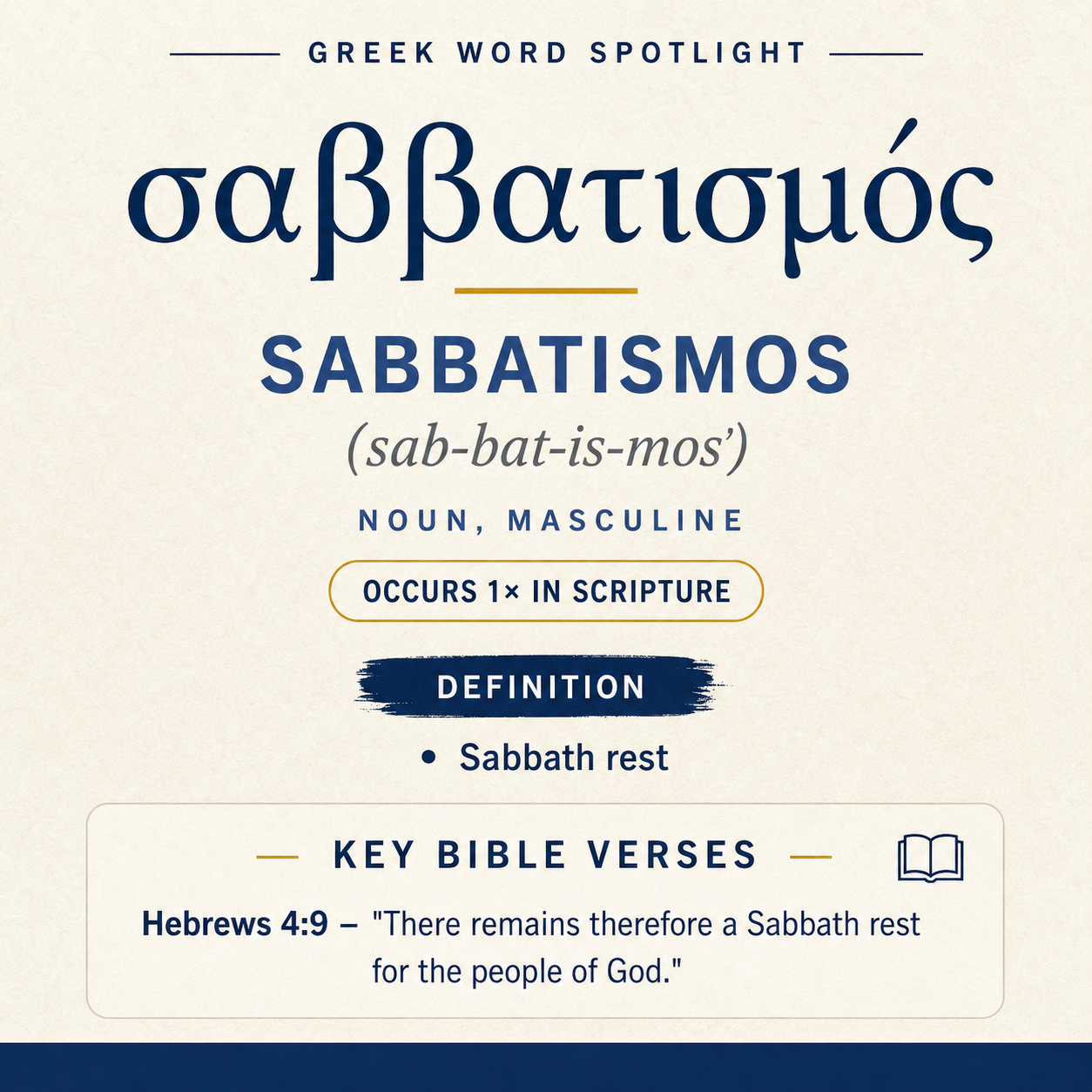
σαββατισμός means “Sabbath rest” and appears once in Scripture, in Hebrews 4:9.
Biblical Occurrence
This noun occurs one time in Scripture. Its sole occurrence is in Hebrews 4:9.
Learn More →Verse Context
Hebrews 4:9 says, “There remains therefore a Sabbath rest for the people of God.”
Learn More →σαββατισμός means “Sabbath rest,” and it appears in the New Testament in Hebrews 4:9. In that sentence it functions as a compact name for what “remains” for “the people of God.”
Root and Related Words
σαββατισμός (Sabbatismos) derives from σάββατον (sabbaton), “Sabbath” (Strong’s G4521). The related word provides the recognizable Sabbath framework within which σαββατισμός expresses its single stated idea: a rest characterized as Sabbath rest.

Occurrences
“There remains therefore a Sabbath rest for the people of God.” (Hebrews 4:9)
In Hebrews 4:9, σαββατισμός stands as the object of the clause: “There remains therefore a Sabbath rest….” The verb “remains” places this rest in the category of something still available or still set aside, rather than something exhausted or concluded. The word is further framed by “therefore,” which signals that this statement draws a conclusion; within the verse itself, σαββατισμός is the summarized outcome of whatever reasoning leads to the “therefore.”
The phrase “for the people of God” assigns this Sabbath rest to a defined community. The verse does not present σαββατισμός as a general human experience, a private feeling, or an undefined ideal; it is spoken of as a remaining provision oriented toward “the people of God.” The wording also treats the rest as something that can be spoken of as a distinct reality—something that can “remain” and can be “for” a particular people.
By choosing the expression “Sabbath rest,” the sentence gives the idea of rest a specific contour. It is not merely rest in the abstract; it is rest described in terms of Sabbath. That Sabbath coloring is carried by σαββατισμός itself, which draws its shape from the related word for “Sabbath.” Within the verse, this has the effect of naming the remaining rest with a familiar, tradition-laden label rather than leaving it as a vague promise of relief.
Sense and Usage
The sole attestation of σαββατισμός presents it as a noun naming a state or provision: “a Sabbath rest.” In Hebrews 4:9, that provision is treated as enduring—something that “remains.” This is not simply a momentary pause that happens to occur; the language implies an ongoing availability. The verse’s syntax also places the rest in a forward-looking posture: the community addressed is told that such a rest still stands open for them as “the people of God.”
The definition “Sabbath rest” indicates that the rest is characterized by the Sabbath idea rather than by some other qualifier (such as military cessation, recovery from sickness, or sleep). The sentence reinforces that orientation by using the definite-sounding phrase “a Sabbath rest,” linking the concept of rest directly to Sabbath. Because the term is derived from the word for “Sabbath,” its usage here signals that the rest is not merely cessation of activity but a rest identified with Sabbath in its own right, as a named kind of rest.
The small word “therefore” also shapes how σαββατισμός functions in the verse. It marks the term as the conclusion of a line of thought rather than an isolated claim. Even without reproducing that wider argument here, the immediate effect is clear: σαββατισμός is the point toward which the “therefore” gestures. The term thus bears the weight of summing up: it gathers what precedes into a single, concrete expression—“a Sabbath rest”—and then assigns it to “the people of God.”
Finally, the prepositional phrase “for the people of God” anchors the meaning in a covenantal-sounding identity marker. The rest is not presented as belonging to an institution, a place, or a ritual mechanism in this verse; it belongs to a people identified as God’s. In this way σαββατισμός serves the verse as a communal promise: the remaining Sabbath rest is not merely a concept but a provision directed toward a defined group.
Imagery
Although Hebrews 4:9 is a single-sentence occurrence, its diction evokes the picture of rest as something set aside and waiting—something that “remains.” Paired with “Sabbath,” the rest carries the simple, concrete imagery of cessation and repose associated with Sabbath, now presented as a continuing reality “for the people of God.”
Sources: Lexical data from Strong’s Exhaustive Concordance and the Translators Brief Lexicon of Extended Strongs for Greek (STEPBible, CC BY). Occurrence data from the Translators Amalgamated Greek New Testament (STEPBible, CC BY). Scripture quotations from the World English Bible (public domain).