Exploring the Meaning of Sala in Greek
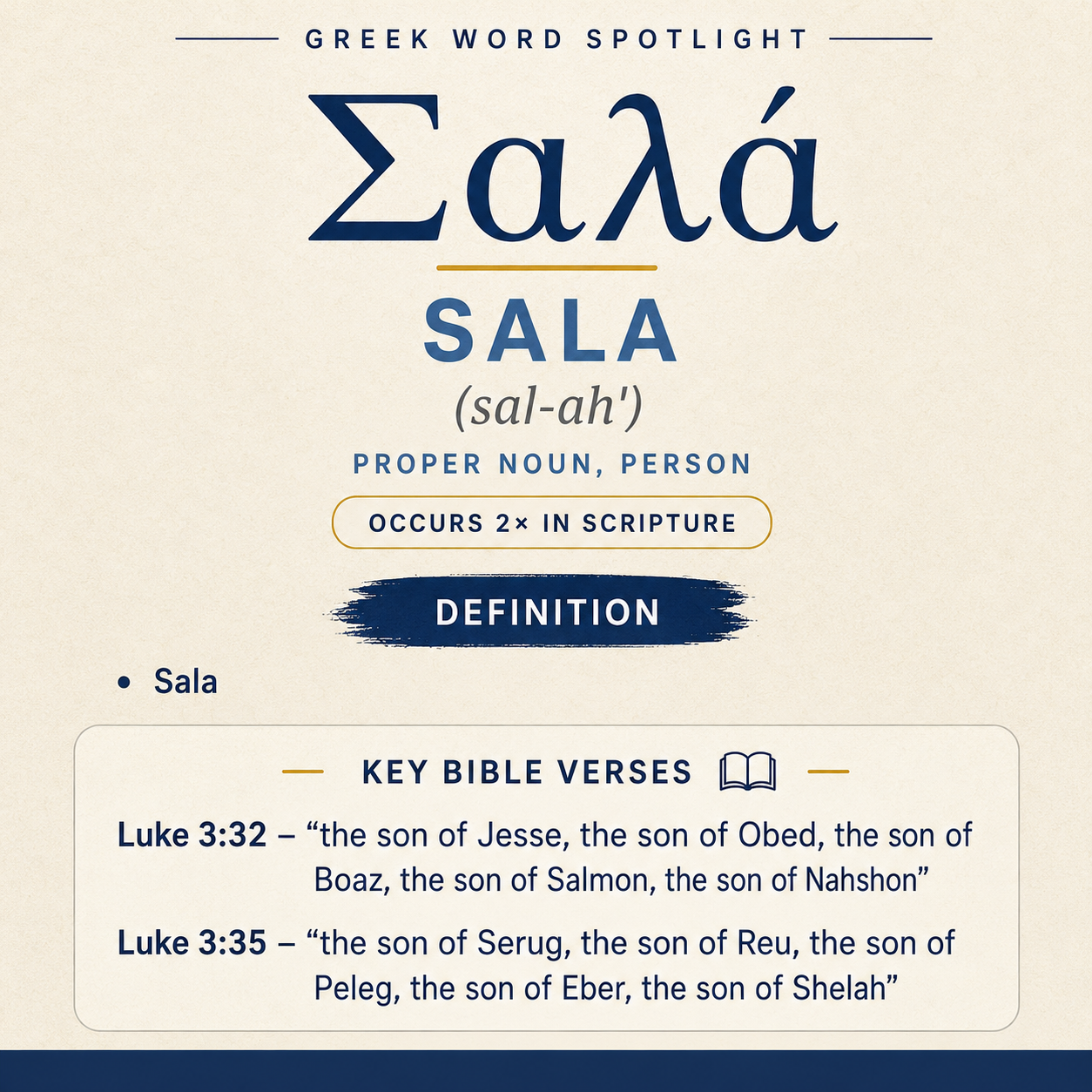
Σαλά (Sala) is the name “Sala,” appearing twice in Luke’s genealogy (Luke 3:32; 3:35).
Genealogy Context
In Luke 3:32 it appears in the genealogy line with Jesse, Obed, Boaz, Salmon, and Nahshon; in Luke 3:35 it appears with Serug, Reu, Peleg, Eber, and Shelah.
Learn More →Σαλά means “Sala,” a personal name appearing in Luke’s genealogy. It occurs within two genealogical sequences where Luke traces lines of descent by repeatedly naming “the son of” one ancestor after another.
Occurrences
Luke 3:32 — “the son of Jesse, the son of Obed, the son of Boaz, the son of Salmon, the son of Nahshon,”
Within this run of names, Σαλά appears as part of a tightly patterned chain of ancestry. The verse presents a sequence of fathers and sons—“the son of Jesse … the son of Nahshon”—with each name serving as a link that connects the next generation to the previous one. In this kind of list, the force of a name like Σαλά is not descriptive but identificatory: it functions to mark a specific person as one node in the lineage being narrated. The style of the sentence also matters: the repeated phrasing “the son of” places every name in the same grammatical role, so Σαλά contributes to the continuity and rhythm of the genealogy, helping Luke maintain the uninterrupted line of descent through which the genealogical claim is expressed.
Because this list is not a story scene with actions and dialogue, the name’s contribution is structural. It anchors a segment of the genealogy between adjacent ancestors, and it does so in a way that implies a relationship of succession. The list’s form makes each person’s identity meaningful chiefly in relation to those immediately around him: a father named in order to identify a son, and a son named in order to continue the chain. Thus Σαλά participates in the genealogy’s cumulative effect—each name is a small, precise step that advances the line from one well-defined point to the next.
Luke 3:35 — “the son of Serug, the son of Reu, the son of Peleg, the son of Eber, the son of Shelah,”
Here Σαλά stands in another stretch of the same kind of ancestry formula. The verse again consists of successive clauses that identify one person by naming his father: “the son of Serug … the son of Shelah.” The name Σαλά, placed within this sequence, functions as a genealogical identifier that ties one generation to another. The list is doing careful work: by advancing through named ancestors, it asserts an ordered progression rather than a vague family connection. In this setting, Σαλά is not presented for its own narrative interest but for its role in the chain that the genealogy is building.
The immediate context in Luke 3:35 also shows how the genealogy moves through distinct clusters of names. Even without additional description, the pattern itself suggests deliberate selection and arrangement. Σαλά contributes to that arrangement by occupying a fixed point between the surrounding names, so that the line can be traced step by step. The repeated “the son of” construction makes the relationship explicit each time, preventing the reader from treating the names as a mere catalogue. In that sense, Σαλά serves the genealogy’s clarity: it helps make the descent legible as a sequence of relationships.

Sense and Usage
As a personal name, Σαλά functions in Luke as a marker of identity within a lineage. In both occurrences, the name appears inside a stylized formula that is concerned with descent: the name is used to connect individuals through father-to-son relationships stated in a uniform way. This means the practical “sense” of Σαλά in these passages is carried by how genealogies work: the name stands for an individual who is significant because of where he stands in the chain.
Because Luke presents the genealogy as a sequence of “the son of X, the son of Y,” the name’s communicative value is relational. The reader is not asked to learn about Σαλά’s actions, speech, or character; instead, the name’s role is to secure continuity between adjacent links. In a genealogy, a name can be indispensable even when it is not elaborated: it provides the necessary specificity for tracing descent, and it ensures that the line proceeds through identifiable persons rather than through generalized categories. Σαλά therefore operates as a precise reference point—one that enables the line to be stated at all.
The repeated pattern also gives the name a kind of weight through accumulation. Each ancestor named in the list adds another unit of continuity, and the regularity of the phrasing treats each as an essential element in the structure. In that framework, Σαλά is not emphasized above the others, yet it is not incidental: removing any one link would alter the stated chain. Luke’s technique turns the genealogy into a carefully linked series in which each named individual matters by contributing to the integrity of the whole.
Finally, these two placements show Σαλά functioning within more than one segment of the genealogy. Luke 3:32 situates the line among a set of names that continue the succession, while Luke 3:35 places it among a different run of ancestors. In both, Σαλά has the same lexical role: a personal name used to articulate descent. The consistency of this usage underscores that the word’s contribution is stable across contexts—serving the genealogy’s purpose of tracing a line through named individuals.
Genealogical Imagery
Although a genealogy is not a narrative scene, it carries its own kind of imagery: a line that moves through time by naming one ancestor after another. In Luke 3:32 and 3:35, Σαλά participates in that forward motion by standing as one of the points through which the line passes. The repeated “the son of” phrasing gives the reader an ordered progression—each name a step—so that the effect is of a continuous chain of descent expressed through the simple act of naming.
Sources: Lexical data from Strong’s Exhaustive Concordance and the Translators Brief Lexicon of Extended Strongs for Greek (STEPBible, CC BY). Occurrence data from the Translators Amalgamated Greek New Testament (STEPBible, CC BY). Scripture quotations from the World English Bible (public domain).