Exploring the Meaning of Rhiza in Greek
ῥίζα (Rhiza) means “root” and appears 17 times in Scripture, including Matthew 3:10; 13:6,21; Mark 4:6,17; 11:20; Luke 3:9; 8:13.
Core Meaning
ῥίζα means “root.” In the cited passages, it refers to a plant or tree’s root, including “the root of the trees.”
Learn More →Gospel Occurrences
It appears in Matthew, Mark, and Luke, including Matthew 3:10; 13:6,21; Mark 4:6,17; 11:20; Luke 3:9; 8:13. These contexts include teaching about trees, fruit, and withering.
Learn More →Rootless Withering
In Matthew 13:6,21; Mark 4:6,17; and Luke 8:13, lack of “root” is linked with withering or short-lived endurance. Mark 11:20 describes a fig tree withered away “from the roots.”
Learn More →ῥίζα names a “root,” the underground or foundational part of a plant, and it is used for both literal vegetation and extended tree-and-plant imagery. In the passages gathered here it appears in preaching about judgment, in Jesus’ parables about receptivity to the word, in an enacted sign involving a fig tree, and in Paul’s olive-tree argument and citation about “the root of Jesse.”

Occurrences
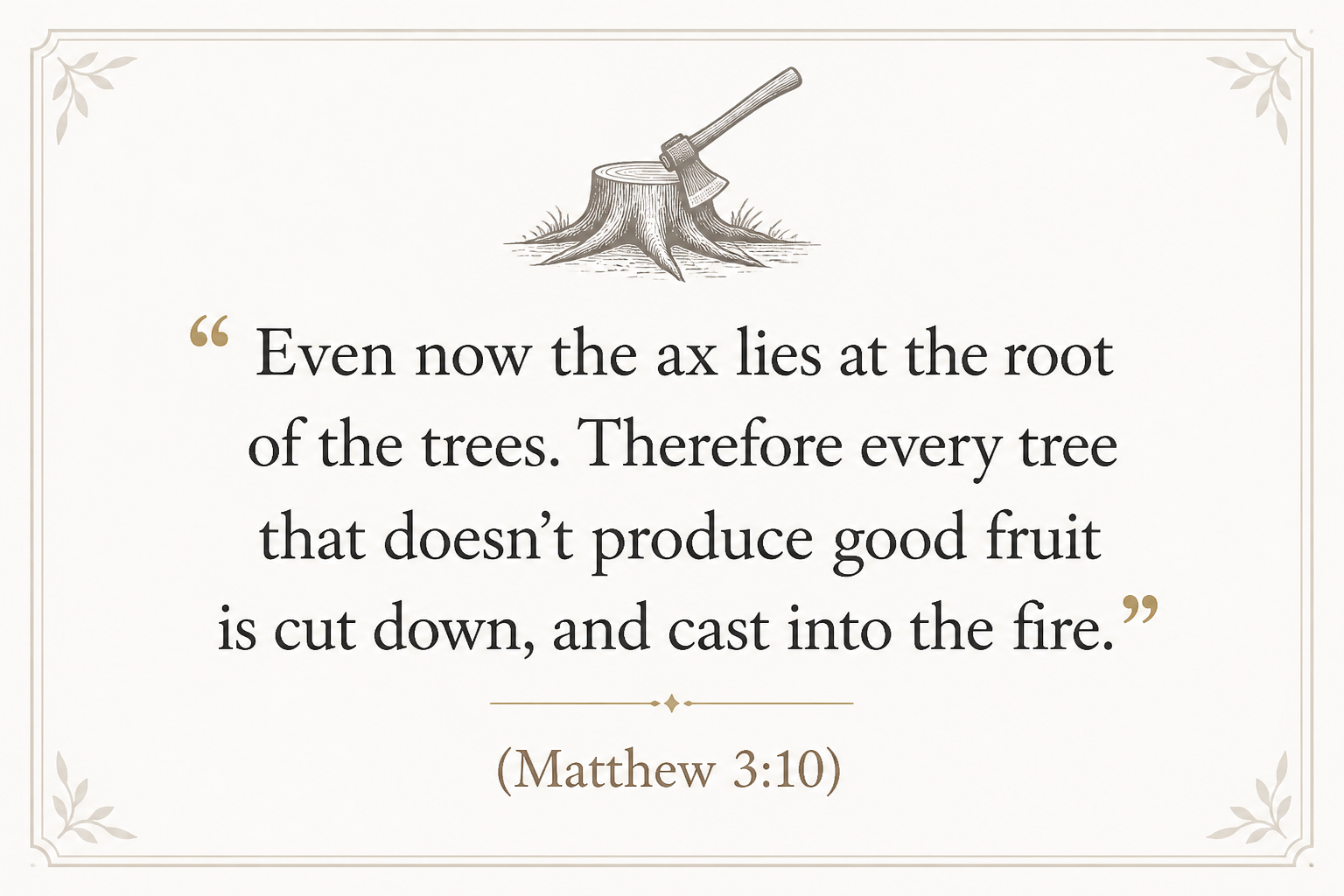
“Even now the ax lies at the root of the trees. Therefore every tree that doesn’t produce good fruit is cut down, and cast into the fire.” (Matthew 3:10)
Here ῥίζα locates the ax at the tree’s base, the place that decides the tree’s fate. The image is not pruning but removal: when the ax is set “at the root,” the whole tree is threatened, and the consequence named is being “cut down, and cast into the fire.” The “root” therefore marks the decisive point of judgment against “every tree” lacking “good fruit.”
When the sun had risen, they were scorched. Because they had no root, they withered away. (Matthew 13:6)
In the parable scene, ῥίζα explains why the plants fail under heat. The sun’s rising exposes what is unseen below the surface: “Because they had no root,” their scorched condition ends in “withered away.” The word supplies the causal link between external pressure (sun and heat) and internal inability to endure.
yet he has no root in himself, but endures for a while. When oppression or persecution arises because of the word, immediately he stumbles. (Matthew 13:21)
The parable’s agricultural image is applied to a person: “no root in himself.” ῥίζα now points to an inner anchoring or base within the hearer. The wording “endures for a while” shows temporary persistence, but when “oppression or persecution arises because of the word,” the lack of root explains why he “immediately… stumbles.” Rootlessness is presented as the inner deficiency that makes the response short-lived under hostile conditions.
When the sun had risen, it was scorched; and because it had no root, it withered away. (Mark 4:6)
This retelling matches the earlier parable line closely and keeps ῥίζα tied to plant life: the heat does not merely discomfort the plant; it exposes that it is rootless. The root is the unseen support that would have enabled persistence; its absence makes “scorched” turn into “withered away.”
They have no root in themselves, but are short-lived. When oppression or persecution arises because of the word, immediately they stumble. (Mark 4:17)
Again ῥίζα is internalized: “no root in themselves.” Mark’s phrasing “are short-lived” draws out the time dimension implicit in root imagery—what lacks a root cannot last. When pressure “arises because of the word,” the stumbling is immediate, as though the moment of strain tests what lies (or fails to lie) beneath the surface.
As they passed by in the morning, they saw the fig tree withered away from the roots. (Mark 11:20)
Here ῥίζα appears in a concrete observation: a fig tree is “withered away from the roots.” The phrase traces the withering to the tree’s base, suggesting a thoroughness that begins at the source of the tree’s life and stability. The disciples’ morning sight underscores the completeness of the change: not merely leaves affected, but the condition reaches “from the roots.”
Even now the ax also lies at the root of the trees. Every tree therefore that doesn’t produce good fruit is cut down, and thrown into the fire.” (Luke 3:9)
Luke’s wording parallels the earlier preaching image: the ax is already positioned “at the root of the trees.” ῥίζα again marks the point where cutting decides the entire tree’s future. The result is stated as a general principle—“Every tree therefore” without good fruit is removed and destroyed—so the “root” becomes the decisive location where fruitlessness meets judgment.
Those on the rock are they who, when they hear, receive the word with joy; but these have no root, who believe for a while, then fall away in time of temptation. (Luke 8:13)
This interpretation brings ῥίζα into the realm of hearing and response: some “receive the word with joy,” yet “have no root.” The root’s lack explains two time markers: “believe for a while” and then “fall away in time of temptation.” The “rock” setting evokes shallowness, and ῥίζα names the missing depth that would have sustained belief when temptation arrives.
If the first fruit is holy, so is the lump. If the root is holy, so are the branches. (Romans 11:16)
Paul uses ῥίζα within an analogy that pairs origins and outcomes. Just as “first fruit” relates to “lump,” so “root” relates to “branches.” In this sentence the root is treated as determinative for what grows from it: “If the root is holy, so are the branches.” ῥίζα functions as the foundational source from which the condition of the branches is inferred.
But if some of the branches were broken off, and you, being a wild olive, were grafted in among them and became partaker with them of the root and of the richness of the olive tree, (Romans 11:17)
In the grafting image, ῥίζα is something one can “become partaker” of. The “wild olive” grafted in shares “with them” in “the root and… the richness of the olive tree.” Root here is not merely a starting point in time; it is a continuing source of nourishment and shared life in the cultivated tree, a basis for participation among branches.
don’t boast over the branches. But if you boast, it is not you who support the root, but the root supports you. (Romans 11:18)
Paul turns ῥίζα into the key relation of dependence. The warning against boasting is grounded in the direction of support: “it is not you who support the root, but the root supports you.” Root is depicted as bearing and sustaining what is above it; the branches’ existence and standing are derivative, and the root’s supporting role is the reason arrogance is misplaced.
Again, Isaiah says, “There will be the root of Jesse, he who arises to rule over the Gentiles; in him the Gentiles will hope.” (Romans 15:12)
In this citation, ῥίζα appears in the title-like phrase “the root of Jesse.” The wording links that “root” to a person who “arises to rule over the Gentiles,” and the result is that “the Gentiles will hope” in him. Root language here connects rulership and hope to an originating line or source denoted by “Jesse,” and it frames the figure as foundational for Gentile expectation.

Sense and Usage
Across these passages ῥίζα consistently works as the base from which a plant’s life, stability, and future are decided. In the preaching scenes (Matthew 3:10; Luke 3:9), placing an ax at the root communicates imminence and finality: to strike the root is to remove the tree itself, with “good fruit” serving as the public evidence that determines whether the tree stands or is destroyed.
In the parable material (Matthew 13:6, 13:21; Mark 4:6, 4:17; Luke 8:13), the root shifts from botany to a diagnosis of response. The recurring phrases “no root” and “no root in himself/themselves” tie endurance to what is unseen and internal. Sun, oppression, persecution, and temptation are the stressors that reveal whether there is a root. Where ῥίζα is absent, the result is always a brief duration—“endures for a while,” “believe for a while,” “short-lived”—followed by collapse (“withered away,” “stumbles,” “fall away”). Root, by implication of these statements, is what would allow a response to persist when tested.
Mark 11:20 keeps the term literal but uses it narratively: the fig tree’s condition is traced “from the roots,” as though the withering has reached the source, not merely the visible extremities. The phrase treats the roots as the place from which the tree’s ongoing vitality is measured.
Romans 11:16–18 employs ῥίζα as the organizing image for origin, participation, and dependence. The root stands to the branches as foundation to outgrowth: the root’s character is linked to the branches (“If the root is holy, so are the branches”), those brought in by grafting become “partaker… of the root,” and the direction of support is fixed—“the root supports you.” In this argument, ῥίζα is not merely a beginning but a sustaining base that defines the relationship between what is below and what is visible above.
Romans 15:12 uses ῥίζα in a concentrated, identifying phrase, “the root of Jesse,” and connects it to rule and hope among the Gentiles. Even here the term keeps its foundational force: the “root” is the figure from whom something public and far-reaching—governance and hope—extends.
Imagery
ῥίζα carries a persistent below-the-surface imagery in these texts: the root is where a tree can be cut down, where a plant’s survival is decided under sun, and where withering can begin. When applied to people and communities, the same image highlights what cannot be seen at first—what supports endurance, what sustains branches, and what grounds hope—yet becomes evident when time and pressure reveal whether a true root is present.
Sources: Lexical data from Strong’s Exhaustive Concordance and the Translators Brief Lexicon of Extended Strongs for Greek (STEPBible, CC BY). Occurrence data from the Translators Amalgamated Greek New Testament (STEPBible, CC BY). Scripture quotations from the World English Bible (public domain).