Exploring the Meaning of Purgos in Greek
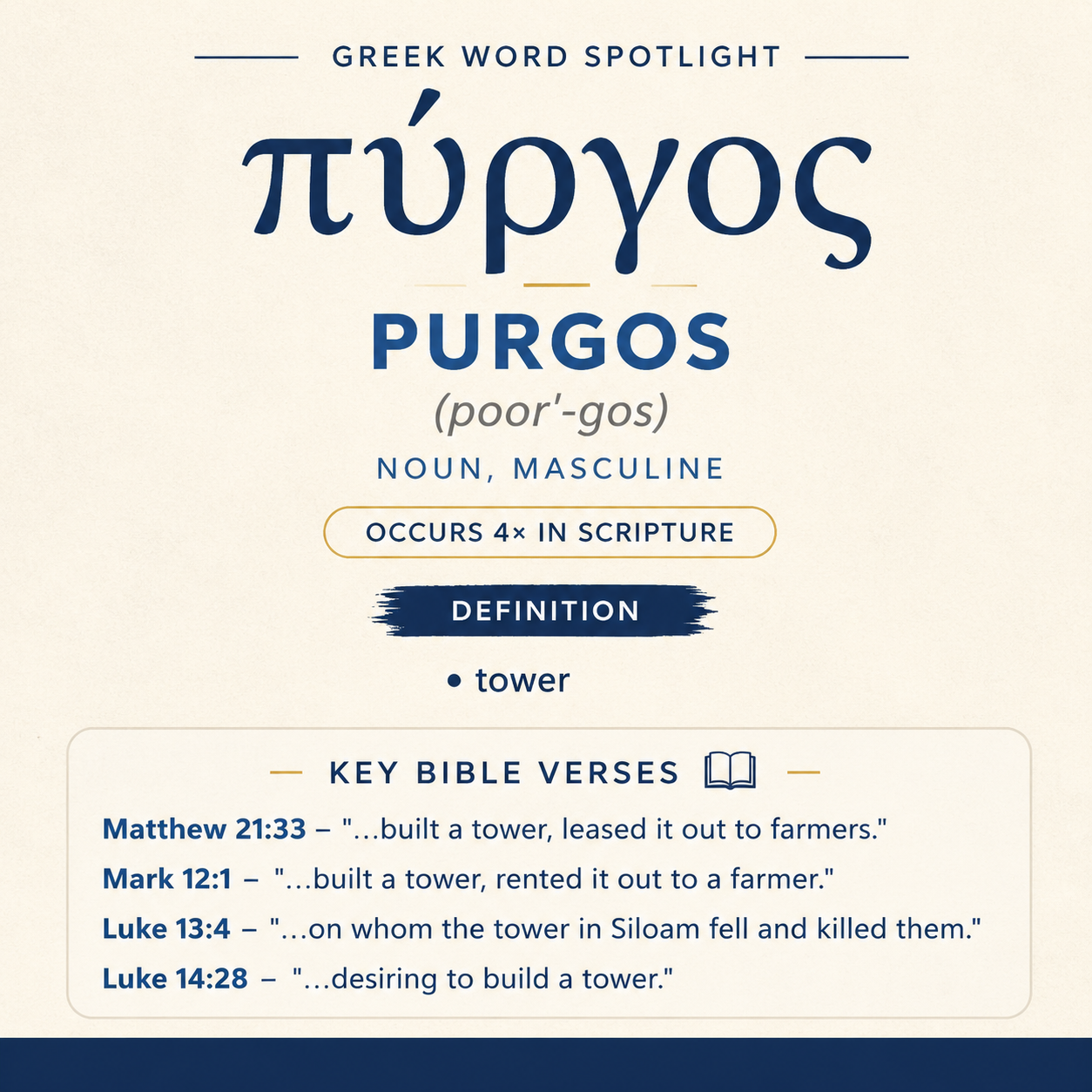
πύργος (Purgos) means “tower” and occurs four times in Scripture: Matthew 21:33, Mark 12:1, Luke 13:4, and Luke 14:28.
Core Meaning
πύργος means “tower.” It appears as a concrete structure in the cited passages.
Learn More →Parable Contexts
In Matthew 21:33 and Mark 12:1, πύργος occurs within parables about a man planting a vineyard. The vineyard is described with protective and functional features, including a tower.
Learn More →Luke References
Luke 13:4 mentions the tower in Siloam that fell and killed eighteen people. Luke 14:28 speaks of someone planning to build a tower and counting the cost first.
Learn More →πύργος denotes a “tower.” In the Gospels it appears in vineyard parables, in a report of a fatal collapse at Siloam, and in a saying about the practical demands of construction.
Occurrences
“Hear another parable. There was a man who was a master of a household, who planted a vineyard, set a hedge about it, dug a wine press in it, built a tower, leased it out to farmers, and went into another country.” (Matthew 21:33)
Here πύργος belongs to a cluster of built features that make the vineyard a developed property: a hedge, a wine press, and a tower. The sequence of actions (“planted… set… dug… built… leased… went”) places the tower among the owner’s deliberate preparations before entrusting the vineyard to farmers. Within the parable’s scene, the tower functions as part of the vineyard’s infrastructure—something constructed in advance that marks the vineyard as organized and equipped, not merely planted and left unattended.
He began to speak to them in parables. “A man planted a vineyard, put a hedge around it, dug a pit for the wine press, built a tower, rented it out to a farmer, and went into another country.” (Mark 12:1)
Mark’s telling closely matches the same vineyard setup, again placing πύργος alongside the hedge and the wine-press excavation (“dug a pit for the wine press”). The tower is presented as an intentional build within the property’s boundaries (“put a hedge around it”), fitting the picture of a vineyard that has been thoughtfully established and then transferred into others’ hands (“rented it out… and went into another country”). In this narrative frame, the tower contributes to the sense of a well-appointed estate: the owner’s investment is not abstract but visible in structures that required planning and labor.
“Or those eighteen, on whom the tower in Siloam fell and killed them; do you think that they were worse offenders than all the men who dwell in Jerusalem?” (Luke 13:4)
In Luke 13:4, πύργος refers to a specific tower associated with Siloam, and the focus shifts from building as preparation to building as a source of sudden disaster. The tower is not a background detail but the direct agent in the event described: it “fell and killed them.” The word therefore carries the weight of a physical structure whose collapse has immediate, lethal consequences. The sentence also fixes the number of victims (“those eighteen”), making the tower’s fall a remembered occurrence with identifiable human cost, and using that incident as the basis for a pointed question addressed to the audience.
“For which of you, desiring to build a tower, doesn’t first sit down and count the cost, to see if he has enough to complete it?” (Luke 14:28)
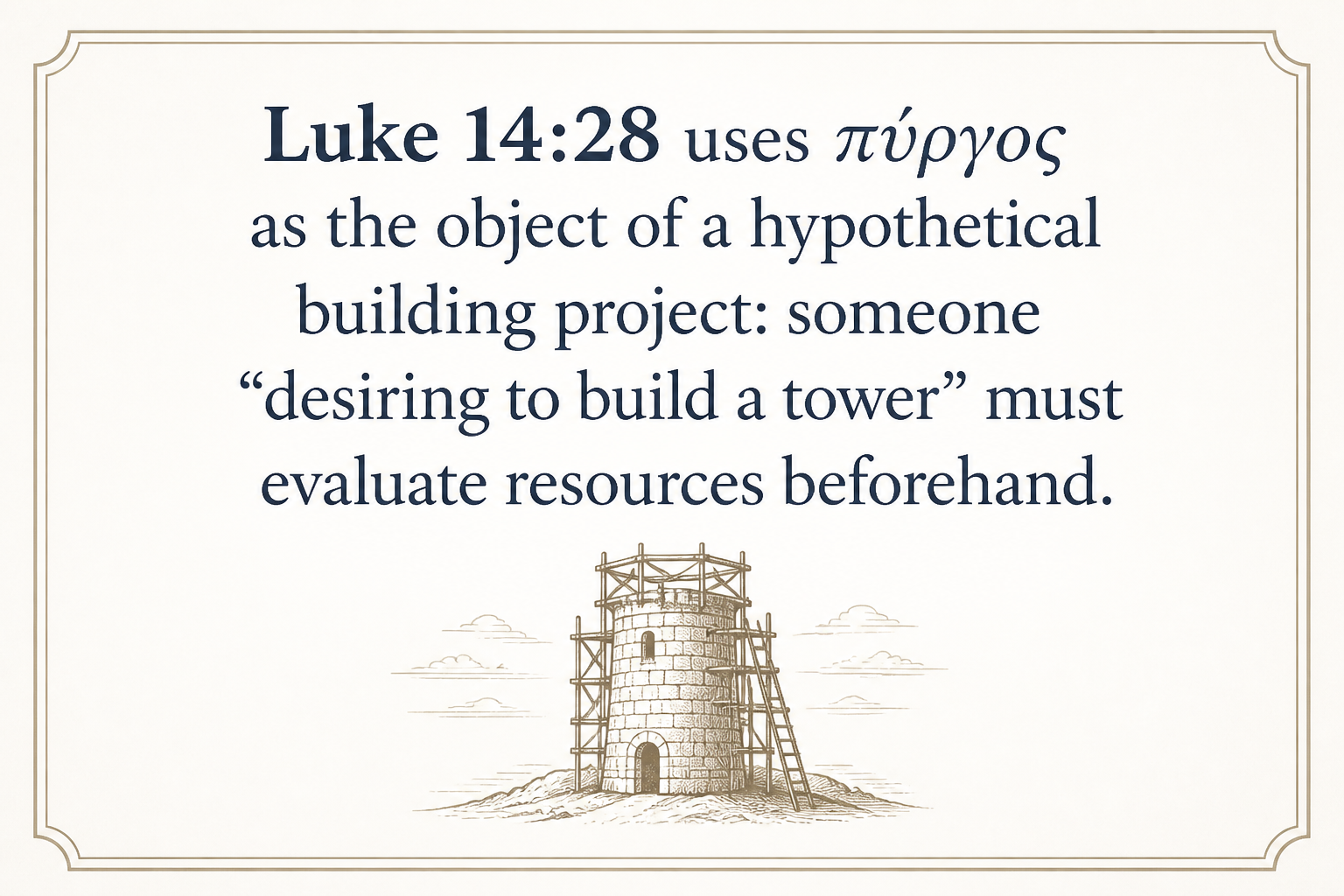
Luke 14:28 uses πύργος as the object of a hypothetical building project: someone “desiring to build a tower” must evaluate resources beforehand. The tower here is a paradigmatic example of a substantial undertaking—something that requires calculation, sufficient means, and follow-through (“count the cost… enough to complete it”). The verb choices (“sit down,” “count”) emphasize deliberation rather than impulse. πύργος thus supports the argument by representing a tangible construction whose incompletion would be evident; it is the kind of structure for which the builder’s capacity (or lack of it) will be publicly demonstrated by whether the project reaches completion.

Sense and Usage
Across these four passages, πύργος consistently names a tower as a concrete, built structure, but it is deployed in different kinds of speech and with different narrative effects.
In Matthew 21:33 and Mark 12:1, the tower appears in a repeated pattern of vineyard development. The tower is one element among several, and its placement in the list is significant: it is something “built,” aligned with the other acts of establishing boundaries and creating productive capacity (the hedge and the wine press). In both versions the tower belongs to the owner’s initial investment before he entrusts the property to others and departs. The vineyard tower thus functions as a marker of forethought and provision within the story world: it is part of what the owner has put in place ahead of time, making the vineyard not only planted but structured.
Luke presents two different uses. In Luke 13:4, the tower is the subject of a tragic memory. A tower is ordinarily associated with stability and permanence, but here the narrative force comes from its failure—its fall. πύργος therefore helps Luke point to the stark fact that even solid-seeming structures can become instruments of death, and that such events provoke interpretation and moral reasoning (“do you think that they were worse offenders…?”). The tower’s collapse is not described in technical detail; the emphasis lies on the outcome (“fell and killed them”) and the interpretive question it raises.
In Luke 14:28, πύργος becomes a teaching illustration about intentional planning. The tower is not yet built; it is desired and contemplated, and the speaker draws attention to the preliminary step of reckoning cost. The tower serves well for this kind of example because it is intrinsically a visible project: one can see whether it is “complete.” The word thus participates in a practical scenario in which the builder’s judgment is tested by the requirement of completion. Within the line of reasoning, πύργος represents a venture substantial enough to demand prior calculation and sufficient resources.
Considered together, these uses show πύργος functioning in three closely related ways while keeping the same referent. (1) As part of an equipped agricultural estate, it is a component of preparedness and establishment (Matthew 21:33; Mark 12:1). (2) As a civic or local structure, it can become the locus of unexpected catastrophe (Luke 13:4). (3) As a major construction goal, it exemplifies the kind of plan that requires sober assessment before beginning (Luke 14:28). The common thread is the tower’s physicality: it is something built, present in the landscape, and capable of shaping outcomes—whether by contributing to an owner’s preparations, by collapsing upon victims, or by demanding a builder’s resources to bring it to completion.
Imagery
In these passages, πύργος evokes the public visibility of what is built. In the vineyard parables (Matthew 21:33; Mark 12:1) the tower stands among features that define the property and signal the owner’s purposeful work before his departure. In Luke 13:4 the same kind of structure becomes memorable precisely because it fell in a way that could not be ignored, leaving “those eighteen” dead. In Luke 14:28 the tower’s visibility is assumed in the insistence on counting the cost to “complete it,” since a tower begun but unfinished would stand as an exposed, ongoing witness to inadequate preparation.
Sources: Lexical data from Strong’s Exhaustive Concordance and the Translators Brief Lexicon of Extended Strongs for Greek (STEPBible, CC BY). Occurrence data from the Translators Amalgamated Greek New Testament (STEPBible, CC BY). Scripture quotations from the World English Bible (public domain).