Exploring the Meaning of Prospegnumi in Greek
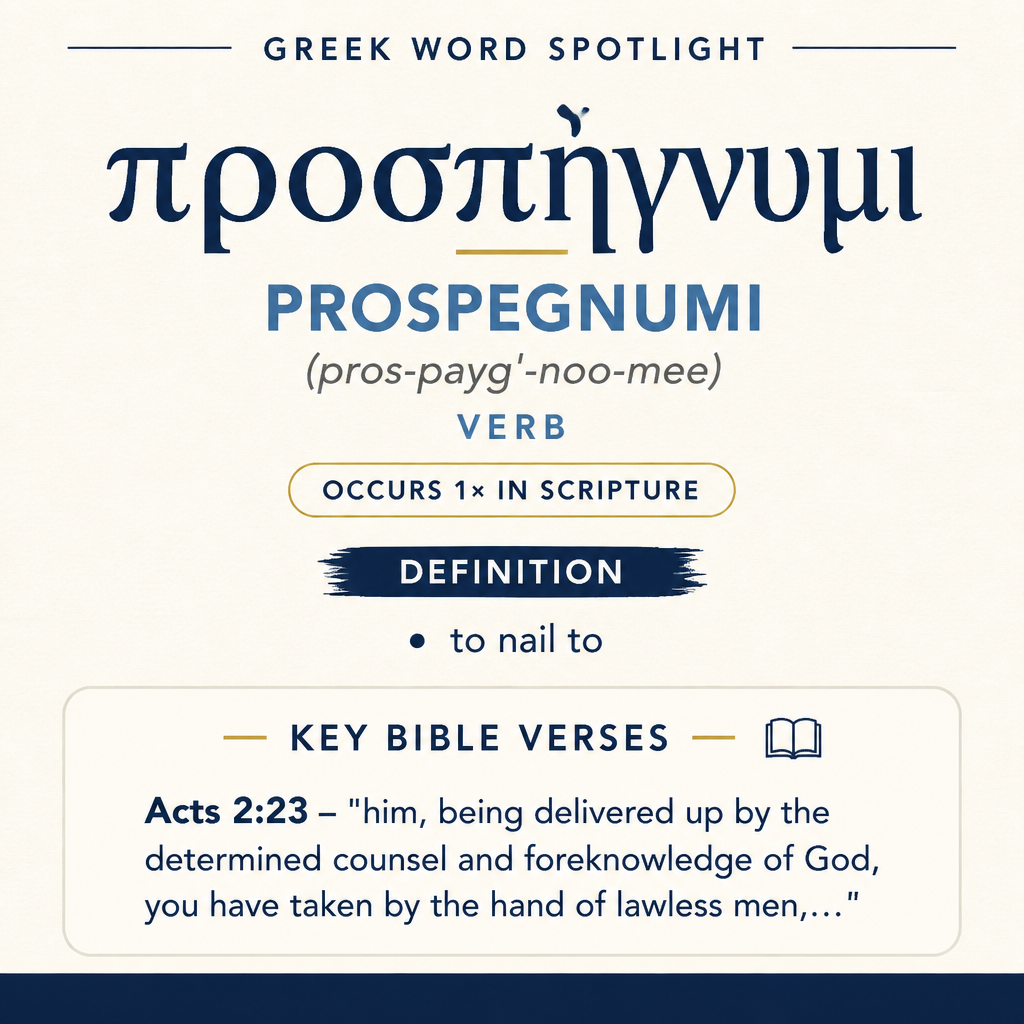
προσπήγνυμι means “to nail to” and appears once in Scripture, in Acts 2:23.
Scripture Occurrence
This word occurs 1 time in Scripture. Its occurrence is in Acts 2:23.
Learn More →Acts 2:23 Context
In Acts 2:23, it appears in the statement addressed to “you.” The verse includes “him, being delivered up by the determined counsel and foreknowledge of God.”
Learn More →προσπήγνυμι means “to nail to” and appears in the apostolic proclamation of Jesus’ death in Acts 2:23. In that setting it gives a specific, concrete description of what was done to him in the act of crucifixion.
Root and Related Words
προσπήγνυμι (Prospegnumi) is formed with πρός (pros), “to/with” (Strong’s G4314), and πήγνυμι (pegnymi), “to set up” (Strong’s G4078). The combination expresses the action of fastening in relation to something—language well suited to an execution carried out by attaching a person to an instrument of death.

Occurrences
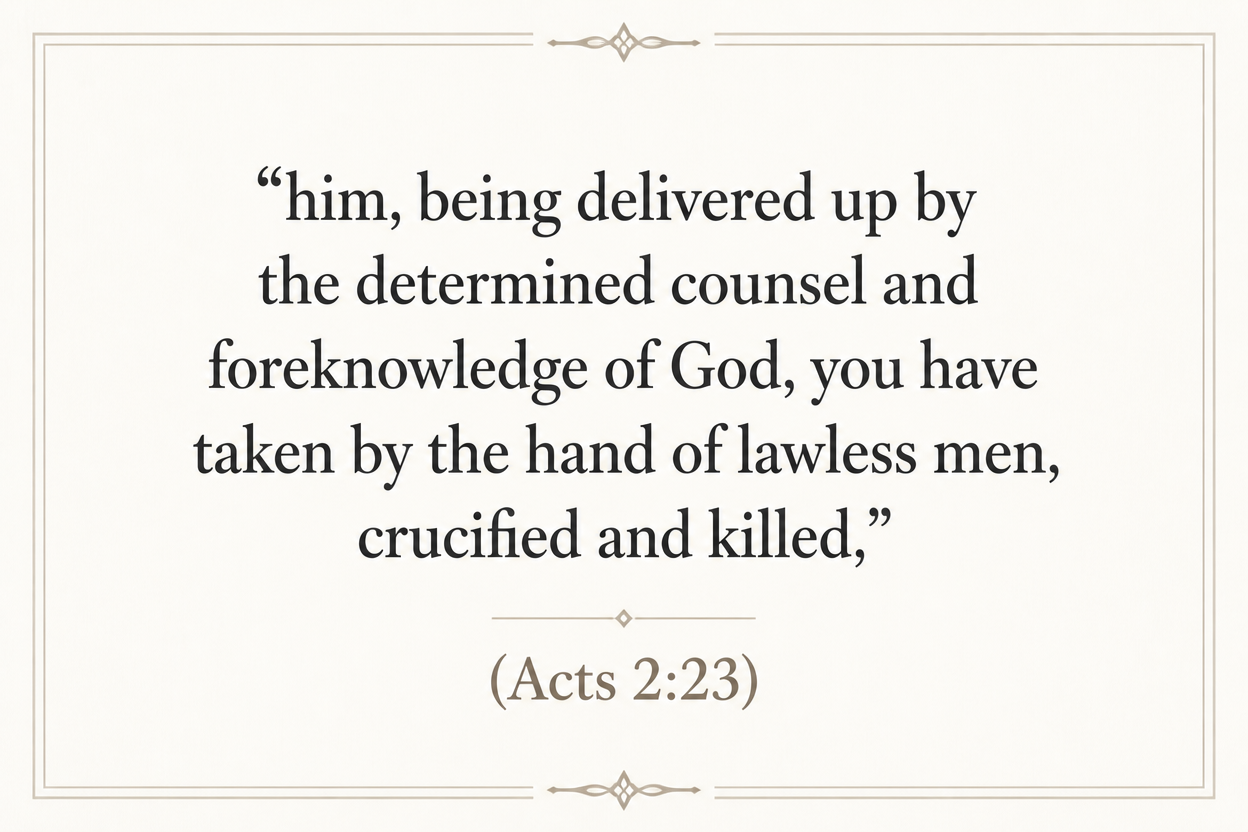
“him, being delivered up by the determined counsel and foreknowledge of God, you have taken by the hand of lawless men, crucified and killed;” (Acts 2:23)
In Acts 2:23, the clause moves in a tight sequence: Jesus is “delivered up,” then “taken,” then “crucified,” and finally “killed.” Within that chain, προσπήγνυμι supplies the tactile, physical act implied by “crucified”—the fastening that makes crucifixion an enacted reality rather than only a judicial verdict. The speaker addresses his hearers directly (“you have taken”), yet he frames the entire event within God’s “determined counsel and foreknowledge,” holding together divine purpose and human action in the same sentence. Against that theological backdrop, the verb’s concrete force keeps the claim anchored in what was done with hands: Jesus was handed over, seized “by the hand of lawless men,” and subjected to a method of death that involves being fixed in place.
The wording also highlights agency and instrumentality. The hearers are implicated (“you have taken”), but the deed is carried out “by the hand of lawless men.” In that arrangement, προσπήγνυμι fits the description of an act performed through intermediaries: it is the sort of action that can be executed by those who physically handle the victim. The verse ends with “killed,” but the verb’s contribution is to name the means by which the killing took place—killing that happens through crucifixion, with its characteristic act of nailing to.
Sense and Usage
The sense “to nail to” is intrinsically specific: it points not merely to causing death but to fastening a person to something as part of the lethal process. Acts 2:23 places that act within a layered account that includes (1) divine intentionality (“determined counsel and foreknowledge of God”), (2) judicial and social transfer (“delivered up”), (3) human seizure (“you have taken”), and (4) execution (“crucified and killed”). In that flow, προσπήγνυμι belongs to the execution layer and functions as the concrete mechanism that makes “crucified” more than a label. Its force is practical and bodily; it evokes an act that restrains, exposes, and fixes the victim in place, and it does so without shifting the verse’s focus away from responsibility and purpose.
The combination with πρός (pros), “to/with,” also suits the spatial logic of the action: nailing is not an isolated motion but a fastening to something, attaching one thing in relation to another. That directional or relational nuance coheres with the execution imagery implied by “crucified,” where the victim is not only harmed but affixed. At the same time, Acts 2:23 uses the verb within accusatory address (“you have taken”), making the concreteness of the action part of the moral weight of the charge: the listeners are not confronted with an abstract wrong but with involvement in a deed carried out through physical acts by human hands.
Because the verb occurs here within a proclamation, its specificity also serves rhetorical clarity. The statement does not merely announce that Jesus died; it names a manner of death that involves deliberate fastening. The verse then pairs that act with the final outcome (“killed”), so that the nailing is understood as a means leading to the end. Thus, in this passage, προσπήγνυμι functions as the vivid, material component of the crucifixion claim, binding the theological framing of God’s counsel to a real, executed action within human history.
Imagery
Acts 2:23 joins the language of counsel and foreknowledge with the language of hands and execution. In that mix, προσπήγνυμι carries stark imagery: a person fastened to something as part of being “crucified and killed.” The word’s concreteness keeps the proclamation from drifting into abstraction; it insists that what is being spoken about is an acted event—done “by the hand of lawless men”—and that the death named at the end of the verse was reached through an intentional, bodily fastening.
Sources: Lexical data from Strong’s Exhaustive Concordance and the Translators Brief Lexicon of Extended Strongs for Greek (STEPBible, CC BY). Occurrence data from the Translators Amalgamated Greek New Testament (STEPBible, CC BY). Scripture quotations from the World English Bible (public domain).