Exploring the Meaning of Proia in Greek
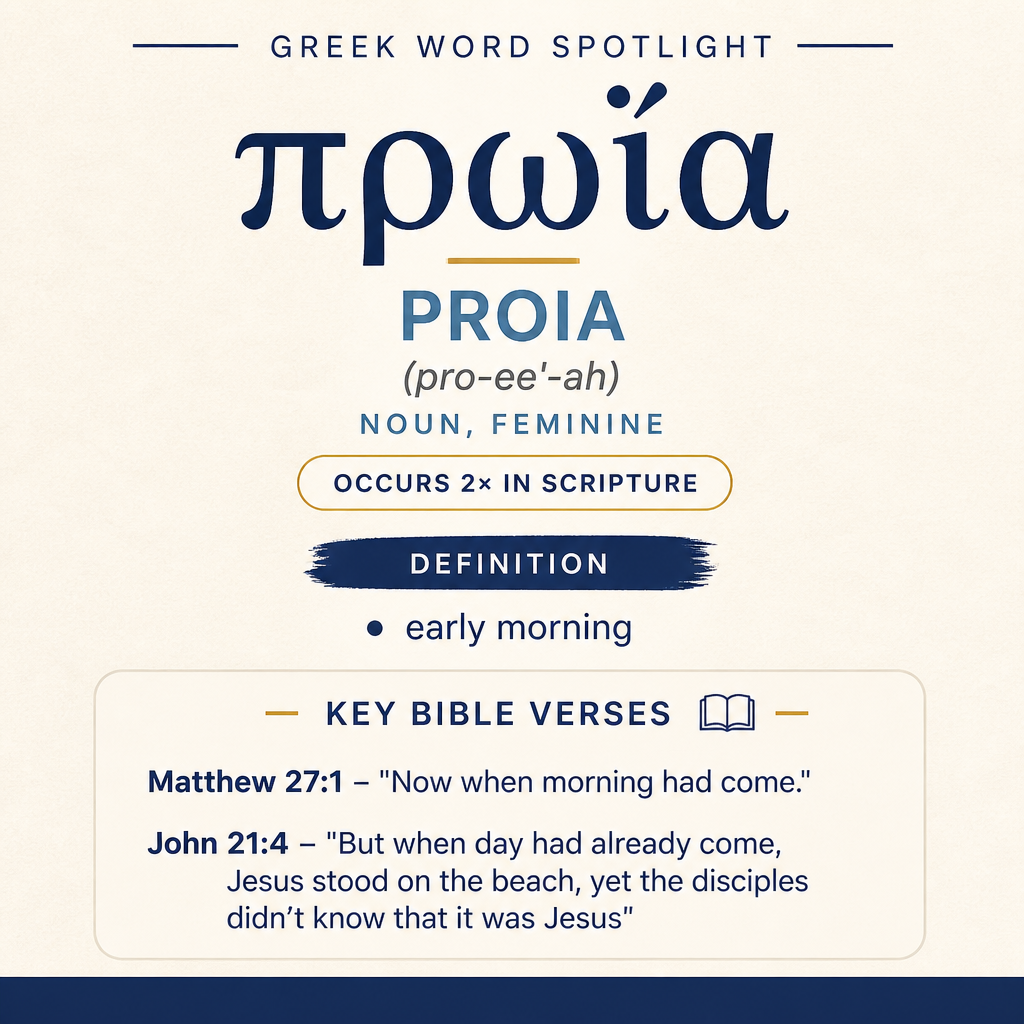
πρωΐα means “early morning” and appears in Matthew 27:1 and John 21:4.
Context Snapshots
In Matthew 27:1 it marks the time when morning had come. In John 21:4 it marks when day had already come.
Learn More →πρωΐα means “early morning,” and it appears in two New Testament narrative moments: the formal decision against Jesus and the quiet shoreline scene after a night of fishing. In both, the word marks the day’s first light as a turning point in what follows.
Root and Related Words
πρωΐα (Proia) derives from πρωΐ (proi), “early” (πρωΐ).
Occurrences
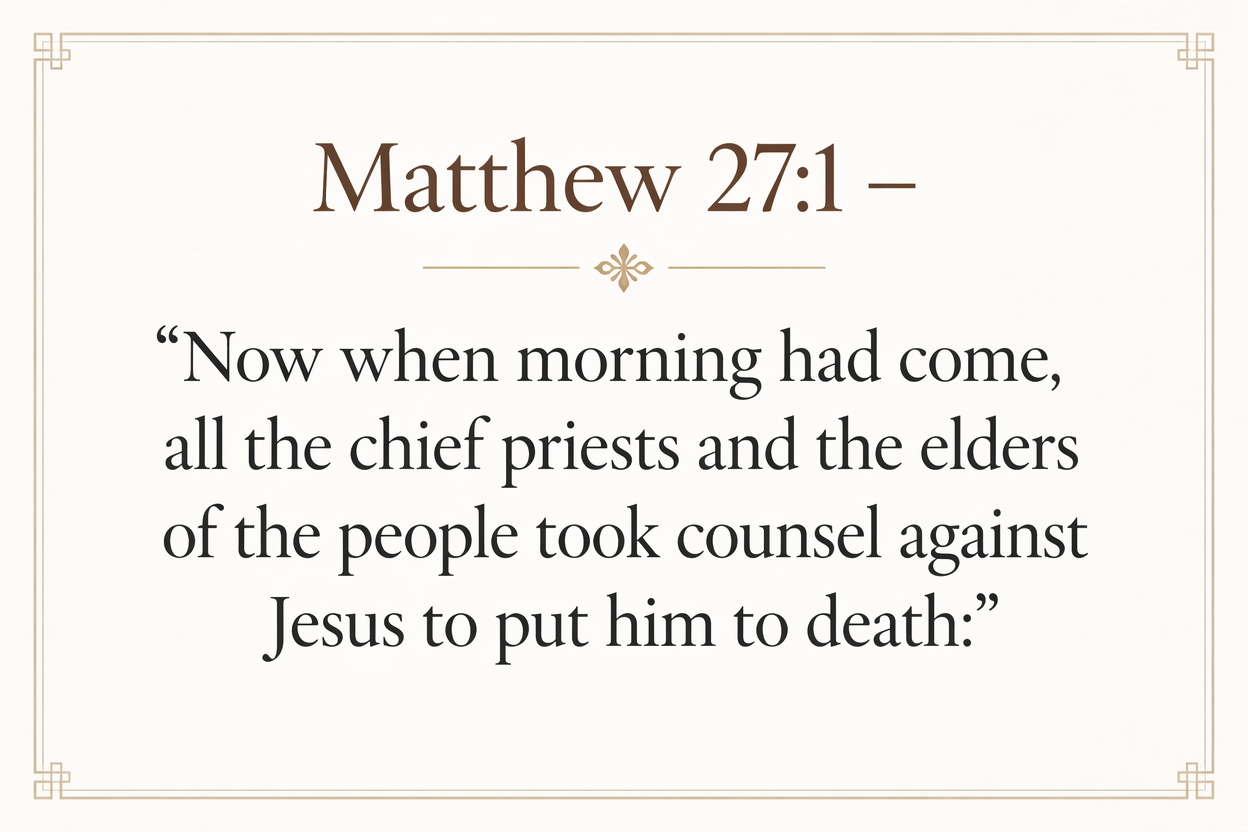
Matthew 27:1 — “Now when morning had come, all the chief priests and the elders of the people took counsel against Jesus to put him to death:”
Here πρωΐα sets the time at which a public, coordinated action takes shape: “all the chief priests and the elders of the people took counsel.” The narrative weight falls on the movement from night to early morning as the moment when deliberation becomes formalized—counsel is taken, and the purpose is explicit: “to put him to death.” In this sentence, “morning” is not a neutral time-stamp; it frames the decision as something made in the earliest part of the day, with a sense of immediacy and resolve. The gathering is portrayed as complete (“all”), and the morning setting underlines an official start to the day’s proceedings: the day begins with a concluded plan against Jesus rather than with hesitation. πρωΐα thus contributes a temporal boundary that signals transition: the arrival of early morning coincides with the leadership’s unified counsel and the initiation of the events that will follow from that counsel.
John 21:4 — “But when day had already come, Jesus stood on the beach, yet the disciples didn’t know that it was Jesus.”
In John 21:4 πρωΐα is tied to the arrival of daylight after a period implied by the contrast: “when day had already come.” The word locates the scene at the early morning edge of daybreak, when visibility is returning and the shore becomes discernible. Against that backdrop, the verse presents two simultaneous realities: Jesus is present (“Jesus stood on the beach”), and recognition is absent (“yet the disciples didn’t know that it was Jesus”). The early-morning setting supports the scene’s tension: the disciples are close enough to see a figure on the beach, yet in the first light they do not identify him. πρωΐα therefore helps shape the atmosphere of the episode—day has begun, but clarity has not fully arrived, at least not in the disciples’ perception. It functions as a narrative hinge from the night’s effort to the morning encounter, marking the moment when the shoreline meeting becomes possible and when the unfolding revelation begins from a place of unrecognized presence.
Sense and Usage
Across these two passages, πρωΐα denotes early morning as the threshold time when decisive developments occur. In Matthew, early morning is associated with intentional human counsel: a collective body gathers and agrees on a purpose (“took counsel… to put him to death”). The word places this decision at the beginning of the day, emphasizing how quickly and deliberately the plan is set into motion once morning arrives. The term thereby frames the act as an opening-day action—what the leaders do “when morning had come” is not incidental scheduling, but the launching point for a coordinated course.
In John, early morning works differently: it frames a scene of presence and misrecognition. “When day had already come” indicates that the time of day is changing, and with it the conditions of perception. Jesus’ stance “on the beach” belongs to that early-morning setting; the disciples’ lack of recognition also belongs to it. The word’s contribution is to locate the moment in the day when light returns but understanding is still incomplete. Early morning becomes a setting in which the world becomes visible again while identity remains veiled to the disciples.
Taken together, these occurrences show πρωΐα as a narrative marker that often carries more than chronology. Early morning is the time when a night ends and a new phase begins. In one scene, the beginning of the day corresponds to a hardened resolve expressed through counsel; in the other, the beginning of the day corresponds to the first moment of contact with Jesus on the shore, even while recognition lags behind sight. The word thus helps the reader track not only when events happen, but how the first part of the day can function as a pivot: decisions are enacted, meetings occur, and the story moves forward from the edge of dawn.
Imagery
The imagery of πρωΐα in these verses is the moment the world shifts from darkness toward light. Matthew’s early morning is crowded with purposeful motion—leaders assembled, counsel taken, a lethal aim declared—so the day’s first hours are colored by urgency and intent. John’s early morning is quiet and spare—shoreline, standing figure, unrecognized presence—so the first light is paired with stillness and a gradual movement toward clarity. In both, πρωΐα evokes the day’s beginning as a time when hidden things begin to surface: plans become explicit, and a person becomes visible even before he is known.
Sources: Lexical data from Strong’s Exhaustive Concordance and the Translators Brief Lexicon of Extended Strongs for Greek (STEPBible, CC BY). Occurrence data from the Translators Amalgamated Greek New Testament (STEPBible, CC BY). Scripture quotations from the World English Bible (public domain).