Exploring the Meaning of Prophetikos in Greek
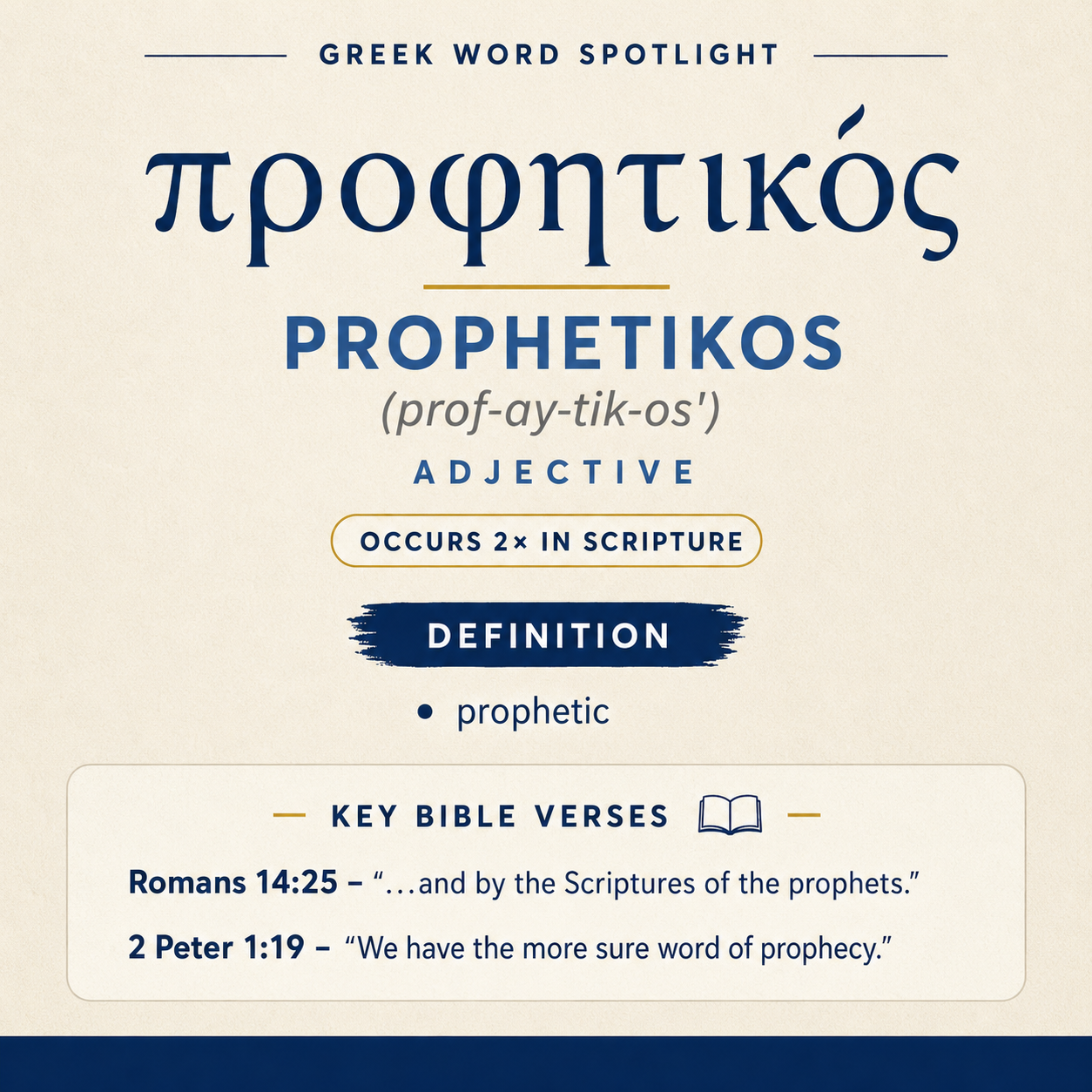
προφητικός means “prophetic” and appears twice in Scripture: Romans 14:25 and 2 Peter 1:19.
Scripture Occurrences
It occurs 2 times in Scripture. The references are Romans 14:25 and 2 Peter 1:19.
Learn More →Context Snapshot
Romans 14:25 mentions “the Scriptures of the prophets.” 2 Peter 1:19 speaks of “the more sure word of prophecy.”
Learn More →προφητικός means “prophetic” and appears in two New Testament contexts: Paul’s closing description of the gospel’s present revelation, and Peter’s exhortation to heed the word of prophecy as light in darkness. In both settings it functions as an adjective that marks something as belonging to prophecy and carrying prophetic character.
Root and Related Words
προφητικός is derived from the noun προφήτης (prophetes), “prophet” (Strong’s G4396). The adjective-forming shape signals an attributive relationship: what it modifies is characterized in relation to the prophet/prophets.

Occurrences
“but now is revealed, and by the Scriptures of the prophets, according to the commandment of the eternal God, is made known for obedience of faith to all the nations;” (Romans 14:25)
In this closing sentence Paul piles up phrases that explain how what “now is revealed” has come into the open and to what end it is being made known. The prophetic element comes through the phrase “the Scriptures of the prophets,” which frames the written witness as belonging to the sphere of prophets and carrying their stamp. Within the sentence, that prophetic attribution sits alongside two other anchors: it is “according to the commandment of the eternal God,” and it is “made known for obedience of faith to all the nations.” The adjective thus helps define the Scriptures’ role in disclosure: revelation is not presented as detached information but as something mediated “by” writings identified with prophets, functioning as a vehicle through which the revealed message is published widely and aims at “obedience of faith.” The prophetic quality is therefore bound up with public making-known and with the authority implied by God’s command.

“We have the more sure word of prophecy; and you do well that you heed it, as to a lamp shining in a dark place, until the day dawns, and the morning star arises in your hearts:” (2 Peter 1:19)
Peter speaks of “the more sure word of prophecy” and immediately moves from description to exhortation: “you do well that you heed it.” Here the adjective marks “word” as prophecy-related—speech that stands in the category of prophecy—and the sentence then paints the effect of attending to it. The prophetic word is compared to “a lamp shining in a dark place,” an image that gives the adjective experiential weight: what is prophetic is not merely a label but something that functions as illumination amid obscurity. The time frame “until the day dawns, and the morning star arises in your hearts” sets a horizon for this heeding. The prophetic word is portrayed as steady light for a dark interval, guiding attention and endurance until a fuller brightness arrives internally (“in your hearts”). The adjective, in this setting, draws prophecy into the realm of guidance and vigilance, defining the “word” as a reliable source of light-worthy instruction.
Sense and Usage
Across these two passages, “prophetic” attaches to different kinds of referents—Scriptures in Paul, and a word in Peter—yet in each case the adjective locates the referent within the prophetic domain and emphasizes its usefulness in God’s disclosure. In Romans, the prophetic character of the Scriptures is linked to the present unveiling (“but now is revealed”) and to worldwide communication (“made known…to all the nations”). The prophetic quality therefore stands close to the ideas of authorization (“according to the commandment of the eternal God”) and purposeful proclamation (“for obedience of faith”). The adjective does not operate as a decorative religious tag; it belongs to a chain of phrases that explain how revelation has been mediated and why it is being broadcast.
In 2 Peter, the prophetic character of the word is highlighted by its reliability (“the more sure”) and by the response it calls for (“heed it”). The lamp metaphor anchors the adjective in lived conditions: prophetic speech is set over against a “dark place,” where light is needed not simply for beauty but for direction and safety. The temporal clause “until the day dawns” shows that the prophetic word serves as an interim yet vital illumination; it is to be attended to persistently until a climactic change described as dawn and the rising of the morning star “in your hearts.” In this way, “prophetic” is associated with clarity granted in darkness and with a forward-looking orientation.
Taken together, these occurrences show “prophetic” functioning as a bridge between past witness and present guidance. In Paul’s sentence, the prophetic Scriptures participate in the making known of what is revealed; in Peter’s sentence, the prophetic word provides sure light to be heeded in anticipation of dawn. The adjective thus marks prophecy as something that speaks into the present—either by written witness that furthers universal knowledge and obedience, or by a sure word that shines until inner daybreak.
Imagery
Only one of the passages turns explicitly to image, but it shapes how “prophetic” feels in use. The prophetic word is likened to “a lamp shining in a dark place” (2 Peter 1:19), emphasizing brightness that is both concentrated and sufficient for the moment. This lamp imagery complements the other occurrence, where prophetic Scriptures are instruments by which what “now is revealed” becomes “made known…to all the nations” (Romans 14:25): prophecy, whether as Scriptures or as word, is portrayed as a means of bringing what is hidden into visibility.
Sources: Lexical data from Strong’s Exhaustive Concordance and the Translators Brief Lexicon of Extended Strongs for Greek (STEPBible, CC BY). Occurrence data from the Translators Amalgamated Greek New Testament (STEPBible, CC BY). Scripture quotations from the World English Bible (public domain).