
Exploring the Meaning of Priska in Greek
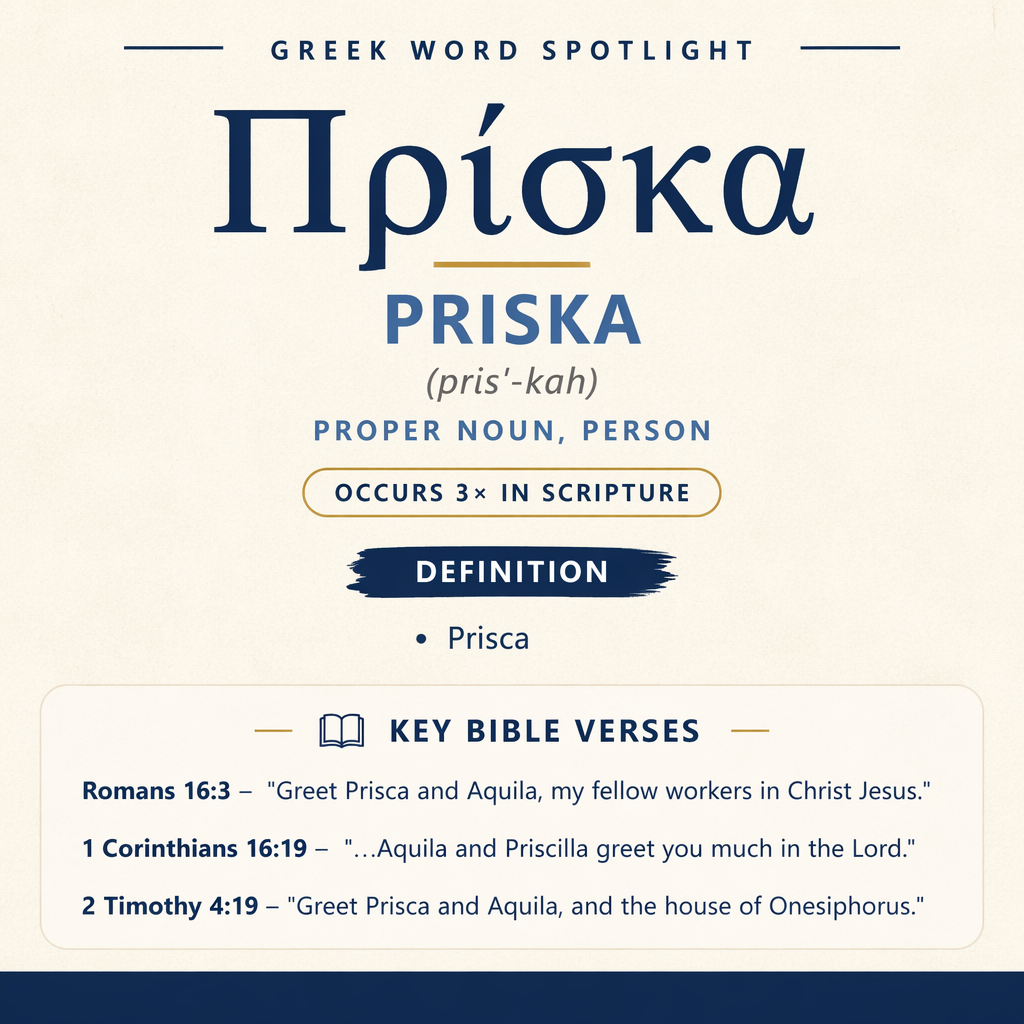
Πρίσκα means “Prisca” and appears three times in Scripture: Romans 16:3, 1 Corinthians 16:19, and 2 Timothy 4:19.
Priska is the personal name “Prisca,” used in the New Testament as part of direct greetings within apostolic letters. In the passages where it appears, the name is paired with Aquila and functions to identify a known co-worker and household within the life of the assemblies.
Occurrences
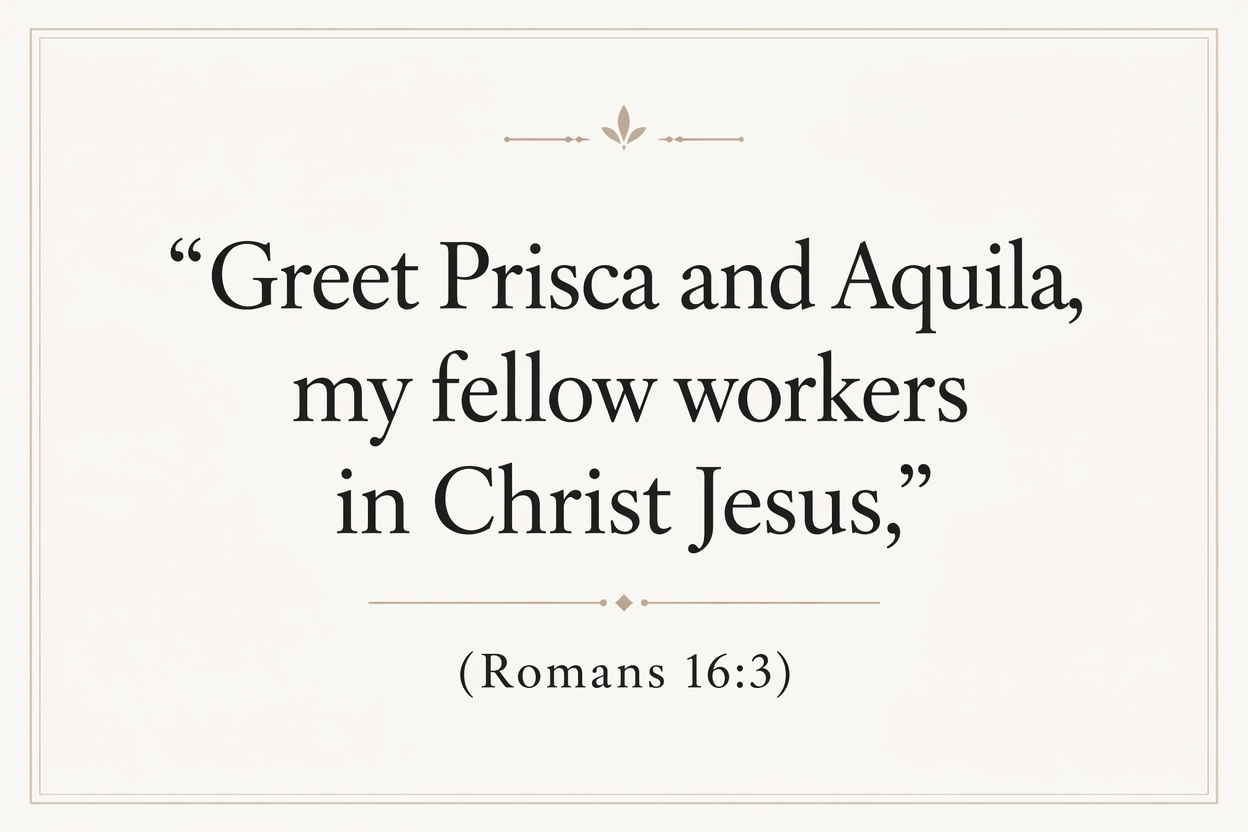
“Greet Prisca and Aquila, my fellow workers in Christ Jesus,” (Romans 16:3)
Here Priska appears as the first of a named pair receiving a greeting. The address is personal and relational: the writer directs the community to extend recognition to “Prisca and Aquila,” and then immediately characterizes them as “my fellow workers in Christ Jesus.” Within the sentence, the name serves two roles at once. First, it anchors the greeting in real people known to the congregation, not in an abstract audience; second, it introduces the description that follows, framing Prisca (together with Aquila) as active participants in shared labor “in Christ Jesus.” The placement of the name inside a greeting formula also highlights that the letter expects a network of relationships across distance: the instruction “Greet” presumes that the recipients can locate and reach Prisca in their own setting.
“The assemblies of Asia greet you. Aquila and Priscilla greet you much in the Lord, together with the assembly that is in their house.” (1 Corinthians 16:19)
In this closing greeting, the name occurs in the form “Priscilla” within the English verse text, paired again with Aquila. The verse layers greetings: first “The assemblies of Asia greet you,” then a more focused greeting from a household. Against the wider background of multiple “assemblies,” Prisca is presented as part of a particular greeting source: “Aquila and Priscilla greet you much in the Lord.” The word marks an identifiable person whose greeting is not casual but emphatic (“much”) and explicitly tied to shared devotion (“in the Lord”). The verse then joins the named pair to a local community sphere: their greeting comes “together with the assembly that is in their house.” In this sentence, Prisca’s name helps locate one node of communal life where a gathered assembly meets in a house. The proper name is therefore not merely a label; it is a pointer to a household setting that functions as a site of Christian assembly, and to the personal agency of those who host or represent that gathering in their greeting.
“Greet Prisca and Aquila, and the house of Onesiphorus.” (2 Timothy 4:19)
Priska appears again within a concise instruction to greet specific people and a household. As in Romans, Prisca is paired with Aquila, indicating an established association recognizable to the recipient. The verse expands the circle of greeting beyond the two individuals: it adds “the house of Onesiphorus.” That juxtaposition places personal greetings and household greetings side by side. Prisca’s name thus functions within a social map that includes both individual co-laborers and extended domestic units. The brevity of the line underscores how familiar these names are within the correspondence: the writer can mention “Prisca and Aquila” without further descriptors, implying that their identity and importance are already understood by the one receiving the letter and by those who will convey the greeting.

Sense and Usage
Across these occurrences, Priska functions as a stable personal identifier in letter-writing contexts where greetings serve to connect communities and affirm relationships. The name does not carry a descriptive title of its own in these verses; instead, its significance arises from the company it keeps and the actions associated with it. In Romans 16:3, Prisca is linked to a characterization—“my fellow workers in Christ Jesus”—so the name is presented in a framework of shared labor and collaboration. In 1 Corinthians 16:19, the name appears within a greeting that is explicitly devotional (“in the Lord”) and communal (“together with the assembly that is in their house”), associating Prisca with the act of sending greetings and with a household assembly. In 2 Timothy 4:19, the name is once more placed within a targeted set of greetings that includes both individuals and a household, showing how personal names could stand as shorthand for relational networks.
The recurring pairing “Prisca and Aquila” in two verses, and the presence of the same pair in the third verse in a slightly different English form (“Priscilla”), shows the name operating consistently within a recognized partnership. Within the limited textual space of epistolary closings, such paired naming works like a relational signature: the letter writer expects that the recipients know these people, can pass on greetings to them, and will understand that honoring them is part of honoring the shared work and fellowship implied by the letter. Priska’s name, therefore, belongs to the vocabulary of connection: it appears when the writer is not developing a doctrinal argument but strengthening bonds—directing greetings, transmitting affection, and marking out lines of cooperation between assemblies.
The settings implied by the greetings also shape how the name is heard. In 1 Corinthians 16:19, the greeting comes not only from individuals but also “together with the assembly that is in their house,” so Prisca is heard in proximity to a concrete gathering place. In 2 Timothy 4:19, the mention of “the house of Onesiphorus” alongside Prisca and Aquila similarly evokes household-based spheres of life where people can be greeted as a group. In such verses, a proper name can carry the weight of presence: it points to someone who is located within a community, whose greeting can be sent, whose relationship to the letter’s recipient is worth activating, and whose place within the network of assemblies can be assumed rather than explained.
Imagery in Context
The name Priska is embedded in the imagery of exchange across distance: greetings move from writer to recipients, from “assemblies of Asia” to another assembly, and from a house-based gathering to a wider community (1 Corinthians 16:19). The repeated call to “Greet Prisca and Aquila” (Romans 16:3; 2 Timothy 4:19) presents community life as personal and addressable—made up of people whose names can be spoken and whose households and partnerships can be recognized in writing. Even in brief lines, the naming of Prisca evokes lived spaces where people meet, work, and extend fellowship through spoken greetings carried by a letter.
Sources: Lexical data from Strong’s Exhaustive Concordance and the Translators Brief Lexicon of Extended Strongs for Greek (STEPBible, CC BY). Occurrence data from the Translators Amalgamated Greek New Testament (STEPBible, CC BY). Scripture quotations from the World English Bible (public domain).





