
Exploring the Meaning of Politeuma in Greek
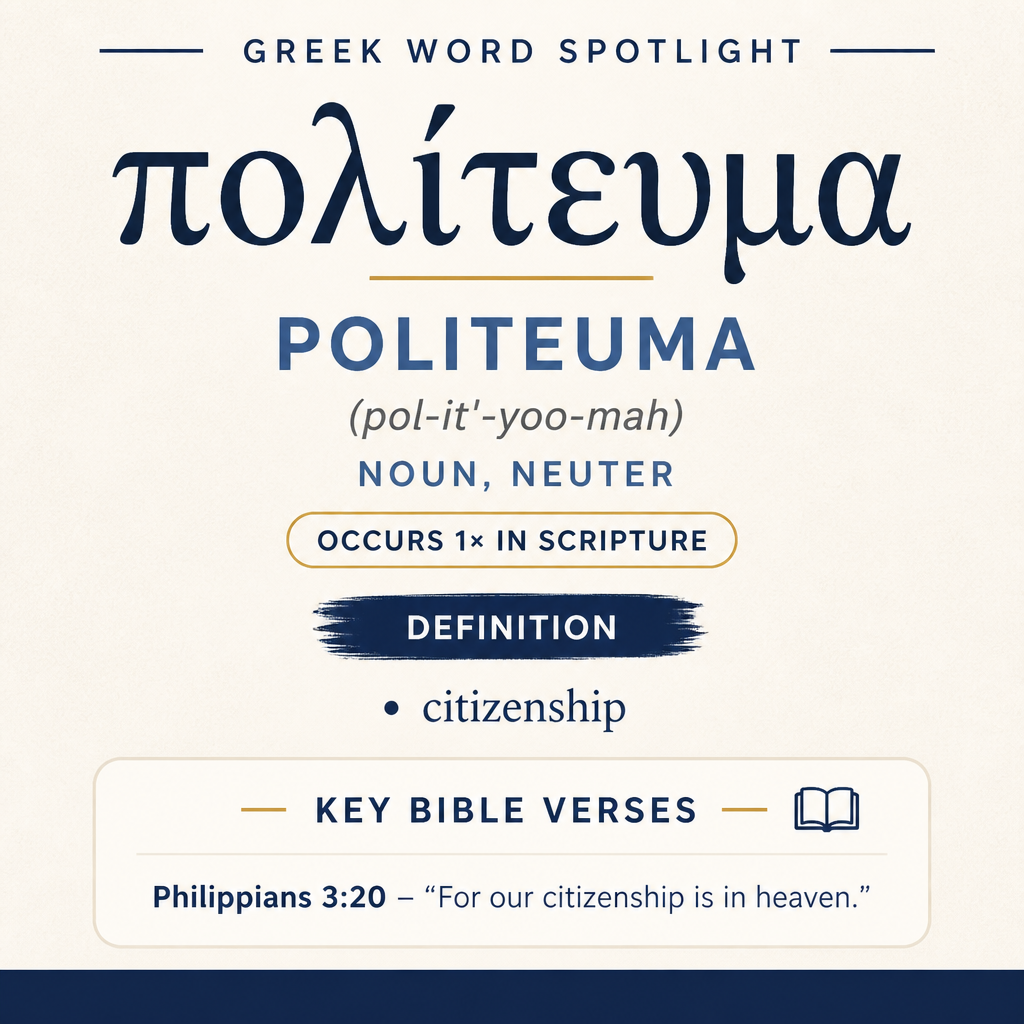
πολίτευμα means “citizenship” and appears once in Scripture, in Philippians 3:20.
Scripture Occurrence
It occurs 1 time in Scripture. The occurrence is in Philippians 3:20.
Learn More →Verse Context
Philippians 3:20 says, “For our citizenship is in heaven, from where we also wait for a Savior, the Lord Jesus Christ,” using πολίτευμα for “citizenship.”
Learn More →πολίτευμα (Politeuma) means “citizenship” and appears in the New Testament in Philippians 3:20. In that single occurrence, it is used to locate the community’s belonging “in heaven” while they “wait for a Savior.”
Root and Related Words
πολίτευμα (Politeuma) is related to the verb πολιτεύω (politeuomai), “be a citizen” (Strong’s G4176). The connection between the noun and the verb sets the noun in the sphere of civic belonging and identity: a “citizenship” is the status or standing that corresponds to “being a citizen.”

Occurrences
“For our citizenship is in heaven, from where we also wait for a Savior, the Lord Jesus Christ,” (Philippians 3:20)
In Philippians 3:20, πολίτευμα identifies what the speakers possess together (“our”) and then anchors it in a specific realm (“in heaven”). The word does more here than name an individual quality; it frames a shared corporate reality that defines where the group belongs. The sentence makes that belonging determinative for posture and expectation: because their citizenship is there, “from where” they “also wait” for “a Savior.” The phrase “from where” links the location of the citizenship to the direction of their hope, so that the heavenward placement of πολίτευμα becomes the standpoint from which the awaited deliverance is expected to come.

The verse also shows how the noun functions with possessive and locative language. The possessive “our” turns “citizenship” into a marker of group identity, while “is in heaven” gives it a fixed placement. The final clause adds a forward-looking orientation: the community’s citizenship is not merely a label but a determinant of where they look and what they anticipate. In this setting, πολίτευμα supports a contrast between present circumstances and ultimate belonging without needing to spell that contrast out; the verse itself accomplishes it by placing the community’s civic status “in heaven” and connecting that placement to the act of waiting.
Sense and Usage
“Citizenship” in Philippians 3:20 operates as a statement of primary affiliation. The word gathers up the idea of belonging, recognized standing, and corporate identity into a single term and then assigns that status to “heaven.” The verse’s structure shows how the sense of “citizenship” is meant to be practical rather than merely descriptive: it grounds expectation (“we also wait”) and it gives a directional source for hope (“from where”).
Because πολίτευμα is paired with the communal pronoun (“our”), it is presented as something held in common. The verse does not treat citizenship as a private possession or an inner feeling; it is a shared status that defines the group as a whole. That shared status then becomes the basis for their waiting together. The sentence’s logic is not complicated but it is tight: citizenship located in heaven → waiting oriented from heaven → the awaited one identified as “a Savior, the Lord Jesus Christ.” In that chain, πολίτευμα supplies the first link, establishing the realm that governs the community’s outlook.
The immediate wording also illustrates how “citizenship” can carry both location and implication. The explicit locative statement (“is in heaven”) places the citizenship somewhere; the implicit implication is that a citizen’s relationship to their homeland shapes their loyalties and expectations. Philippians 3:20 draws that implication out only as far as the verse itself goes: it does not list duties or behaviors, but it does point to a posture—waiting—and to a source—“from where.” In other words, πολίτευμα is used to explain why the community waits and why their waiting is directed heavenward.
Finally, the verse places πολίτευμα alongside a distinctly personal and named expectation: “a Savior, the Lord Jesus Christ.” In this single context, “citizenship” is not an abstract idea floating on its own; it is tied to the anticipation of a coming person. The noun helps frame that anticipation as appropriate to their true belonging: the one they wait for is expected to come from the same realm in which their citizenship resides.
Imagery
Philippians 3:20 gives πολίτευμα a clear spatial coloring by setting it “in heaven” and then turning the reader’s gaze upward and forward: the community waits for a Savior “from where” that citizenship is located. The imagery is of belonging fixed in one realm and expectation oriented from that realm toward the present—citizens whose homeland is above, watching for the arrival of their Savior.
Sources: Lexical data from Strong’s Exhaustive Concordance and the Translators Brief Lexicon of Extended Strongs for Greek (STEPBible, CC BY). Occurrence data from the Translators Amalgamated Greek New Testament (STEPBible, CC BY). Scripture quotations from the World English Bible (public domain).





