
Exploring the Meaning of Plege Greek
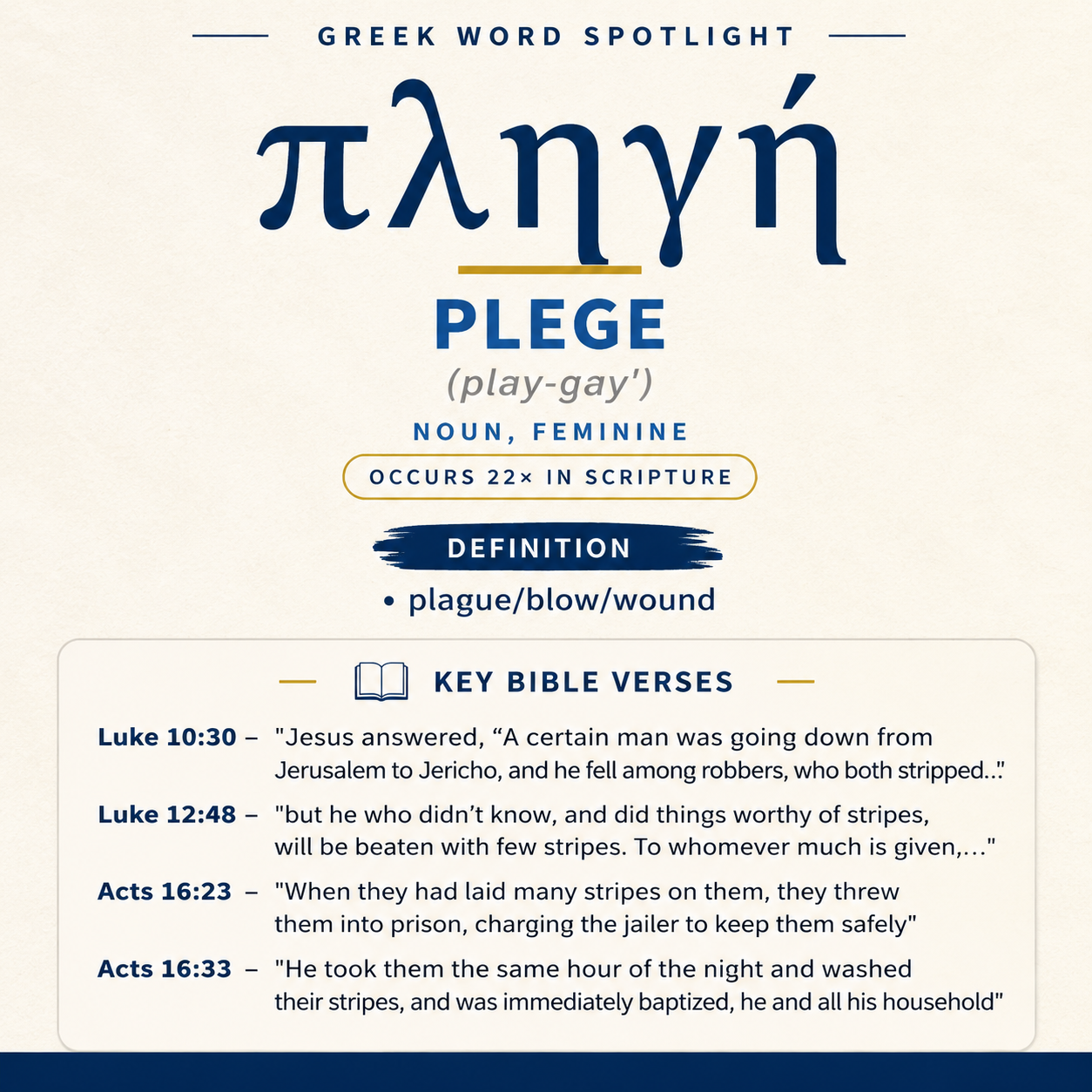
πληγή means plague, blow, or wound, appearing 22 times in Scripture, including Luke, Acts, 2 Corinthians, and Revelation.
Core Meaning
πληγή is defined as “plague/blow/wound.” In several passages it is rendered as “stripes” in contexts of being beaten.
Learn More →Narrative Contexts
In Luke 10:30 it appears in a scene where a man fell among robbers. In Acts 16:23, 16:33 it is used of stripes inflicted and later washed.
Learn More →Judgment Plagues
In Revelation 9:18 and 9:20, πληγή refers to plagues connected with widespread death and a call to repentance. These plagues are associated with fire, smoke, and sulfur.
Learn More →πληγή denotes a “plague/blow/wound” and appears in narratives of physical assault, disciplinary punishment, apostolic suffering, and apocalyptic judgment. In the listed passages it ranges from injuries inflicted by criminals and persecutors to catastrophic plagues that strike the earth, and even a single, conspicuous wound that marks the beast.
Occurrences
Luke 10:30: “Jesus answered, “A certain man was going down from Jerusalem to Jericho, and he fell among robbers, who both stripped him and beat him, and departed, leaving him half dead.”
Here πληγή belongs to the violence done to a traveler: the man is “beat… leaving him half dead.” The word’s force lies in the concrete harm of an attack—injury received at close range—set alongside robbery (“stripped him”) and abandonment (“departed”). The scene frames πληγή as bodily damage that renders a person helpless.

Luke 12:48: “but he who didn’t know, and did things worthy of stripes, will be beaten with few stripes. To whomever much is given, of him will much be required; and to whom much was entrusted, of him more will be asked.”
In this teaching, πληγή is expressed as “stripes” connected to being “beaten.” The emphasis is measured severity: “few stripes” corresponds to culpability (“didn’t know… worthy of stripes”). The word contributes the idea of a punitive blow that can be counted and scaled, serving as an image for accountability and proportional response.
Acts 16:23: “When they had laid many stripes on them, they threw them into prison, charging the jailer to keep them safely,”
πληγή appears as “stripes” inflicted upon Paul and Silas before imprisonment. The sequence matters: the “many stripes” precede confinement, highlighting bodily suffering as part of their public treatment. The word underlines the physical cost and the official character of the punishment, since it is followed by orders to the jailer to secure them.
Acts 16:33: “He took them the same hour of the night and washed their stripes, and was immediately baptized, he and all his household.”
The “stripes” here are visible and tangible enough to be “washed.” πληγή thus stands not only for the act of beating but also for the resulting wounds requiring care. The immediacy (“the same hour of the night”) places the washing of these injuries alongside the household’s baptism, making the wounds part of the night’s decisive events.
2 Corinthians 6:5: “in beatings, in imprisonments, in riots, in labors, in watchings, in fastings;”
In this catalog of hardships, πληγή is rendered “beatings” and placed first among social and bodily pressures (“imprisonments… riots… labors”). The word contributes a blunt marker of physical assault within a broader pattern of affliction. It is not an isolated incident but one item in an ongoing, varied experience of hardship.
2 Corinthians 11:23: “Are they servants of Christ? (I speak as one beside himself.) I am more so: in labors more abundantly, in prisons more abundantly, in stripes above measure, and in deaths often.”
Here πληγή (“stripes”) is intensified: “above measure.” The phrase portrays blows that exceed ordinary limits, set amid repeated “prisons” and frequent danger (“deaths often”). The word’s contribution is the sense of repeated, severe bodily injury presented as evidence within Paul’s comparison of service and suffering.
Revelation 9:18: “By these three plagues were one third of mankind killed: by the fire, the smoke, and the sulfur, which proceeded out of their mouths.”
In this apocalyptic vision, πληγή becomes “plagues” that kill “one third of mankind.” The word shifts from individual wounds to large-scale destructive blows. The text ties these plagues to specific instruments of devastation—“fire… smoke… sulfur”—so the word functions as a label for lethal strikes that come in distinct forms.
Revelation 9:20: “The rest of mankind, who were not killed with these plagues, didn’t repent of the works of their hands, that they wouldn’t worship demons, and the idols of gold, and of silver, and of brass, and of stone, and of wood; which can’t see, hear, or walk.”
πληγή (“plagues”) here marks a moral dividing line: people survive “these plagues” yet “didn’t repent.” The word carries the weight of experienced judgment that still fails to produce change. In the sentence, “plagues” are the immediate crisis; the persistent idol-worship is the continued response, making πληγή an external blow met with stubbornness.
Revelation 11:6: “These have the power to shut up the sky, that it may not rain during the days of their prophecy. They have power over the waters, to turn them into blood, and to strike the earth with every plague, as often as they desire.”
Here πληγή is again “plague,” but tied to agency: “to strike the earth with every plague, as often as they desire.” The word contributes the idea of repeated, discretionary blows against “the earth,” in the same breath as other acts affecting creation (“shut up the sky… turn them into blood”). πληγή thus functions as a category of inflicted disaster under purposeful control.
Revelation 13:3: “One of his heads looked like it had been wounded fatally. His fatal wound was healed, and the whole earth marveled at the beast.”
πληγή is now a “wound,” and it is conspicuously “fatal” in appearance yet “healed.” The word contributes a visible mark of apparent death and recovery that drives public reaction (“the whole earth marveled”). In this scene the wound is not one injury among many; it is the defining sign that reshapes perception of the beast.
Revelation 13:12: “He exercises all the authority of the first beast in his presence. He makes the earth and those who dwell in it to worship the first beast, whose fatal wound was healed.”
The “fatal wound” is repeated as an identifying feature of “the first beast.” πληγή functions as a remembered, persuasive fact used to compel worship: the healed wound becomes part of the mechanism by which “the earth and those who dwell in it” are moved toward devotion. The word thus carries rhetorical power in the narrative, not merely medical detail.
Revelation 13:14: “He deceives my own people who dwell on the earth because of the signs he was granted to do in front of the beast, saying to those who dwell on the earth that they should make an image to the beast who had the sword wound and lived.”
Here πληγή is specified as a “sword wound,” and the emphasis falls on survival: “had… wound and lived.” The word contributes the concrete, weapon-linked injury that supports deception and the making of an image. Within the verse, the wound functions as a credential—an injury tied to death-threat that did not end in death—feeding the broader movement toward false worship.

Sense and Usage
Across these passages πληγή consistently points to harm that comes as an inflicted blow, whether on an individual body or on a wider human population. In Luke and Acts it appears in the domain of interpersonal violence and judicial or mob punishment, where “stripes” can be “many,” “few,” or even “above measure,” and where the aftermath can be tended by washing. These contexts keep πληγή close to the surface of the body: the word evokes injury that is felt, seen, and counted, and it naturally aligns with verbs of beating and actions of care.
In 2 Corinthians, πληγή stands inside lists, functioning as a concise label for repeated bodily affliction alongside imprisonment and social turmoil. The term helps compress experience into a recognizable category of suffering: “beatings” and “stripes” are not abstract hardship but concrete blows endured in the course of a demanding life.
Revelation widens the scope. In chapters 9 and 11, πληγή becomes “plague,” a form of striking that falls upon “mankind” and “the earth,” sometimes with lethal effect and sometimes with repeated frequency. Even there the word retains its core force as an inflicted blow; the scale changes, but the conceptual shape remains an assault that lands. In chapter 13 the focus narrows again to one “wound”—not a series of stripes or a wave of plagues, but a single, defining injury that is “fatal” in appearance, connected to a “sword,” and astonishingly healed. In that setting πληγή is a narrative marker that drives amazement, worship, and deception: the wound is both physical and socially consequential.
Imagery
These texts keep πληγή tethered to the idea of a strike that leaves evidence. The Good Samaritan setting portrays blows that leave a man “half dead.” Acts and 2 Corinthians present stripes as the marks of persecution that can be counted, exceeded, and washed. Revelation paints the word on a larger canvas—earth-striking plagues and a singular, unforgettable wound—so that bodily injury and world-scale calamity stand as parallel images of a blow that lands with real effect.
Sources: Lexical data from Strong’s Exhaustive Concordance and the Translators Brief Lexicon of Extended Strongs for Greek (STEPBible, CC BY). Occurrence data from the Translators Amalgamated Greek New Testament (STEPBible, CC BY). Scripture quotations from the World English Bible (public domain).




