Exploring the Meaning of Pistikos in Greek
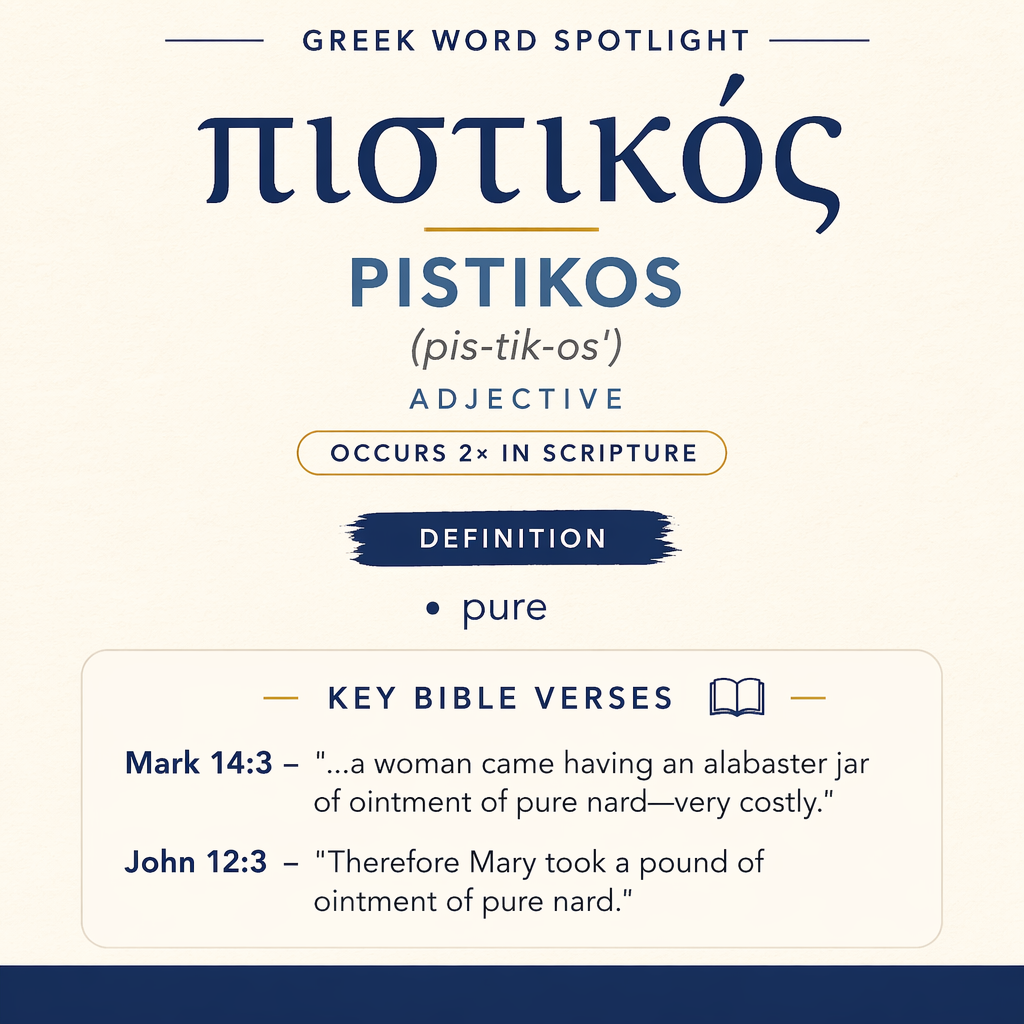
πιστικός (Pistikos) means “pure” and appears twice in Scripture, in Mark 14:3 and John 12:3.
Context in Verses
In Mark 14:3 it describes an alabaster jar of ointment. In John 12:3 it describes “pure nard,” very precious, used to anoint Jesus’s feet.
Learn More →πιστικός means “pure” and appears in two Gospel scenes describing “pure nard” used to anoint Jesus. In both settings, the word characterizes the ointment’s quality within an act of costly devotion.
Root and Related Words
πιστικός is related to pistis (πίστις), “faith” (Strong’s G4102).

Occurrences
“While he was at Bethany, in the house of Simon the leper, as he sat at the table, a woman came having an alabaster jar of ointment of pure nard—very costly. She broke the jar, and poured it over his head.” (Mark 14:3)
Here πιστικός modifies “nard” in the phrase “ointment of pure nard—very costly.” The narrative places Jesus at table in Bethany and focuses attention on the woman’s approach with an “alabaster jar.” Within this description, “pure” functions as a quality marker that helps explain why the ointment is “very costly”: the narrator ties the material value of the offering to its stated condition. The physical actions that follow—she “broke the jar” and “poured it over his head”—make the purity of the ointment more than an abstract label. The scene emphasizes irreversibility and lavishness: breaking the container and pouring out its contents enacts a one-time gift, and the adjective “pure” frames that gift as unadulterated as it is expended.
The word also shapes how the reader imagines the sensory and social moment. A meal setting (“as he sat at the table”) is interrupted by the opening of a sealed, precious substance. By calling the nard “pure,” the description guides the evaluation of what is being released and wasted (in purely material terms): it is not a lesser substitute but the best sort of what it claims to be. The adjective therefore supports the narrative’s stress on costliness and the totality of the act—she does not portion out a little, but empties what is presented as genuine and high-grade.

“Therefore Mary took a pound of ointment of pure nard, very precious, and anointed Jesus’s feet and wiped his feet with her hair. The house was filled with the fragrance of the ointment.” (John 12:3)
In John’s account, πιστικός again modifies “nard” and stands alongside the valuation “very precious.” The quantity is specified (“a pound of ointment”), and the adjective “pure” serves to qualify what that weight consists of. The action is directed to Jesus’s “feet,” and the anointing is followed by an intimate, concrete gesture: Mary “wiped his feet with her hair.” In this scene, “pure” contributes to the portrayal of the ointment as worthy of such deliberate use. The narrative does not treat the substance as ordinary perfume; it is introduced as a valuable material that fits the significance of the act being performed.
John adds a pronounced sensory consequence: “The house was filled with the fragrance of the ointment.” Against that detail, “pure” helps the reader picture the fragrance as arising from an ointment that is unmixed and thus potent in what it is. The adjective supports the picture of abundance: the space is not merely scented; it is “filled.” Since the scene highlights both a measured quantity and an enveloping aroma, “pure” stands as part of the reason the fragrance can dominate the house and become a defining feature of the moment.
Sense and Usage
Across these two occurrences, πιστικός functions as an adjective of quality attached to “nard,” and it appears within descriptions that also emphasize value (“very costly,” “very precious”). The repeated pairing of “pure” with explicit language of expense suggests that the word’s force in these narratives is not merely technical but evaluative: it helps establish the ointment as the real thing, the sort that would justifiably be counted as costly and treated as precious. In both passages, the adjective helps interpret the action by clarifying what kind of substance is being expended on Jesus.
The two scenes also show how “pure” operates when the same material is deployed differently. In Mark, the ointment is associated with an “alabaster jar” that is broken, and the emphasis falls on the decisive outpouring “over his head.” In John, the quantity is stated (“a pound”), the anointing focuses on “feet,” and the action includes wiping with hair, followed by the house being filled with fragrance. In each case, “pure” contributes to the portrayal of an offering that is not half-measure or compromised: the quality of what is given matches the totality with which it is given.
Because πιστικός occurs only in these anointing contexts, its usage is tightly connected to tangible, sensory material—ointment, fragrance, a container, the act of pouring or anointing. The adjective therefore works within the narrative to anchor the reader’s understanding of what is being offered: not a vague “gift,” but a specific, valuable ointment characterized as “pure.” The result is that the word participates in the passages’ concrete realism: weight, vessel, bodily contact, and scent are all foregrounded, and “pure” is one of the terms that intensifies the reader’s sense of the ointment’s worth within that realism.
Imagery
In both Mark 14:3 and John 12:3, “pure” is attached to a substance whose presence is made vivid—either by the breaking of an alabaster jar and the pouring over Jesus’s head, or by the spreading fragrance that fills a house. The adjective thus carries imagery of unreserved outpouring: what is poured out is presented as unalloyed and precious, so that the act leaves an unmistakable trace on the scene—on Jesus’s body and in the air of the room.
Sources: Lexical data from Strong’s Exhaustive Concordance and the Translators Brief Lexicon of Extended Strongs for Greek (STEPBible, CC BY). Occurrence data from the Translators Amalgamated Greek New Testament (STEPBible, CC BY). Scripture quotations from the World English Bible (public domain).