
Exploring the Meaning of Pege in Greek
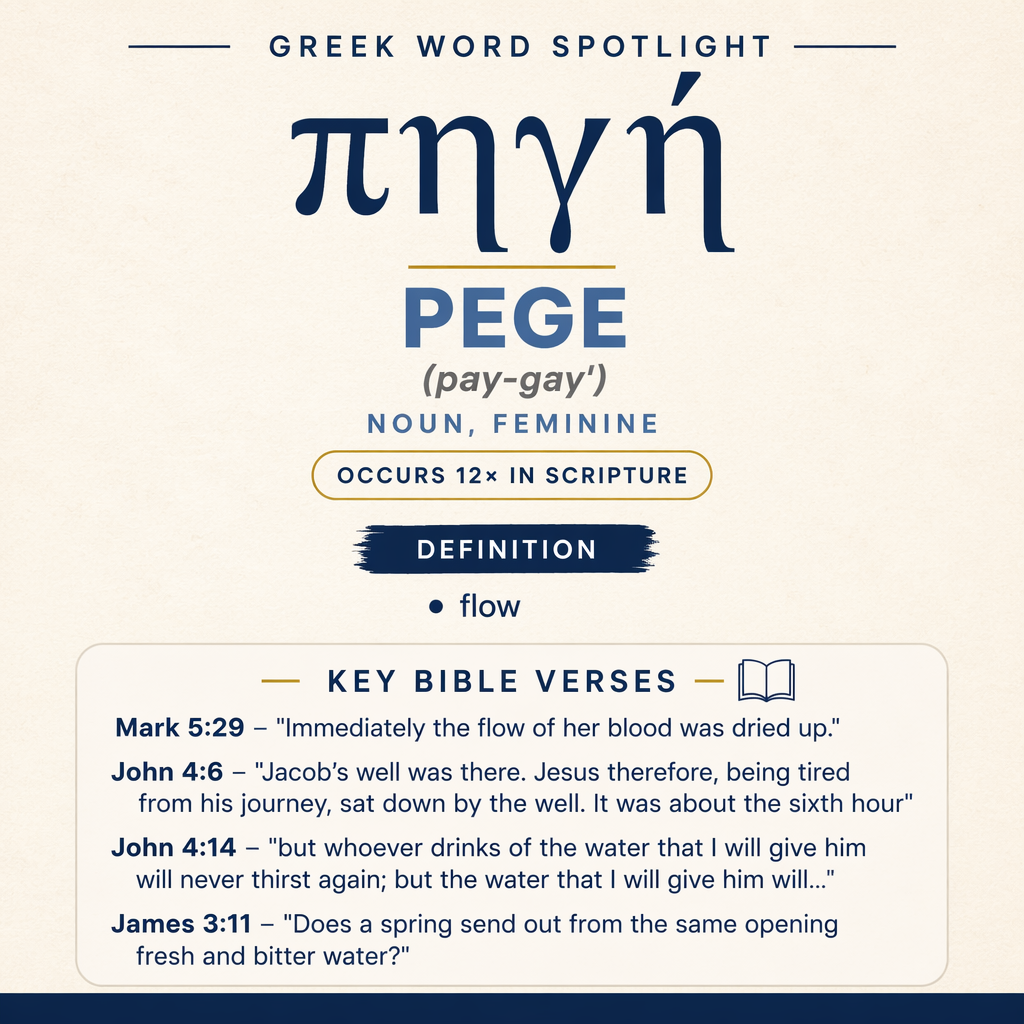
πηγή means “flow” and appears 12 times in Scripture, including Mark 5:29, John 4, James 3, 2 Peter 2:17, and Revelation 7–8.
Core Meaning
πηγή is defined as “flow.” In Scripture it is used with water imagery and other kinds of flowing.
Learn More →Gospel Context
In Mark 5:29 it refers to the flow of blood being dried up. In John 4 it appears in the setting of Jacob’s well and water Jesus gives.
Learn More →Later References
James 3:11–12 uses πηγή for a spring’s output of fresh, bitter, or salt water. Revelation 7:17 mentions springs of life-giving waters, while 2 Peter 2:17 speaks of wells without water.
Learn More →πηγή appears in scenes where something is pictured as a flow—sometimes bodily, sometimes as water drawn from a well or issuing as a spring, and sometimes as waters caught up in judgment or promise. Across the cited passages it helps describe what is sourced, what is supplied, and what is affected when that flow is present, absent, or transformed.
Occurrences
“Immediately the flow of her blood was dried up, and she felt in her body that she was healed of her affliction.” (Mark 5:29)
Here πηγή is used for a physical flow within the woman’s body. The verse ties the drying up of that flow directly to an immediate change she can feel—“she felt in her body”—and it frames that stoppage as the concrete sign that “she was healed of her affliction.” The word anchors the miracle in a specific, observable reversal: the flow that defined her condition is the very thing that ceases.
“Jacob’s well was there. Jesus therefore, being tired from his journey, sat down by the well. It was about the sixth hour.” (John 4:6)
In this setting πηγή is associated with a well identified as “Jacob’s.” The narrative places Jesus beside it at a particular time (“about the sixth hour”) and emphasizes his weariness from travel. The well functions as a fixed source point in the landscape: the place where someone would come to draw water and where the encounter that follows can unfold in a normal, everyday location tied to water and rest.
“but whoever drinks of the water that I will give him will never thirst again; but the water that I will give him will become in him a well of water springing up to eternal life.” (John 4:14)
Within Jesus’ promise, πηγή is the inner well that results from receiving “the water that I will give him.” The verse presents movement and vitality: it is “springing up,” not static. The result is framed in terms of thirst and satisfaction (“will never thirst again”) and in terms of direction and outcome (“springing up to eternal life”). πηγή thus contributes the picture of an ongoing, active flow within a person, contrasted with recurring thirst.
“Does a spring send out from the same opening fresh and bitter water?” (James 3:11)
James uses πηγή as a familiar feature of nature—a spring with “the same opening.” The question depends on the expectation of consistency: what issues from a source corresponds to its character. The contrast is between “fresh and bitter,” and the argument turns on whether one and the same source can produce conflicting outputs. πηγή here supplies the concrete image of a single origin and its outflow.
“Can a fig tree, my brothers, yield olives, or a vine figs? Thus no spring yields both salt water and fresh water.” (James 3:12)
This continues the line of reasoning, now stating the conclusion explicitly: “Thus no spring yields both salt water and fresh water.” πηγή is again the source, but the focus is the yield—the kind of water that comes from it. By pairing springs with fruit-bearing plants in the same verse, James reinforces the common-sense link between source and product: what a thing is governs what it gives. πηγή provides the water-based parallel to the agricultural examples.
“These are wells without water, clouds driven by a storm; for whom the blackness of darkness has been reserved forever.” (2 Peter 2:17)
In 2 Peter, πηγή is used in a negative depiction: “wells without water.” The phrase trades on the expectation that a well exists to provide a flow; its emptiness becomes a critique in itself. The verse stacks images of unreliability—empty wells and storm-driven clouds—and then moves to a severe outcome (“the blackness of darkness has been reserved forever”). πηγή contributes the sense of promise unfulfilled: something that appears to be a source but does not supply.
“for the Lamb who is in the middle of the throne shepherds them and leads them to springs of life-giving waters. And God will wipe away every tear from their eyes.” (Revelation 7:17)
Here πηγή appears in a consoling, pastoral image: the Lamb “shepherds” and “leads” to “springs of life-giving waters.” Springs are not merely present; they are the destination of guidance and care. The flow is characterized as “life-giving,” and the verse pairs it with the removal of sorrow: “God will wipe away every tear from their eyes.” πηγή thus supports an image of sustained provision and relief, presented as something one is led toward.
“The third angel sounded, and a great star fell from the sky, burning like a torch, and it fell on one third of the rivers, and on the springs of the waters.” (Revelation 8:10)
In this judgment scene, πηγή is grouped with “rivers” as part of the water system affected by the star’s fall. The verse is precise in scope (“one third”) and depicts the impact as an intrusion into the places where waters run and where they originate. πηγή here highlights that the disruption reaches not only visible streams but also the sources—what feeds the waters—so the effect is structural and far-reaching.
“He said with a loud voice, “Fear the Lord, and give him glory; for the hour of his judgment has come. Worship him who made the heaven, the earth, the sea, and the springs of waters!” (Revelation 14:7)
πηγή is included in the catalog of what the Creator made: “the heaven, the earth, the sea, and the springs of waters.” The word therefore contributes to a comprehensive picture of the world’s ordered domains, from the vast (“heaven,” “sea”) to the particular sources that feed waters on earth. In a call to worship framed by impending judgment, springs are not incidental; they are named as part of the created order that grounds the call.
“The third poured out his bowl into the rivers and springs of water, and they became blood.” (Revelation 16:4)
As in Revelation 8:10, πηγή appears alongside “rivers,” but now the action is direct transformation: “they became blood.” The verse underscores totality within the targeted domain: both moving channels and their sources are affected. πηγή contributes the idea that what is normally a sustaining flow is turned into something else, making the judgment touch what people would look to for water at its origins as well as in its course.
“He said to me, “I have become the Alpha and the Omega, the Beginning and the End. I will give freely to him who is thirsty from the spring of the water of life.” (Revelation 21:6)
In this promise, πηγή is “the spring of the water of life,” offered freely to “him who is thirsty.” The verse pairs that gift with an authoritative self-declaration (“the Alpha and the Omega, the Beginning and the End”), placing the spring within a context of divine sufficiency and finality. πηγή here serves as the named source from which the thirsty receive, emphasizing generosity (“give freely”) and the satisfaction of need.
Sense and Usage
The definition “flow” plays out in two primary ways across these passages. First, it can denote a bodily flow whose cessation marks healing (Mark 5:29). In that use, πηγή points to an ongoing discharge that is central to the person’s condition; its drying up is not a mere detail but the concrete indicator that the affliction has been reversed.
Second, πηγή is repeatedly attached to water as a source and as what issues from that source. John 4 places Jesus by “Jacob’s well” and then uses the same sort of imagery to describe an internalized, active well “springing up” (John 4:6, 4:14). The movement from an external location to an internal spring intensifies the picture of flow: the issue is no longer simply where water can be found in a place, but how a supply becomes present within a person, producing an upward, ongoing action (“springing up”).
James draws on the ordinary expectation that sources are consistent. The spring has “the same opening” (James 3:11), and the conclusion “no spring yields both salt water and fresh water” (James 3:12) rests on the commonsense link between the character of the source and the quality of its output. In this use, πηγή carries argumentative weight: it offers a stable natural analogy for what it means to expect coherence between what something is and what it gives.
2 Peter 2:17 uses πηγή as a negative counter-image: a well that should provide flow but does not. Because wells exist in relation to what they supply, “wells without water” is an image of emptiness and disappointment. The word’s force comes from that mismatch between appearance (a well) and reality (no water), turning the source-image into a critique.
Revelation uses πηγή to speak both of creation and of eschatological outcome. Springs belong to the ordered world God made (Revelation 14:7), yet they can be struck and transformed in judgment (Revelation 8:10; 16:4). In the same book, springs are also the place of pastoral leading and comfort (“springs of life-giving waters,” Revelation 7:17) and the offered gift for thirst (“the spring of the water of life,” Revelation 21:6). Across these uses, πηγή consistently marks a point of origin for waters—whether those waters are life-giving, disrupted, or altered—so that attention is drawn not only to what flows but to where that flow is sourced.
Imagery
Because πηγή can name a flow in the body and a source of waters in the world, it readily carries both intimate and environmental imagery. Mark 5:29 locates flow within human frailty and healing; John 4 links the everyday reality of a well to the promise of an inner spring that “will never” leave one thirsting (John 4:14). James treats springs as a simple, observable feature that illustrates coherence between source and output (James 3:11–12). Revelation gathers the image into a larger horizon: springs can be objects of worship as part of what God made (Revelation 14:7), targets in judgments that reach to the sources themselves (Revelation 8:10; 16:4), and destinations of shepherding care and enduring consolation (Revelation 7:17; 21:6).
Sources: Lexical data from Strong’s Exhaustive Concordance and the Translators Brief Lexicon of Extended Strongs for Greek (STEPBible, CC BY). Occurrence data from the Translators Amalgamated Greek New Testament (STEPBible, CC BY). Scripture quotations from the World English Bible (public domain).




