Exploring the Meaning of Petros in Greek
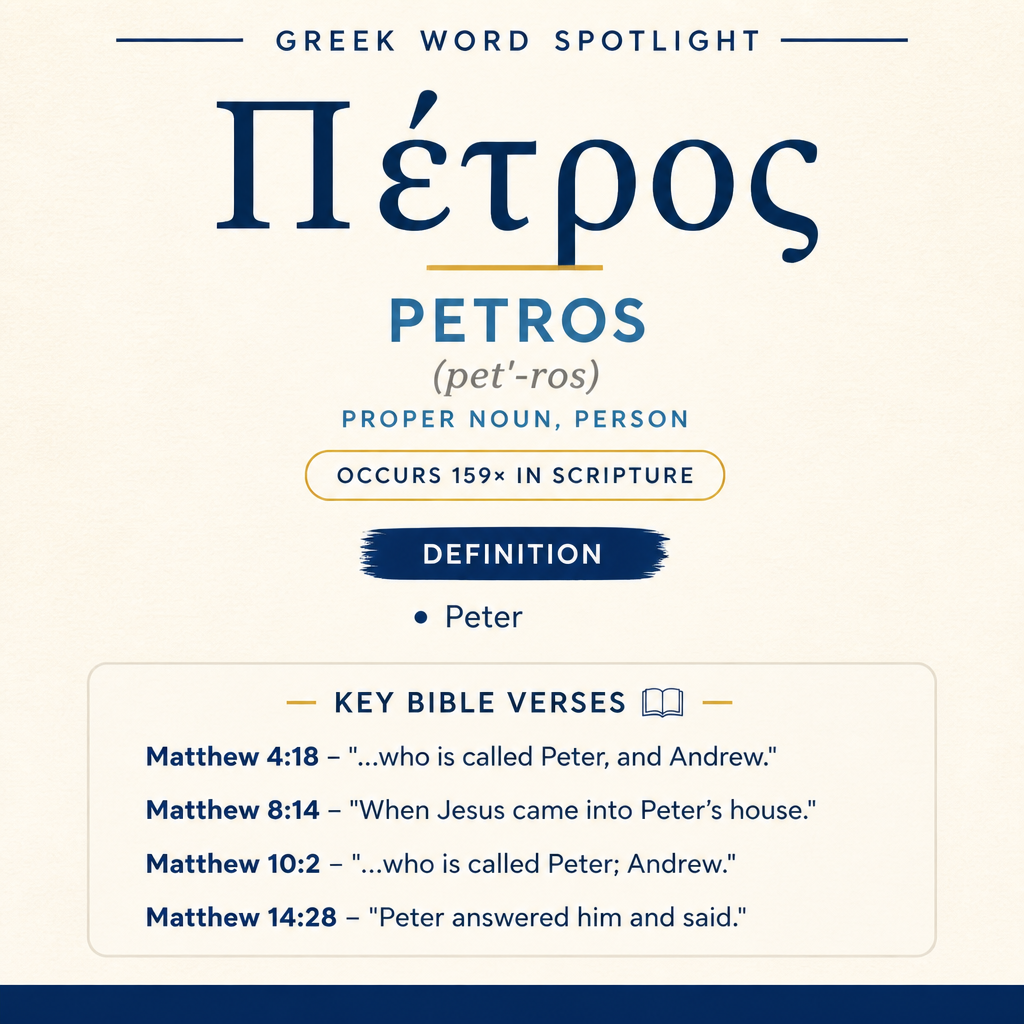
Πέτρος (Petros) means “Peter” and appears 159 times in Scripture, including Matthew 4:18; 8:14; 10:2; 14:28–29; 15:15; 16:16; 16:18.
Meaning
Πέτρος is the Greek name translated “Peter.” In Matthew 4:18, Simon is identified as the one called Peter.
Learn More →Gospel Scenes
In Matthew, Peter speaks and acts in key moments, including walking toward Jesus on the waters (Matthew 14:28–29). Jesus also enters Peter’s house (Matthew 8:14).
Learn More →Named Apostle
Matthew 10:2 lists “Simon, who is called Peter” among the twelve apostles. In Matthew 16:16, Simon Peter confesses, “You are the Christ, the Son of the living God.”
Learn More →Πέτρος refers to Peter, a named individual who appears repeatedly in the Gospel narratives in settings that range from ordinary domestic life to moments of public confession and correction. In the passages cited here, the name functions both as a personal identifier and as a marker for Peter’s distinctive involvement in Jesus’ ministry.
Occurrences
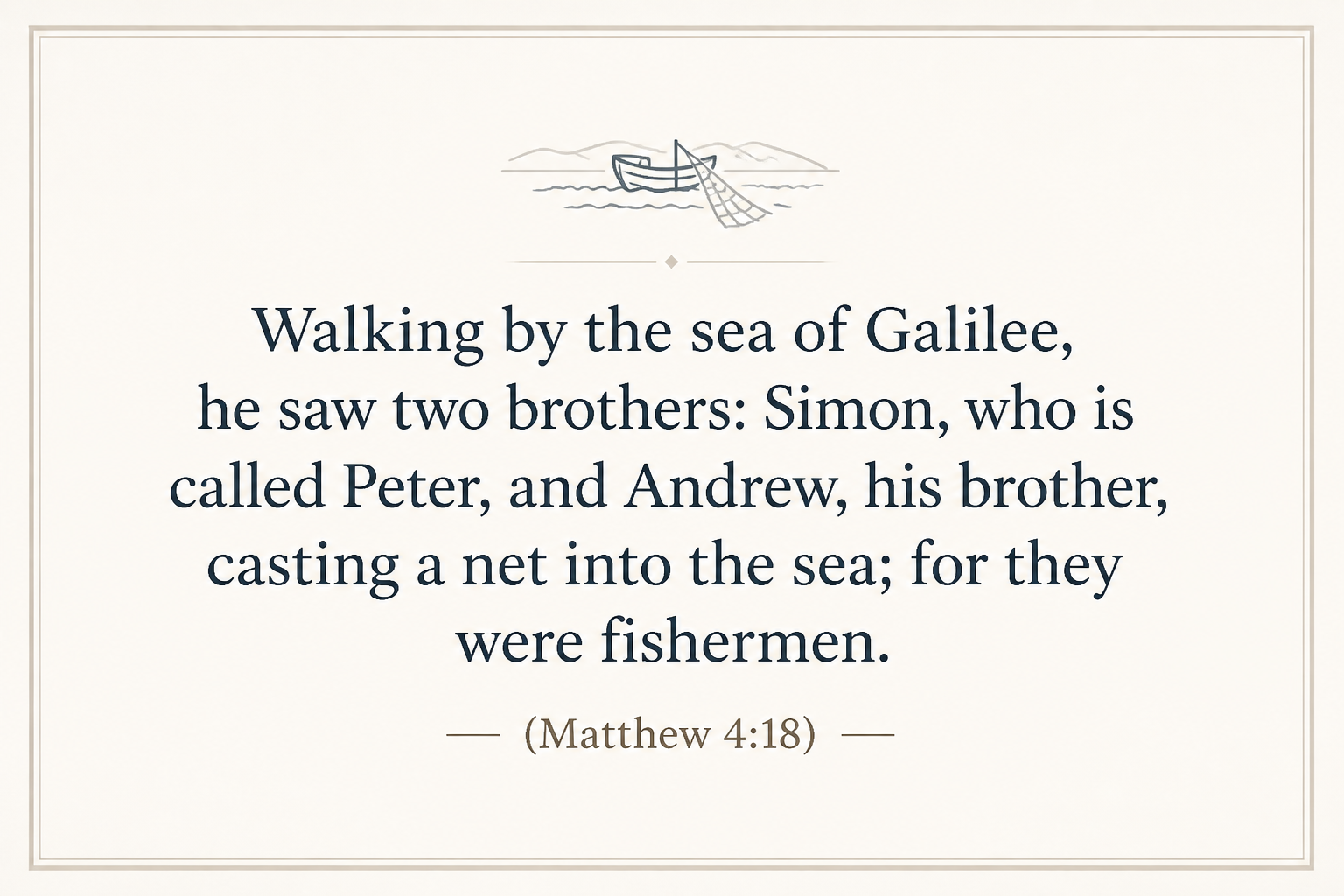
Walking by the sea of Galilee, he saw two brothers: Simon, who is called Peter, and Andrew, his brother, casting a net into the sea; for they were fishermen. (Matthew 4:18)
Here Πέτρος appears as an additional name attached to Simon: “Simon, who is called Peter.” The wording anchors Peter’s identity in a concrete scene of work—two brothers “casting a net into the sea”—and introduces him first in relation to family (“Andrew, his brother”) and vocation (“for they were fishermen”). The name distinguishes which Simon is in view and, in this opening mention, is paired with the ordinary setting of the Sea of Galilee.
When Jesus came into Peter’s house, he saw his wife’s mother lying sick with a fever. (Matthew 8:14)
Πέτρος identifies the owner or head of a household: “Peter’s house.” The reference locates the action in a private domestic space, and it frames the scene in terms of family connection (“his wife’s mother”) and need (“lying sick with a fever”). The name is thus tied to a place where Jesus “came,” giving the narrative a specific relational and physical setting rather than an anonymous home.
Now the names of the twelve apostles are these. The first, Simon, who is called Peter; Andrew, his brother; James the son of Zebedee; John, his brother; (Matthew 10:2)
In this list, Πέτρος again appears as the name by which Simon is also known, but now in a formal enumeration: “Now the names of the twelve apostles are these.” The phrase “The first, Simon, who is called Peter” places Peter at the head of the roster within the sentence’s structure. The name functions as an identifying label within the group and helps the reader track the same figure introduced earlier by the sea.
Peter answered him and said, “Lord, if it is you, command me to come to you on the waters.” (Matthew 14:28)
Πέτρος is the speaker who addresses Jesus directly as “Lord” and proposes a specific test of identity: “if it is you.” The request “command me to come to you on the waters” shows Peter’s initiative in the moment and makes his name the narrative handle for the disciple who voices this daring petition. The name, placed first in the sentence, spotlights him as the one who responds verbally to what is happening.
He said, “Come!” Peter stepped down from the boat, and walked on the waters to come to Jesus. (Matthew 14:29)
Here Πέτρος identifies the person who acts on the spoken command “Come!” The name attaches to a sequence of physical movements: “stepped down from the boat,” “walked on the waters,” and “to come to Jesus.” In this scene, Peter is not merely present; the narrative assigns to him the distinctive action of leaving the boat and moving toward Jesus, and the repetition of “come” (command and goal) ties Peter’s movement to Jesus’ word.
Peter answered him, “Explain the parable to us.” (Matthew 15:15)
Πέτρος is again marked out as the one who speaks for a wider circle: “Explain the parable to us.” The plural “us” signals that Peter’s request is not only personal curiosity but a representative question on behalf of others listening. The name therefore functions as a narrative cue for whose voice articulates the disciples’ need for clarification.
Simon Peter answered, “You are the Christ, the Son of the living God.” (Matthew 16:16)
Πέτρος appears alongside Simon as a combined identification: “Simon Peter.” The doubled naming emphasizes the same individual while preparing for a climactic spoken confession. In the quoted words, Peter’s statement is direct and declarative—“You are the Christ, the Son of the living God”—and the name fixes responsibility for that confession on him. The narrative weight of the sentence rests on who says it, and Πέτρος supplies that personal attribution.
I also tell you that you are Peter, and on this rock I will build my assembly, and the gates of Hades will not prevail against it. (Matthew 16:18)
In this saying, Πέτρος is addressed directly: “you are Peter.” The name is set in a sentence that also contains architectural and conflict imagery: “on this rock I will build my assembly,” and “the gates of Hades will not prevail against it.” Within the wording itself, Peter’s name is placed in close proximity to “rock,” and the declaration links the addressed person to the unfolding purpose described (“I will build my assembly”). The name functions not merely to identify him but to anchor a pronouncement aimed at Peter personally (“I also tell you”).
Peter took him aside, and began to rebuke him, saying, “Far be it from you, Lord! This will never be done to you.” (Matthew 16:22)
Πέτρος identifies the one who initiates a private, corrective interaction: “took him aside,” “began to rebuke him.” The content of Peter’s rebuke is emphatic—“Far be it from you, Lord! This will never be done to you”—and the name highlights that this strong resistance comes from the same disciple who has just voiced a major confession. The narrative uses the name to keep the reader oriented to the continuity of character across sharply different speeches.
But he turned, and said to Peter, “Get behind me, Satan! You are a stumbling block to me, for you are not setting your mind on the things of God, but on the things of men.” (Matthew 16:23)
Here Πέτρος is the direct addressee of a severe correction. The sequence “he turned, and said to Peter” frames the rebuke as personal and face-to-face in the scene. The words spoken to Peter identify the problem in terms of orientation and values: “you are not setting your mind on the things of God, but on the things of men.” The name marks the recipient of this confrontation and makes clear that the correction is aimed at Peter’s stance expressed in the prior exchange.
After six days, Jesus took with him Peter, James, and John his brother, and brought them up into a high mountain by themselves. (Matthew 17:1)
Πέτρος appears in a small, selected group: “Peter, James, and John his brother.” The name signals inclusion among those whom Jesus “took with him” for a distinct experience, separated from others: “brought them up into a high mountain by themselves.” Peter’s name here functions as a marker of proximity to Jesus in this particular movement and setting, defined by time (“After six days”) and isolation (“by themselves”).
Peter answered, and said to Jesus, “Lord, it is good for us to be here. If you want, let’s make three tents here: one for you, one for Moses, and one for Elijah.” (Matthew 17:4)
Πέτρος is again the one who responds verbally to an extraordinary setting, addressing Jesus as “Lord” and evaluating the moment: “it is good for us to be here.” His proposal—“let’s make three tents here”—is detailed and structured (“one for you, one for Moses, and one for Elijah”), showing Peter attempting to give a lasting form to what is being witnessed. The name links this impulse to Peter specifically, continuing the pattern in which his voice often articulates a reaction on behalf of the group (“for us”).

Sense and Usage
Across these passages, Πέτρος functions as the stable personal name by which the narrative tracks the same individual through changing contexts: work by the sea, home life, formal apostolic listing, perilous movement “on the waters,” classroom-like questioning about a parable, and the heights of confession and correction. The repeated formula “Simon, who is called Peter” (Matthew 4:18; 10:2) and the combined form “Simon Peter” (Matthew 16:16) show the name operating as an established identifier, capable of being paired with Simon to ensure clarity and continuity.
In dialogue scenes, the name often introduces speech acts that shape the episode’s direction. Peter asks for a command that would draw him toward Jesus “on the waters” (Matthew 14:28) and then becomes the one who acts on that command (Matthew 14:29). He also asks for explanation—“Explain the parable to us” (Matthew 15:15)—placing him as a conduit for shared understanding. In Matthew 16, the name frames two opposite-sounding interventions: a high confession (“You are the Christ, the Son of the living God,” Matthew 16:16) and then a forceful objection (“This will never be done to you,” Matthew 16:22), followed by a direct reprimand addressed to him (Matthew 16:23). The effect is that Πέτρος becomes a focal point for moments when speech reveals alignment or misalignment with “the things of God.”
The name also attaches to spaces and roles: “Peter’s house” (Matthew 8:14) places him within a household network that includes “his wife’s mother,” while “The first, Simon, who is called Peter” (Matthew 10:2) positions him prominently in the named group of apostles within that sentence. When Jesus “took with him Peter, James, and John” (Matthew 17:1), Πέτρος marks a disciple included in a more intimate circle for a journey “up into a high mountain.” In that setting, Peter’s suggestion about “three tents” (Matthew 17:4) shows him responding to the presence of Jesus, Moses, and Elijah with an attempt to provide shelter and structure, again using “us” language that includes the others with him.
Imagery
Although Πέτρος is a personal name, these passages surround it with vivid settings that color how the reader encounters Peter: nets and a shoreline (Matthew 4:18), a household sickbed (Matthew 8:14), open water and a boat (Matthew 14:28–29), and a “high mountain” reached in seclusion (Matthew 17:1). In Matthew 16:18, the address “you are Peter” stands within imagery of building (“on this rock I will build my assembly”) and opposition (“the gates of Hades will not prevail against it”), giving the name a place within language of durability and contest in that specific saying. Taken together, the scenes present Peter as a figure met in ordinary places and in moments charged with weighty words and decisive action.
Sources: Lexical data from Strong’s Exhaustive Concordance and the Translators Brief Lexicon of Extended Strongs for Greek (STEPBible, CC BY). Occurrence data from the Translators Amalgamated Greek New Testament (STEPBible, CC BY). Scripture quotations from the World English Bible (public domain).