
Exploring the Meaning of Perioikeo in Greek
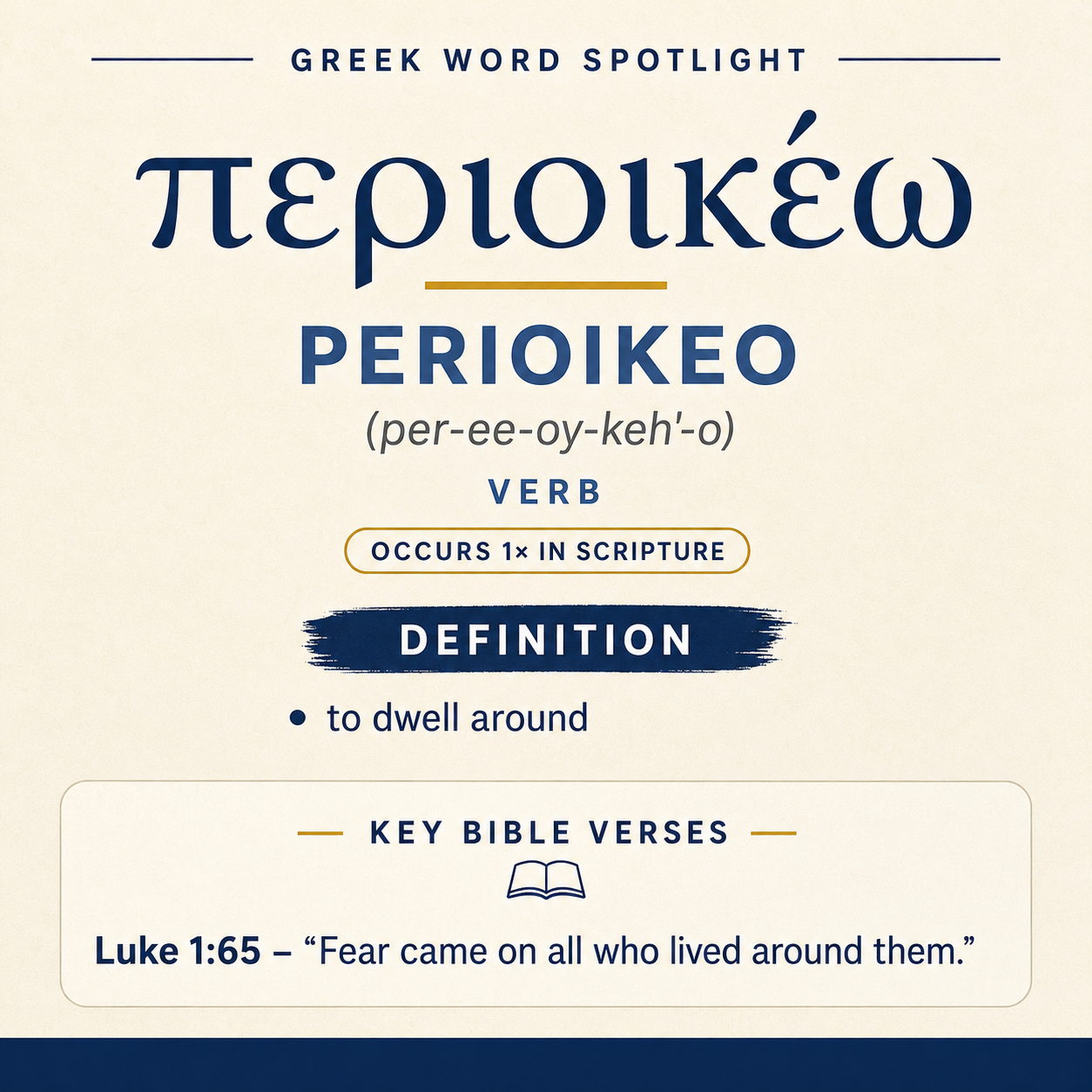
περιοικέω means “to dwell around” and appears once in Scripture, in Luke 1:65.
Luke 1:65 Context
In Luke 1:65, fear came on all who lived around them. These sayings were talked about throughout the hill country of Judea.
Learn More →περιοικέω expresses the idea of dwelling around, describing people who live in the surrounding area. It appears once in the New Testament, in Luke’s opening chapter amid the spread of public talk after events connected with John’s birth.
Root and Related Words
περιοικέω (Perioikeo) corresponds to a compound built from peri (περί), “about” (Strong’s G4012), and oikeo (οἰκέω), “to dwell” (Strong’s G3611). Together these elements frame the verb’s spatial perspective: dwelling is conceived with reference to a center, with κατοικία understood in relation to what lies “around.”
Occurrences
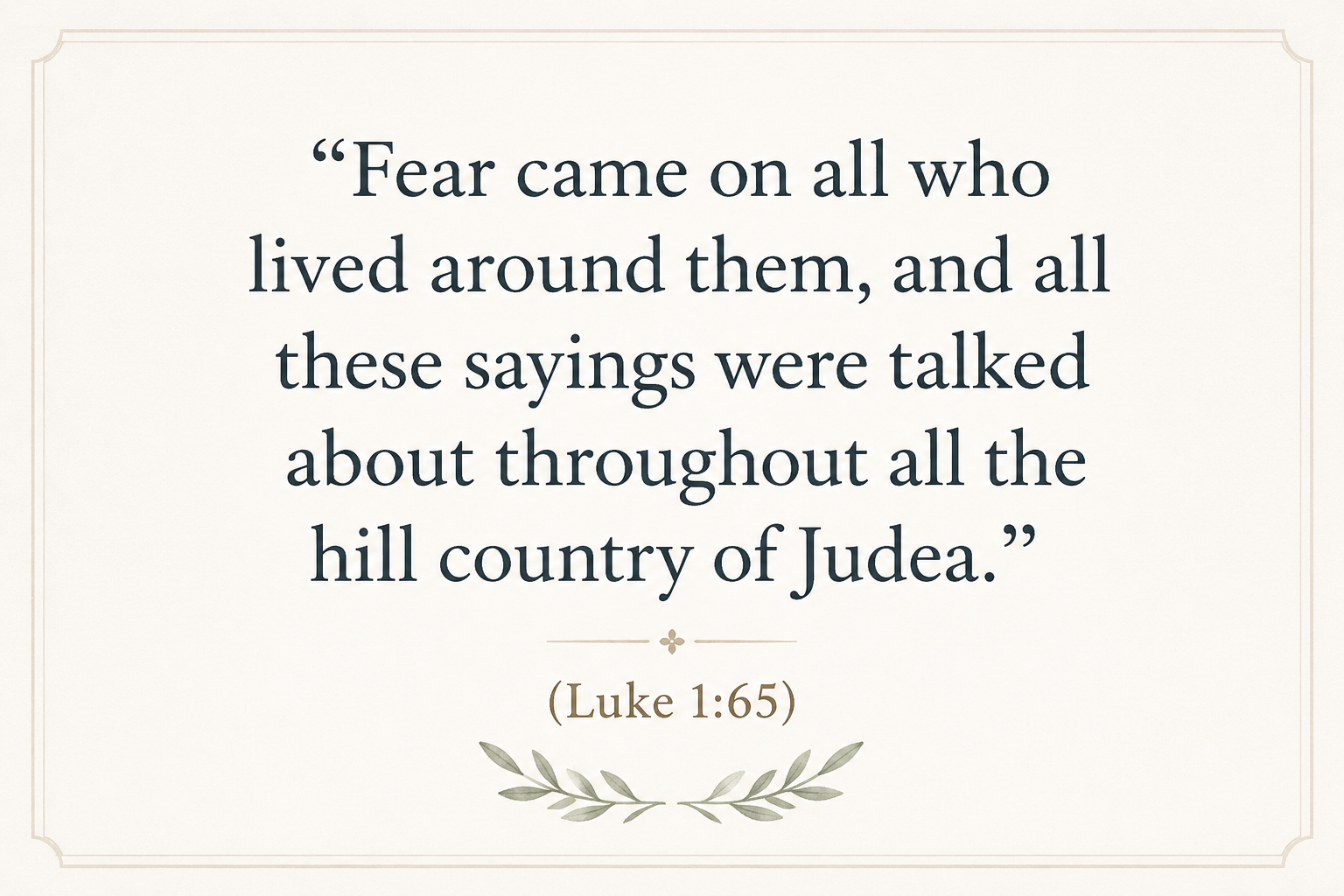
“Fear came on all who lived around them, and all these sayings were talked about throughout all the hill country of Judea.” (Luke 1:65)
In Luke 1:65, περιοικέω locates a ring of neighbors in relation to “them,” the household and immediate setting in which the preceding events have taken place. The verse moves in two widening circles: first, “all who lived around them,” and then “throughout all the hill country of Judea.” The verb belongs to the first circle. It marks those close enough by residence to be directly affected by what happens and to feel its impact quickly—“Fear came on all who lived around them.” Their reaction is not described as distant curiosity but as the immediate response of people for whom the event is local and proximate.
The following clause—“all these sayings were talked about throughout all the hill country of Judea”—shows how the report travels beyond the group designated by περιοικέω. The “around-dwellers” are presented as the first community to register the fear and, by implication from the verse’s progression, the first setting in which the “sayings” begin to circulate. περιοικέω therefore contributes a concrete social geography: it names the surrounding residents whose nearness makes them the initial audience and early carriers of the talk that expands across a broader region.
Sense and Usage
The sense “to dwell around” functions in Luke 1:65 as a relational verb: it does not merely state that people live somewhere, but that their living is oriented around a focal point (“them”). This relational quality matters for the verse’s portrayal of how communal reactions form. Fear does not fall on an undefined public first; it comes on those whose homes and daily paths encircle the scene. The verb thus sets up a natural bridge between an event and a spreading report: proximity of residence creates proximity of attention.
Because it is tied to a center, περιοικέω also implicitly distinguishes between the focal household and the surrounding neighborhood. The text does not require the reader to picture a formal boundary; the verb itself supplies the concept of adjacency. The immediate circle is defined not by formal membership but by where people live in relation to the center. That is enough to explain why “all who lived around them” are the ones first named as experiencing fear, before the narrative mentions the wider “hill country of Judea.”
In this context, the verb’s “around” component is not decorative; it organizes the verse’s movement from local reaction to regional discussion. Luke’s sentence is structured like ripples: an occurrence at the center, a surrounding population that feels it first, and then a larger landscape across which the associated “sayings” are talked about. περιοικέω is the term that articulates the first ripple, anchoring the account in lived space—neighbors and nearby residents—rather than in abstract “public opinion.”
The definition also fits the verse’s emphasis on communal speech. Talk “throughout all the hill country” presupposes a network of contacts and shared hearing. By naming those who “lived around,” the narrative identifies a plausible starting point for that network: people close enough to one another and to the focal household for news to move quickly. The verb therefore supports the depiction of rapid dissemination without adding any separate idea beyond the spatial fact of living in the surrounding area.
Imagery
Luke 1:65 pairs a settled landscape with a sudden, shared reaction: people living in a ring of nearby homes experience fear, and the talk spreads outward across Judea’s hill country. The imagery carried by περιοικέω is domestic and geographic at once—ordinary dwelling arranged around a center—so that the extraordinary response (“Fear came”) is portrayed as arising within everyday neighborhoods before it becomes a broader regional conversation.
Sources: Lexical data from Strong’s Exhaustive Concordance and the Translators Brief Lexicon of Extended Strongs for Greek (STEPBible, CC BY). Occurrence data from the Translators Amalgamated Greek New Testament (STEPBible, CC BY). Scripture quotations from the World English Bible (public domain).





