Exploring the Meaning of Pateo in Greek
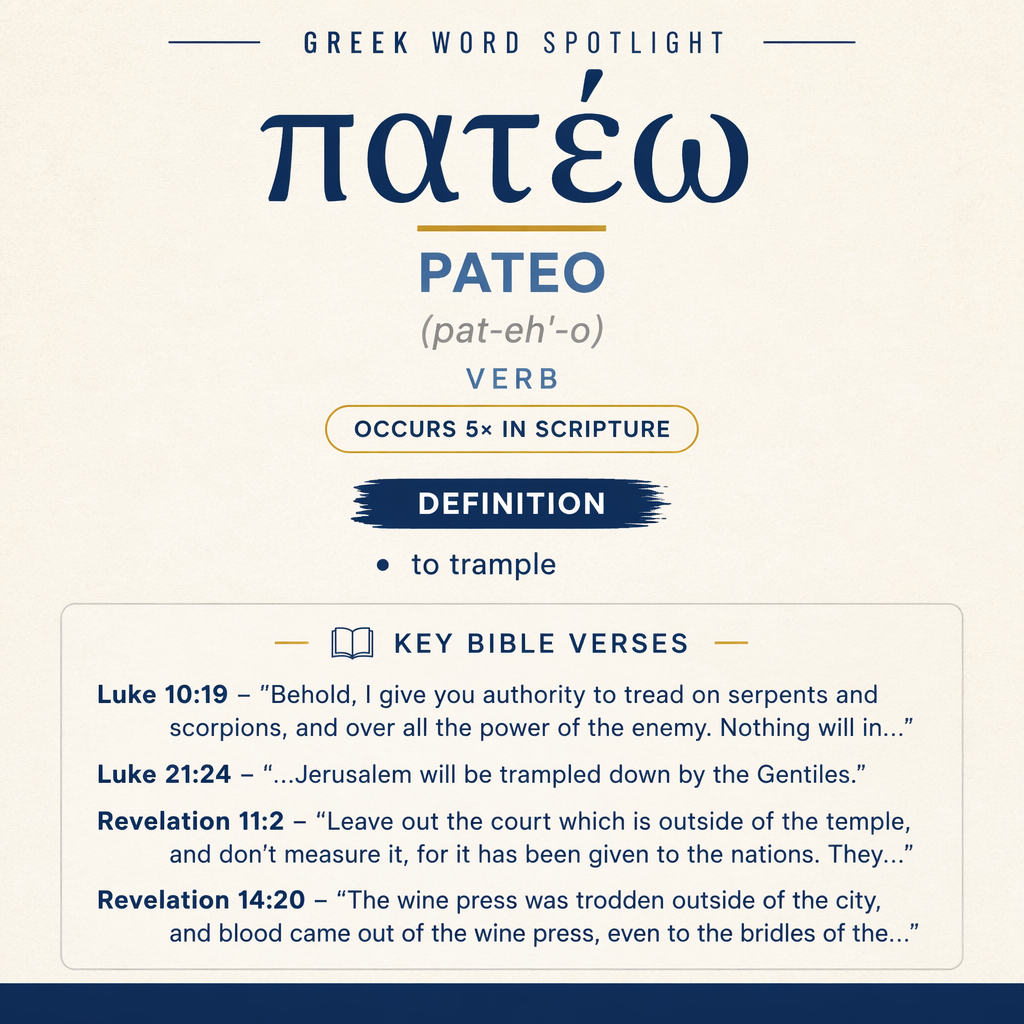
πατέω (Pateo) means “to trample” and occurs 5 times in Scripture in Luke 10:19; 21:24; Revelation 11:2; 14:20; 19:15.
Core Meaning
πατέω means “to trample.” In Luke 10:19 it describes treading on serpents and scorpions.
Learn More →Luke Occurrences
Luke 21:24 uses πατέω for Jerusalem being “trampled down.” Luke 10:19 connects it with authority to tread.
Learn More →Revelation Occurrences
Revelation 11:2 says the nations will trample the outer court. Revelation 14:20 and 19:15 use it for the wine press being trodden.
Learn More →πατέω means “to trample,” an action-word that evokes forceful treading underfoot. In the New Testament it appears in sayings about authority over hostile powers, in prophecies of a city’s subjection, and in Revelation’s images of the wine press and judgment.
Root and Related Words
πατέω is related to the verb paio (παίω), “to strike” (Strong’s G3817), a connection that aligns with the physical, forceful character of trampling.
Occurrences
“Behold, I give you authority to tread on serpents and scorpions, and over all the power of the enemy. Nothing will in any way hurt you.” (Luke 10:19)
Here trampling is framed as an authorized act: “I give you authority to tread.” The objects named—“serpents and scorpions”—bring the image down to the ground, where feet meet what threatens. Yet the sentence immediately expands the scope: the treading is “over all the power of the enemy,” so the concrete act becomes a way of describing dominance over hostile power. The promise “Nothing will in any way hurt you” interprets the trampling as an action in which danger is rendered unable to injure, not merely avoided.
“They will fall by the edge of the sword, and will be led captive into all the nations. Jerusalem will be trampled down by the Gentiles, until the times of the Gentiles are fulfilled.” (Luke 21:24)
In this prophecy, πατέω shifts from a granted action to a suffered condition: Jerusalem “will be trampled down.” The surrounding clauses describe defeat and displacement—some “fall by the edge of the sword,” others are “led captive into all the nations”—and the trampling of the city fits that same picture of being brought under. The phrase “by the Gentiles” specifies who does the trampling, and the time marker “until the times of the Gentiles are fulfilled” presents the trampling as a continuing state with an endpoint set by larger timing. The word thus contributes an image of sustained domination, where the city is treated as something underfoot.
“Leave out the court which is outside of the temple, and don’t measure it, for it has been given to the nations. They will tread the holy city under foot for forty-two months.” (Revelation 11:2)
This passage places trampling inside a measured, bounded scene: John is told to measure but to “leave out the court which is outside of the temple.” That excluded space is explained: “it has been given to the nations.” The trampling follows from that giving—“They will tread the holy city under foot”—and the added phrase “under foot” makes the bodily imagery explicit, as though the city is beneath the feet of outsiders. The duration “for forty-two months” gives the trampling a defined period, not an instant. Within the verse’s temple-court setting, πατέω communicates not only harm but desecration and disregard: what is “holy” is treated as ground to be walked on by those to whom it has been handed over.
“The wine press was trodden outside of the city, and blood came out of the wine press, even to the bridles of the horses, as far as one thousand six hundred stadia.” (Revelation 14:20)
Here the verb describes the physical act that makes a wine press do its work: it “was trodden.” The location “outside of the city” places the action at a remove from the city proper, while the result is rendered in shocking concreteness: “blood came out of the wine press.” The text dwells on scale—“even to the bridles of the horses” and “as far as one thousand six hundred stadia”—so the treading is not a small motion but an act with immense, overflowing consequence. πατέω contributes the essential mechanism of the scene: the press yields its outflow because something is being trampled within it.
“Out of his mouth proceeds a sharp, double-edged sword, that with it he should strike the nations. He will rule them with an iron rod. He treads the wine press of the fierceness of the wrath of God, the Almighty.” (Revelation 19:15)
In this climactic depiction, trampling is attributed to a singular agent: “He treads the wine press.” The surrounding lines stack images of decisive power: a “sharp, double-edged sword” that strikes, and rule “with an iron rod.” Against that backdrop, the wine press is defined not as ordinary harvest work but as “the wine press of the fierceness of the wrath of God, the Almighty.” The trampling is therefore presented as an enactment of wrath: an action performed with irresistible authority and effect. Compared with Revelation 14:20, the wine-press imagery remains, but the emphasis here is on who does the treading and what it represents—wrath carried out in active, crushing motion.
Sense and Usage
Across these passages, πατέω consistently communicates a forceful treading that places something beneath the feet. In Luke 10:19, the word sits inside a promise of protection and authority: trampling on threatening creatures portrays superiority over “all the power of the enemy.” In Luke 21:24, the same action becomes the city’s plight—Jerusalem is subjected to an ongoing trampling that corresponds to conquest and captivity and that lasts “until” a fixed turning point. Revelation 11:2 sharpens the idea by pairing trampling with the language of sacred space and measured access: what is “given to the nations” is what they tread, and the holy city’s being “under foot” depicts humiliation and violation over a defined period.
In Revelation 14:20 and 19:15, the verb moves from civic subjection to the wine-press metaphor, where trampling is the decisive action that produces outflow. The word’s concrete bodily sense—feet pressing down repeatedly—fits the image of treading a press, and the texts use that concreteness to convey magnitude: in 14:20, the consequence is pictured as blood flowing at extraordinary depth and distance; in 19:15, the trampling is bound directly to “the fierceness of the wrath of God, the Almighty.” Taken together, these occurrences show that the verb can describe trampling as (1) an act granted to overcome threats, (2) an experience endured by a city brought under foreign control, and (3) an action within apocalyptic imagery that communicates crushing severity.
Imagery
The word’s imagery is consistently downward: power is expressed by what can be placed underfoot. Luke uses that downward motion to picture safety in the face of dangerous creatures and hostile power, while Luke 21 and Revelation 11 use it to portray a city’s humiliation under outsiders. Revelation intensifies the physicality by moving from streets and courts to a wine press, where trampling becomes a vivid picture of overwhelming outcome—whether described by an immense flow from the press (Revelation 14:20) or by the One who “treads the wine press of the fierceness of the wrath of God” (Revelation 19:15).
Sources: Lexical data from Strong’s Exhaustive Concordance and the Translators Brief Lexicon of Extended Strongs for Greek (STEPBible, CC BY). Occurrence data from the Translators Amalgamated Greek New Testament (STEPBible, CC BY). Scripture quotations from the World English Bible (public domain).