Exploring the Meaning of Patara in Greek
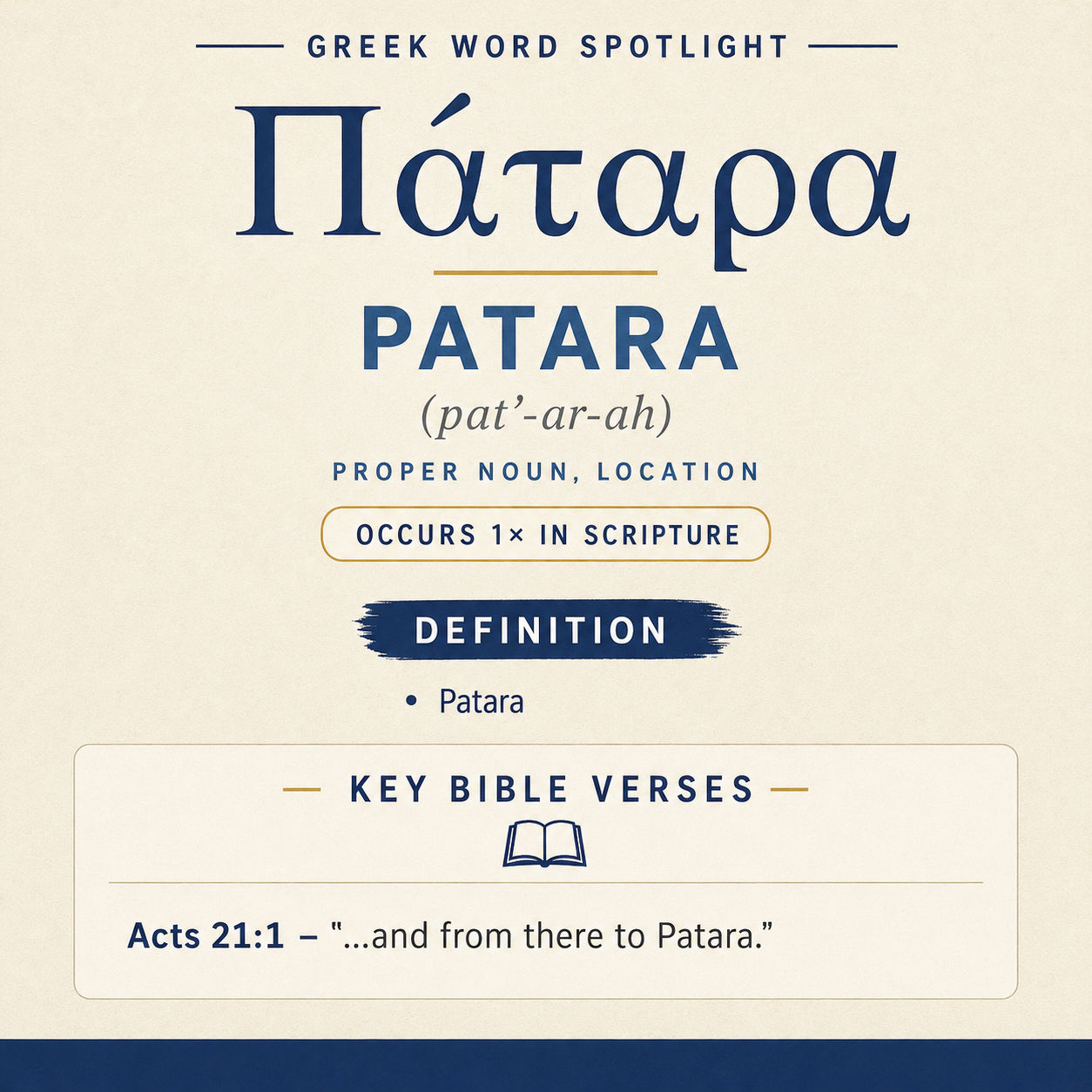
Πάταρα means “Patara” and appears in Acts 21:1.
Verse Context
In Acts 21:1, Patara is listed along a sailing route with Cos and Rhodes.
Learn More →Πάταρα refers to Patara, a named place that appears in the travel narrative of Acts. In its single New Testament occurrence it functions as a concrete waypoint within a sequence of sea-voyage movements.
Occurrences
“When we had departed from them and had set sail, we came with a straight course to Cos, and the next day to Rhodes, and from there to Patara.” (Acts 21:1)
Here Πάταρα names the final destination in a rapid chain of coastal stops: Cos, then Rhodes, then Patara. The verse is written in the first-person plural (“we”), placing Patara within the narrator’s itinerary rather than in a detached geographic catalogue. Patara therefore contributes the feel of an ordered route: the ship “set sail,” traveled “with a straight course,” and progressed day by day (“the next day”) until arriving “from there to Patara.” Within the sentence, Patara marks a point of arrival that is grammatically parallel to the earlier locations, yet it stands out by being introduced as the last element—what the vessel reaches after moving beyond Rhodes. The placement makes Patara the immediate next setting implied by the narrative’s forward motion.
Patara is not introduced with descriptive clauses, local color, or explanation; it is simply named. That terseness serves the travel-log style of Acts 21:1: the emphasis falls on movement and continuity (“departed… set sail… came… and… and… and from there…”). In this kind of reporting, a place-name works like a fixed coordinate. The name Patara supplies specificity without slowing the pace, allowing the sentence to compress distance and time into a readable sequence. It signals that the journey is proceeding by identifiable stages, each stage anchored by a recognized port or stopping point, and it prepares the reader to expect the next action to occur at or after this arrival.

Sense and Usage
As a proper noun, Πάταρα functions primarily as a locator: it identifies where the travelers came to in the course of sailing. In Acts 21:1 the word participates in a pattern of narration that maps movement through named places. That pattern depends on the stability of the names themselves. The meaning carried is not a description of the place but the referential force of naming—Patara is “this particular place” on the route, distinct from Cos and Rhodes, and capable of serving as a meaningful step in the story’s progression.
The syntactic setting of the word also shapes how it is heard. Patara follows a prepositional phrase (“from there to Patara”) that presents the location as the outcome of departure from an immediately prior point (“Rhodes”). This makes Patara a hinge between what precedes and what follows: it is reached as the result of travel, and it implicitly becomes the next base from which further travel can be narrated. The verse’s cadence—straight course, next day, from there—depicts a sequence governed by direction and time. In that cadence, Patara serves as a concrete endpoint of the sentence’s unfolding, anchoring the travel account to a real geography even though the verse itself offers no description of terrain, harbor, or city life.
The use of multiple place-names together invites the reader to hear Patara as part of a network of ports. The narrative does not pause to tell what Patara is like; instead it uses the name to maintain the momentum of a journey. In this way the word’s function is not merely cartographic but literary: it supports the portrayal of purposeful transit. The phrase “we came with a straight course” highlights directness, and the string of destinations conveys efficiency and progress. Patara, standing at the end of the list, helps close the verse with a sense of having successfully completed a leg of travel.
Because Patara is a proper name, its contribution is bound to its role in reference rather than to a range of translated senses. It does not flex into metaphor or broaden into a general category within this passage; it stays a name. Yet even within that constraint, the narrative use carries weight: naming a place fixes the scene, documents a stage in the itinerary, and gives the reader a spatial marker within the story’s larger movement. Acts 21:1 treats Patara as one of the real points through which the “we” group passes, and so the word reinforces the travel setting and the unfolding of events through successive locations.
Imagery
Although Πάταρα is a simple place-name, the verse in which it appears is rich in travel imagery: departure, sailing, a “straight course,” the rhythm of days, and the sense of a vessel moving from port to port. Within that motion, Patara evokes the moment of arrival at the end of a day’s progression—an unadorned but definite landing point in a journey narrated step by step.
Sources: Lexical data from Strong’s Exhaustive Concordance and the Translators Brief Lexicon of Extended Strongs for Greek (STEPBible, CC BY). Occurrence data from the Translators Amalgamated Greek New Testament (STEPBible, CC BY). Scripture quotations from the World English Bible (public domain).