Exploring the Meaning of Pater in Greek
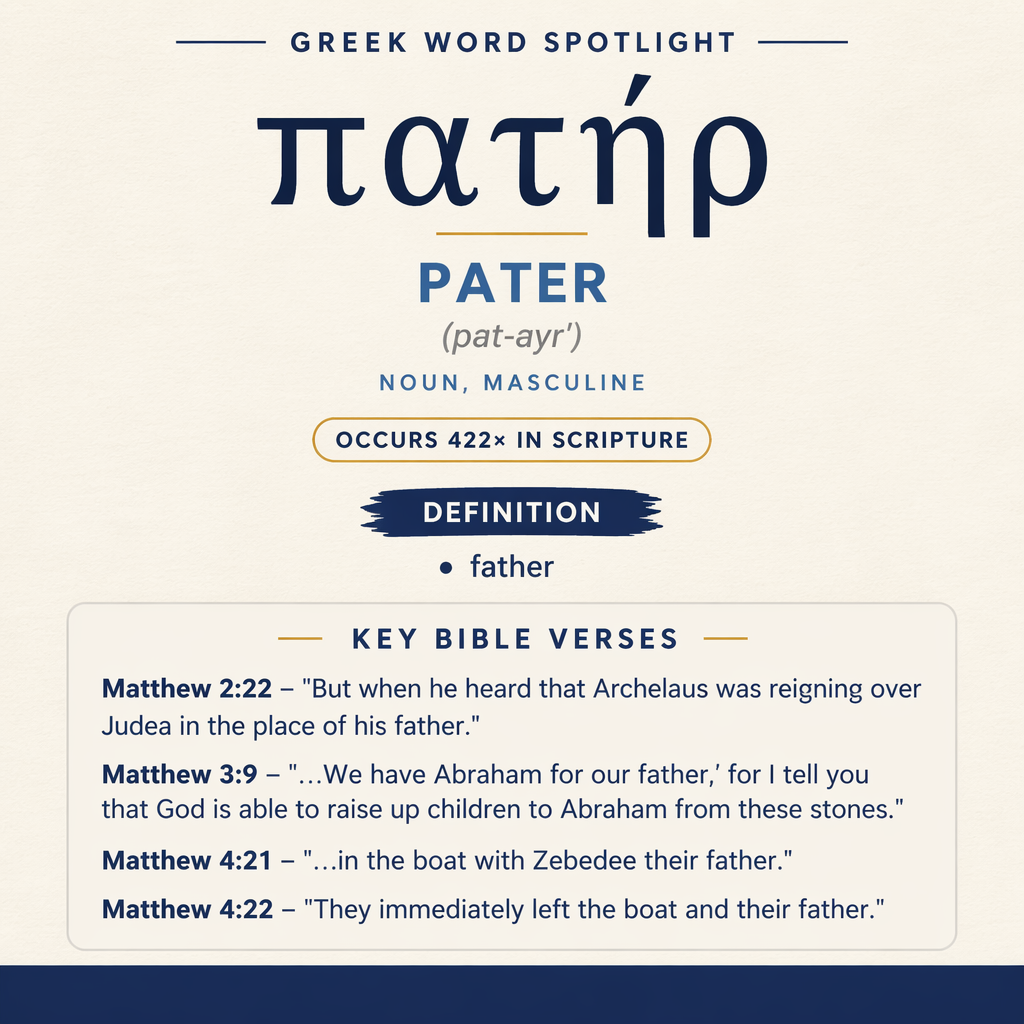
πατήρ (Pater) means “father” in Greek and appears 422 times in Scripture, including Matthew 2:22; 3:9; 4:21–22; 5:16,45,48; 6:1.
Core Meaning
πατήρ means “father.” It is a Greek word used for a father in Scripture.
Learn More →Gospel Examples
In Matthew, πατήρ refers to human fathers (e.g., Herod; Zebedee) and to “your Father who is in heaven.” Sample references include Matthew 2:22 and 5:16.
Learn More →Occurrence Count
πατήρ occurs 422 times in Scripture. Among the listed occurrences are Matthew 3:9, 4:22, and 5:48.
Learn More →πατήρ means “father,” used for both human fathers within families and for God as “Father” in heaven. In the passages quoted here, it names lines of descent, everyday household bonds, and the heavenly Father whose character, knowledge, and reward shape public and private life.
Occurrences
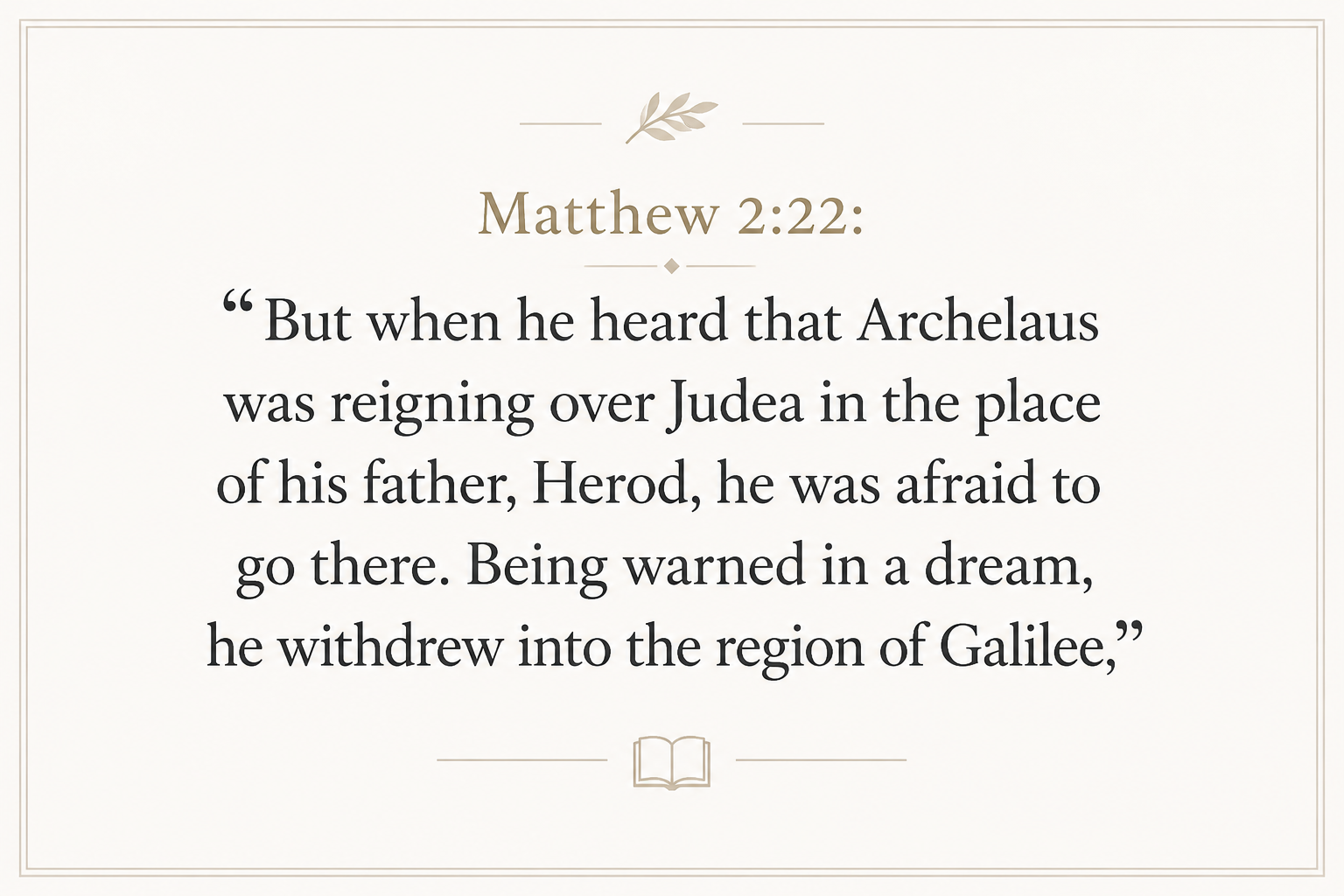
Matthew 2:22: “But when he heard that Archelaus was reigning over Judea in the place of his father, Herod, he was afraid to go there. Being warned in a dream, he withdrew into the region of Galilee,”
Here πατήρ anchors political succession in a parent-child relationship: Archelaus reigns “in the place of his father, Herod.” The word identifies Herod as the prior ruler and explains why Archelaus’ rule is perceived as a continuation of what came before. The fear described in the verse is tied to this father-to-son continuity: the son’s reign is understood against the backdrop of the father’s reign.
Matthew 3:9: “Don’t think to yourselves, ‘We have Abraham for our father,’ for I tell you that God is able to raise up children to Abraham from these stones.”
In this warning, πατήρ marks Abraham as a claimed father, the figure through whom people assert identity and standing: “We have Abraham for our father.” The statement is internal (“to yourselves”), suggesting reliance on ancestry as a kind of assurance. The reply juxtaposes “father” and “children” in the same line of thought: if God can “raise up children to Abraham from these stones,” then merely naming Abraham as father does not control who counts as his children.
Matthew 4:21: “Going on from there, he saw two other brothers, James the son of Zebedee, and John his brother, in the boat with Zebedee their father, mending their nets. He called them.”
πατήρ situates Zebedee within a working family scene: he is “their father,” present with his sons in the boat. The word establishes household structure in an ordinary setting (“mending their nets”) and clarifies the relationship that frames the call that follows (“He called them”). By naming Zebedee as father, the verse shows the call occurring not in isolation but within the sons’ existing ties and responsibilities.
Matthew 4:22: “They immediately left the boat and their father, and followed him.”
Here πατήρ is part of what is left behind. The immediacy (“immediately”) heightens the weight of departure: it is not only the boat but also “their father.” The word therefore emphasizes that the decision to follow involves separation from a primary family bond, not merely a change of location or task.
Matthew 5:16: “Even so, let your light shine before men; that they may see your good works, and glorify your Father who is in heaven.”
In this instruction, πατήρ refers to “your Father who is in heaven,” placing fatherhood in the sphere of heaven rather than household. The purpose clause ties public visibility (“before men”) and observable deeds (“your good works”) to a directed outcome: people glorify the Father. The word therefore frames ethical conduct as something that points beyond the doer to the heavenly Father as the one honored.
Matthew 5:45: “that you may be children of your Father who is in heaven. For he makes his sun to rise on the evil and the good, and sends rain on the just and the unjust.”
πατήρ is paired with “children,” expressing a family-like relationship to the Father in heaven. The verse then describes the Father’s actions in the created order: sun and rain are given without partiality across moral categories (“evil and the good,” “just and the unjust”). In this scene, “Father” is defined by what he does—he provides broadly and consistently—and the language of fatherhood underlines that the envisioned “children” are to correspond to that pattern.
Matthew 5:48: “Therefore you shall be perfect, just as your Father in heaven is perfect.”
Here πατήρ appears in a comparative statement: the Father in heaven is the reference point. The force of the comparison lies in the Father’s character as the standard (“just as your Father in heaven is perfect”). The word places the demanded aim within a filial framework: the Father’s own quality becomes the measure set before those addressed.
Matthew 6:1: ““Be careful that you don’t do your charitable giving before men, to be seen by them, or else you have no reward from your Father who is in heaven.”
πατήρ again identifies the Father as “in heaven,” now in relation to reward. The contrast is between performing charity “to be seen” and receiving “reward from your Father.” Fatherhood here is associated with a kind of recognition that differs from human applause. The warning makes the Father the decisive audience: reward is located with him, not with “men.”
Matthew 6:4: “so that your merciful deeds may be in secret, then your Father who sees in secret will reward you openly.”
In this saying, πατήρ is defined by perception and response: “your Father who sees in secret.” The repetition of “secret” connects the hidden setting of deeds to the Father’s sight, implying that secrecy does not remove the act from his awareness. The promised outcome—he “will reward you openly”—presents fatherhood in terms of attentive knowledge and active recompense.
Matthew 6:6: “But you, when you pray, enter into your inner room, and having shut your door, pray to your Father who is in secret, and your Father who sees in secret will reward you openly.”
πατήρ is the direct addressee of prayer: “pray to your Father who is in secret.” The verse depicts an intensely private setting (“inner room,” “shut your door”) and matches it with the Father’s relation to secrecy (“who is in secret,” “who sees in secret”). Naming God as Father makes prayer an act within a personal relationship, while the linked promise of reward portrays this Father as one who both notices and answers beyond the closed door.
Matthew 6:8: “Therefore don’t be like them, for your Father knows what things you need, before you ask him.”
Here πατήρ grounds prayer in the Father’s prior knowledge: “your Father knows what things you need, before you ask him.” The word “Father” frames divine knowledge as parental awareness of children’s needs. The logic supports restraint in prayer (“don’t be like them”), not because needs are irrelevant, but because the Father already knows them in advance of speaking.
Matthew 6:9: “Pray like this: ‘Our Father in heaven, may your name be kept holy.”
πατήρ opens the model prayer as a shared address: “Our Father in heaven.” The pronoun makes the relationship communal rather than individual, while “in heaven” situates the Father’s realm. The first petition is oriented toward the Father’s “name” and its sanctity (“may your name be kept holy”), showing that fatherhood here is tied to reverence and worshipful speech at the outset of prayer.

Sense and Usage
Across these passages, “father” functions in two main ways: as an ordinary kinship term and as a title for God that organizes the life of disciples. In the human sphere, πατήρ identifies lineage and household bonds with concrete social consequences. A ruler stands “in the place of his father, Herod” (Matthew 2:22), and the term clarifies why a new reign is experienced as continuity rather than a clean break. In the fishing scene, “Zebedee their father” (Matthew 4:21) is not an abstract genealogical note but part of a working tableau—father and sons together in a boat, engaged in their trade. The follow-up line sharpens the cost of commitment: they leave “their father” (Matthew 4:22), meaning the call disrupts a central, expected loyalty within the family.
When the same word is used for Abraham (Matthew 3:9), it still stays within the definition “father,” but the emphasis shifts from immediate household to ancestral identity. Claiming “Abraham for our father” is presented as a self-justifying thought, answered by a reminder that God can produce “children to Abraham” apart from the presumed lines of descent. In this way, the word carries the weight of inherited status while also being placed under God’s freedom to create a people who truly count as Abraham’s children.
The predominant use in these excerpts, however, is for God as Father “in heaven” (Matthew 5:16; 5:45; 5:48; 6:1; 6:9) and as the one “who sees in secret” (Matthew 6:4; 6:6). This fatherhood is not presented as a bare label but as a relational frame with recognizable features. The Father is the one whom others should “glorify” when good works are seen (Matthew 5:16), making him the true recipient of honor. He is also portrayed through providential action in the world—sunrise and rainfall given across moral divisions (Matthew 5:45)—so that “children of your Father” are defined by resemblance to his impartial generosity. The Father’s perfection sets a standard for his children (Matthew 5:48), not as an external rule only, but as the character of the one they call Father.
In Matthew 6, the Father’s role is tightly connected to inner motivation and hidden devotion. Reward language (“no reward from your Father” in 6:1; “will reward you openly” in 6:4, 6:6) places the Father as the decisive judge of sincerity, distinguishing his response from human spectatorship. The repeated description “who sees in secret” builds a portrait of fatherhood as attentive and discerning: secrecy limits human notice, not the Father’s sight. Finally, the Father’s knowledge of needs “before you ask him” (Matthew 6:8) supports a posture of trust in prayer, and the address “Our Father in heaven” (Matthew 6:9) joins intimacy (“Father”) with reverence (“in heaven,” “may your name be kept holy”).
Imagery
The word gathers two complementary images in these texts: the tangible presence of a father within daily life, and the unseen presence of the Father in heaven within hidden devotion. Zebedee sits in the boat as nets are mended (Matthew 4:21), a father close enough to be left behind in an instant (Matthew 4:22). By contrast, the Father “who is in secret” is approached behind a shut door (Matthew 6:6) and yet is portrayed as seeing, knowing, and rewarding. Together these scenes present “father” as both a bond that shapes visible choices and a relationship that governs unseen motives.
Sources: Lexical data from Strong’s Exhaustive Concordance and the Translators Brief Lexicon of Extended Strongs for Greek (STEPBible, CC BY). Occurrence data from the Translators Amalgamated Greek New Testament (STEPBible, CC BY). Scripture quotations from the World English Bible (public domain).