
Exploring the Meaning of Paromoios in Greek
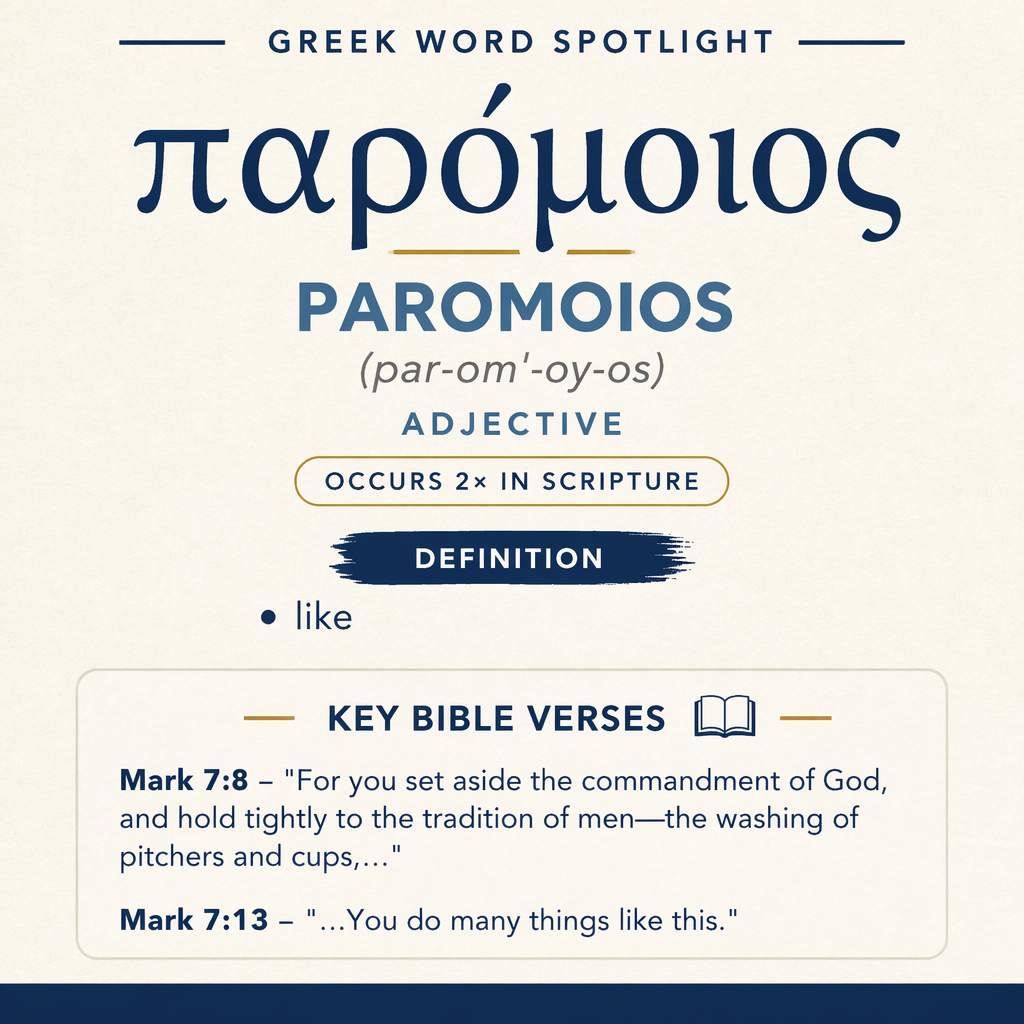
παρόμοιος means “like” and appears twice in Scripture, both in Mark 7:8 and Mark 7:13.
Scripture Occurrences
This word occurs 2 times in Scripture. Both occurrences are in Mark 7 (Mark 7:8; Mark 7:13).
Learn More →Mark 7 Context
In Mark 7:8 it appears amid Jesus’ words about holding tightly to human tradition. In Mark 7:13 it is used in the phrase “You do many things like this.”
Learn More →παρόμοιος means “like,” and it appears in two sayings of Jesus in Mark 7 where he confronts human tradition that displaces God’s commandment. In both places it functions as a comparative term, pointing to further instances that match what has just been named.
Root and Related Words
παρόμοιος is connected with homoios (ὅμοιος), “like,” and with para (παρά), “from/with/beside.”

Occurrences
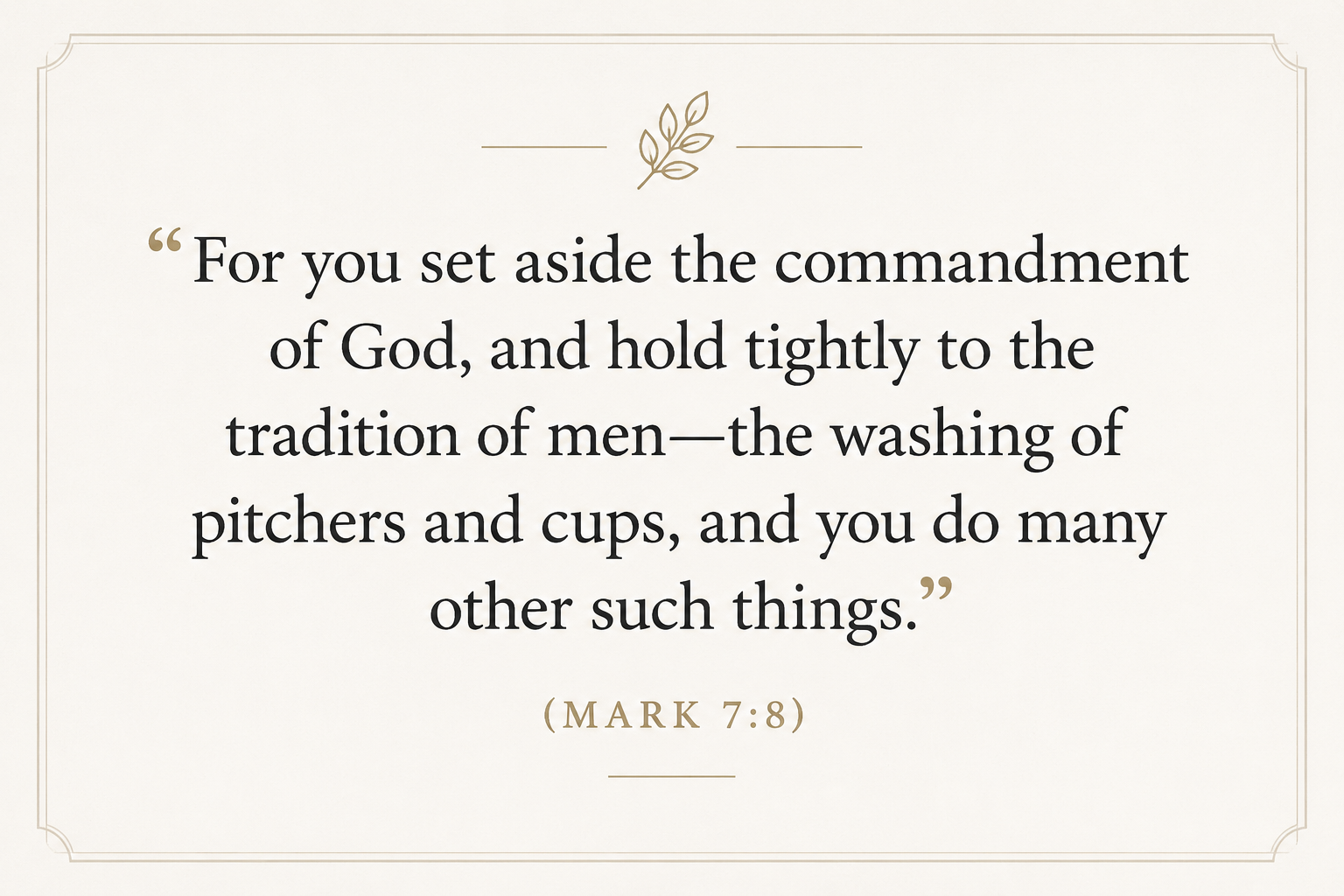
“For you set aside the commandment of God, and hold tightly to the tradition of men—the washing of pitchers and cups, and you do many other such things.” (Mark 7:8)
Here “like” appears at the end of a denunciation that contrasts two loyalties: setting aside “the commandment of God” while holding tightly to “the tradition of men.” The verse provides one concrete example—“the washing of pitchers and cups”—and then uses “like” to extend the indictment beyond that single practice. The comparison does not introduce a new topic so much as it gathers additional behaviors into the same category as the example just named: they are “other such things,” comparable in kind to the practice of ritual washing as it is being used in this conflict. In this way, παρόμοιος helps the sentence move from a particular instance to a broader pattern, implying that the washing example is representative rather than isolated.
making void the word of God by your tradition, which you have handed down. You do many things like this.” (Mark 7:13)
In this second occurrence, “like” again stands near the close, but now the charge has sharpened into a direct description of effect: their tradition is “making void the word of God.” The phrase “which you have handed down” frames “tradition” as something transmitted, and “like this” points back to what has just been described as the mechanism and outcome of that transmission. The comparative term gathers “many things” under the same evaluative description: they resemble “this,” the practice of using inherited tradition in a way that nullifies God’s word. “Like” thus serves as a hinge between the specific case at hand and a wider set of similar actions, emphasizing that the problem is recurrent and multifaceted rather than confined to one dispute.
Sense and Usage
Across these two uses, παρόμοιος operates as a word of likeness that marks resemblance within a moral and religious controversy. In Mark 7:8, the likeness is signaled after a concrete example (“the washing of pitchers and cups”), and it draws additional unnamed behaviors into alignment with that example; the word functions to widen the scope from one observable practice to “many other such things.” In Mark 7:13, the likeness is anchored not in a physical act but in an outcome—“making void the word of God”—and it extends that same outcome to other conduct: “many things like this.”
Because the comparison is placed at the conclusion of each statement, it has a summative force. The speaker does not merely list two or three practices; he points to a repeating type. The likeness expressed is therefore not a small, incidental similarity but a way of classifying actions: various behaviors belong together because they share the same character in the dispute—acts and customs that, in these sayings, stand on the side of “the tradition of men” over against “the commandment of God,” and actions that contribute to “making void the word of God.”
The two verses also show how “like” can connect different kinds of referents without changing its basic comparative function. In one verse it follows mention of vessels (“pitchers and cups”) and their washing; in the other it follows a statement about tradition’s effect on God’s word. In both, παρόμοιος does the same rhetorical work: it prevents the listener from treating the immediately mentioned case as exceptional. Instead, it frames it as a sample of a larger set, prompting the audience to recognize a broader resemblance among many actions.
Imagery
Within these sayings, the imagery paired with “like” is practical and domestic—“the washing of pitchers and cups”—yet it is set inside a larger argument about what has priority. The word of likeness makes the ordinary scene of cleaning household vessels stand for a whole cluster of comparable practices, and then it links that cluster to a grave result described in the second occurrence: tradition that “make[s] void the word of God.”
Sources: Lexical data from Strong’s Exhaustive Concordance and the Translators Brief Lexicon of Extended Strongs for Greek (STEPBible, CC BY). Occurrence data from the Translators Amalgamated Greek New Testament (STEPBible, CC BY). Scripture quotations from the World English Bible (public domain).




