Exploring the Meaning of Paroikos in Greek
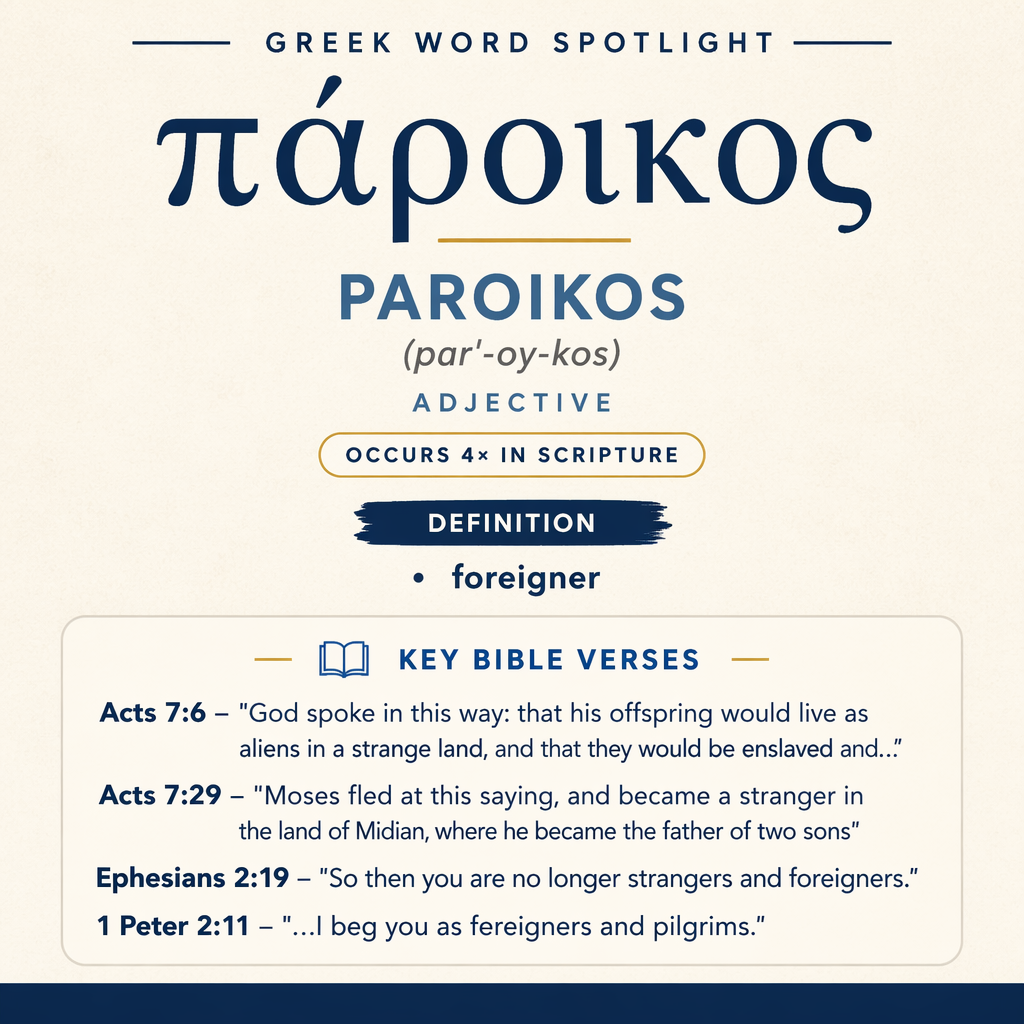
πάροικος (Paroikos) means “foreigner” and appears four times in Scripture: Acts 7:6; Acts 7:29; Ephesians 2:19; 1 Peter 2:11.
Core Meaning
πάροικος means “foreigner.” It is used for those living as aliens or strangers.
Learn More →Acts Examples
In Acts 7:6 it describes offspring living as aliens in a strange land. In Acts 7:29 it describes Moses as a stranger in Midian.
Learn More →Later Usage
Ephesians 2:19 contrasts being “strangers and foreigners” with being fellow citizens with the saints. 1 Peter 2:11 addresses believers as foreigners and pilgrims.
Learn More →πάροικος means “foreigner.” It appears in narrative retellings of Israel’s past (Acts 7), in a church’s changed status in relation to God’s people (Ephesians 2), and in an exhortation that addresses believers’ social posture and moral conduct (1 Peter 2).
Root and Related Words
πάροικος is connected with para (παρά), “from/with/beside” (Strong’s G3844), and oikos (οἶκος), “house: home” (Strong’s G3624). Together these related words frame the idea of someone positioned alongside a “house/home,” rather than being situated within it as a natural member.
Occurrences
“God spoke in this way: that his offspring would live as aliens in a strange land, and that they would be enslaved and mistreated for four hundred years.” (Acts 7:6)
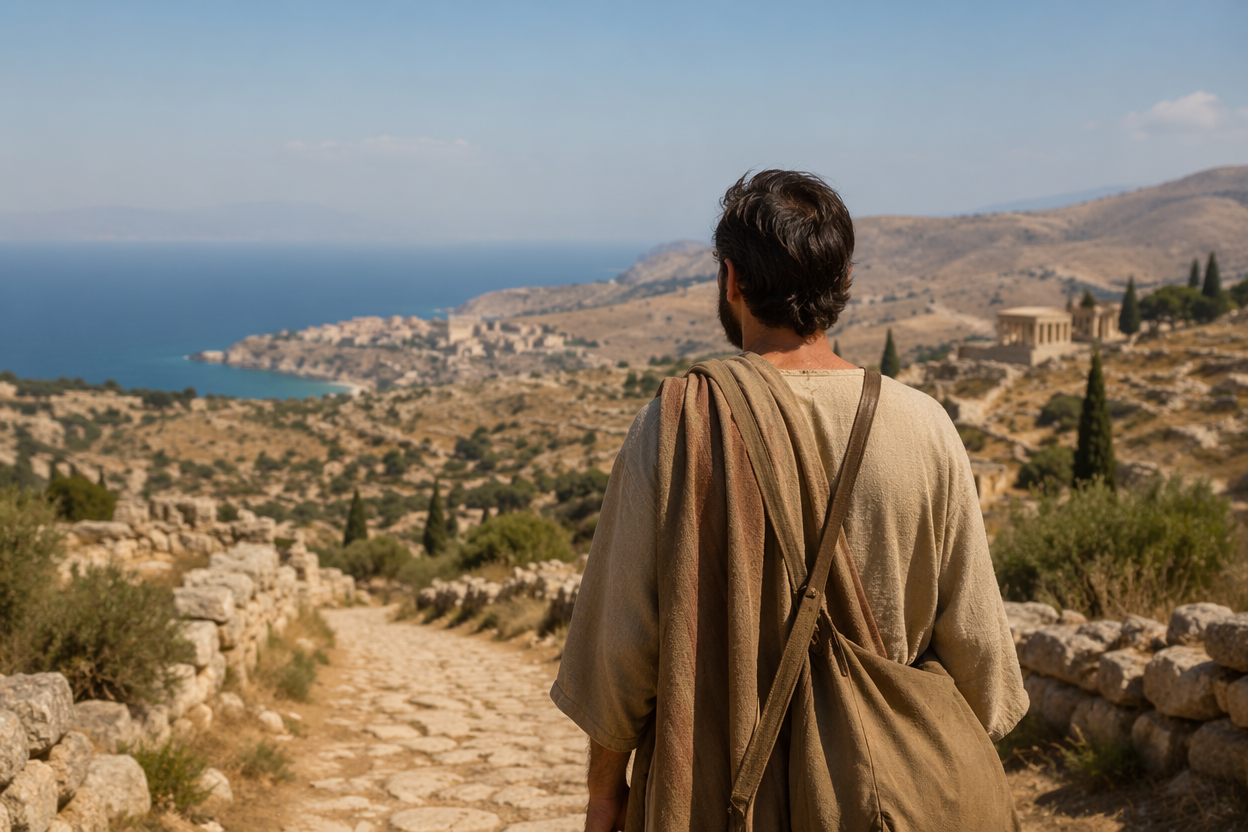
Here the word identifies Abraham’s offspring as people living in a place that is explicitly called “a strange land.” The verse pairs their status as aliens with vulnerability: they “would be enslaved and mistreated.” πάροικος, in this setting, contributes the social location of being outside the protections and privileges of belonging; the line from “aliens” to oppression is presented as a predictable trajectory within that foreign setting.
“Moses fled at this saying, and became a stranger in the land of Midian, where he became the father of two sons.” (Acts 7:29)
In this episode Moses’ change of place (“fled”) leads to a change of standing: he “became a stranger in the land of Midian.” The verse holds together two realities that can coexist: foreignness and ordinary life. The same sentence that names him a stranger also mentions that he “became the father of two sons.” πάροικος marks a settled kind of displacement—life continues, even generationally, yet the person’s relationship to the land remains that of an outsider.
“So then you are no longer strangers and foreigners, but you are fellow citizens with the saints and of the household of God,” (Ephesians 2:19)
This verse uses the word in a contrast: “no longer” describes a past condition, while the present is “fellow citizens” and “of the household of God.” πάροικος belongs to the former side of the contrast, placed beside “strangers,” and set against the language of civic belonging (“fellow citizens”) and family belonging (“household”). In this scene, the term functions as a label for exclusion from communal identity and rights—something that is now reversed for the addressed community.
“Beloved, I beg you as foreigners and pilgrims, to abstain from fleshly lusts, which war against the soul;” (1 Peter 2:11)
Here πάροικος is part of the address (“Beloved”) and becomes a basis for a plea about conduct: “I beg you as foreigners and pilgrims, to abstain from fleshly lusts.” The term is not used to describe geographic relocation in the verse itself; instead it frames an identity that supports moral exhortation. By invoking “foreigners and pilgrims,” the verse casts its audience as people whose stance in the world is not one of settled ownership, and it ties that stance to an inner conflict: “fleshly lusts” that “war against the soul.” The word thus contributes a social self-understanding that is meant to shape choices.
Sense and Usage
Across these passages, “foreigner” is consistently tied to the experience of being outside a host community’s normal lines of belonging. In Acts 7:6, foreignness is paired with powerlessness: living “as aliens” in “a strange land” is followed by enslavement and mistreatment, showing how the label can locate a people in a precarious situation. Acts 7:29 narrows the focus to an individual: Moses becomes a stranger in Midian, and the term highlights that even long-term residence and family life do not remove the outsider status implied by “foreigner.”
Ephesians 2:19 places the word in a carefully structured reversal. Being a “foreigner” is contrasted with two complementary images of belonging: political incorporation (“fellow citizens”) and domestic incorporation (“of the household of God”). In this use, the word describes what it means to lack recognized membership, and the verse’s emphasis falls on the transition away from that condition into full inclusion among “the saints” and within God’s “household.”
In 1 Peter 2:11, “foreigner” works less as a report of someone’s location and more as an identity that carries implications. The verse links that identity to disciplined living: abstaining from desires that assault the inner life. The word’s force here lies in how foreignness can reframe expectations—someone who is a foreigner does not take their surroundings as ultimate, and that posture is pressed into service as motivation for resisting impulses described as hostile to the soul.
When the four occurrences are read together, πάροικος shows a range of reference while keeping a consistent core: it can describe a people group in a host land, an individual living away from his native setting, a former status of exclusion contrasted with full inclusion, and a chosen self-description that undergirds ethical appeal. In each case, the word marks a boundary between those who belong and those who do not, and the surrounding language clarifies whether the emphasis is on suffering, personal displacement, newly granted membership, or moral vigilance.
Imagery
The passages often set “foreigner” against images of place and home. Acts speaks of “a strange land” and “the land of Midian,” giving foreignness a geographic contour. Ephesians sets “foreigners” opposite “the household of God,” turning the idea into an image of access to a home and family. First Peter pairs “foreigners and pilgrims,” evoking movement and temporary residence, then directs attention inward to a conflict that “war against the soul.” Together these scenes picture foreignness as standing outside the settled center—whether that center is a land, a civic community, or a household—while still living, moving, and making choices within that condition.
Sources: Lexical data from Strong’s Exhaustive Concordance and the Translators Brief Lexicon of Extended Strongs for Greek (STEPBible, CC BY). Occurrence data from the Translators Amalgamated Greek New Testament (STEPBible, CC BY). Scripture quotations from the World English Bible (public domain).