
Exploring the Meaning of Paroikia in Greek
παροικία means “sojourning” and appears twice in Scripture: Acts 13:17 and 1 Peter 1:17.
Core Meaning
παροικία is defined as “sojourning.” It describes the condition of staying as an alien.
Learn More →Acts Context
In Acts 13:17, it refers to the people staying as aliens in the land of Egypt.
Learn More →Peter’s Exhortation
In 1 Peter 1:17, it is used in the phrase “pass the time of your sojourning.”
Learn More →παροικία speaks of “sojourning,” the condition of residing somewhere without belonging as a settled member. It appears in two New Testament settings: Israel’s stay in Egypt and the believer’s present life lived as a foreign resident before God.

Root and Related Words
Paroikia is connected with the adjective paroikos (πάροικος), “foreigner” (Strong’s G3941), from which it derives.

Occurrences
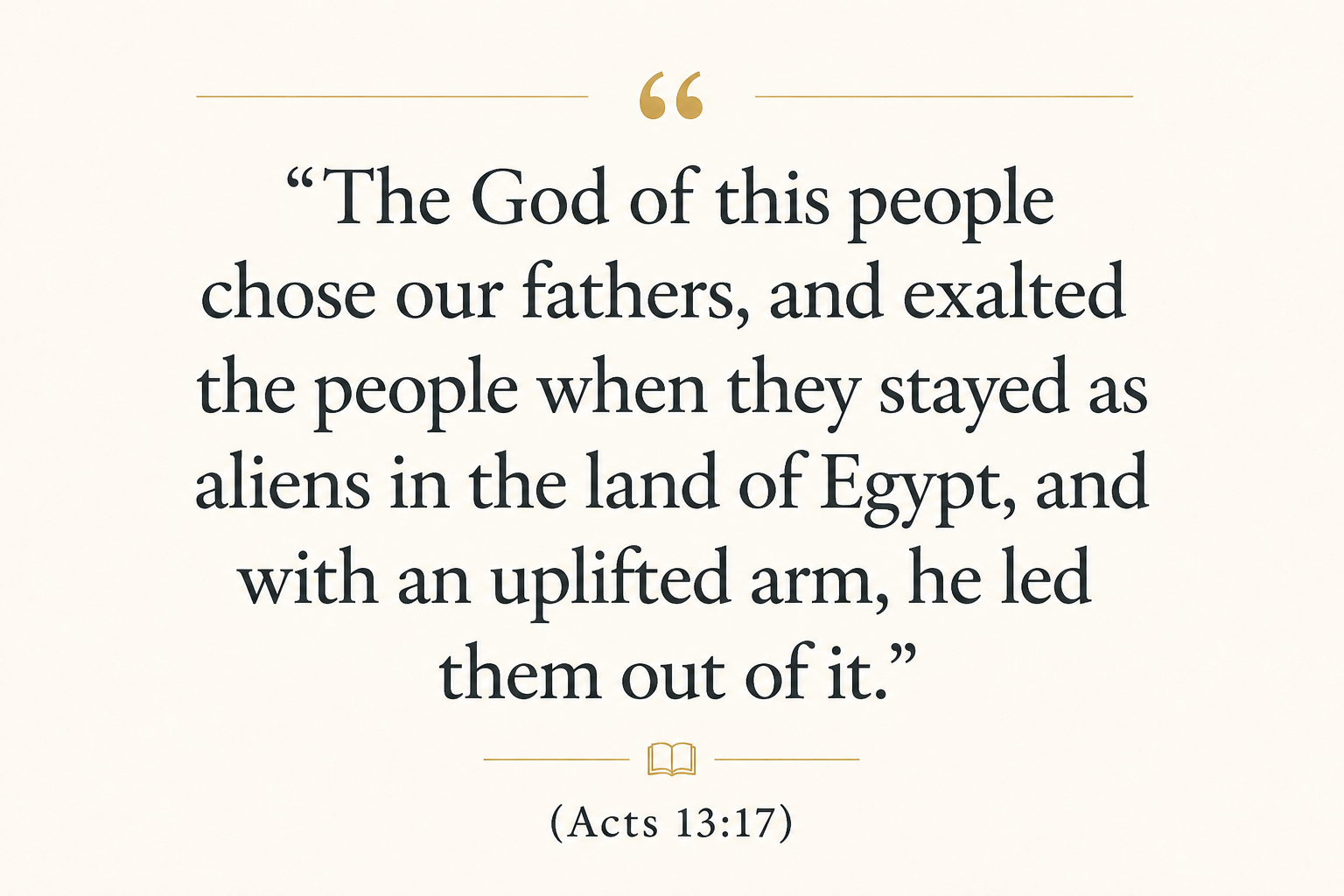
“The God of this people chose our fathers, and exalted the people when they stayed as aliens in the land of Egypt, and with an uplifted arm, he led them out of it.” (Acts 13:17)
In Acts 13:17, the word is set within a brief retelling of Israel’s early history. The sentence moves through three coordinated actions: God “chose our fathers,” “exalted the people,” and then “led them out” of Egypt “with an uplifted arm.” Within that movement, παροικία marks the people’s situation “in the land of Egypt” as a stay characterized by alien status. The line “when they stayed as aliens” frames their residence not as a settled homeland but as a life lived under the conditions of being outsiders, which in turn sharpens the force of the deliverance described at the end of the verse: the God who strengthened them in that situation also brought them out of it.
The immediate context in the verse is political and geographic rather than emotional or inward: “in the land of Egypt” identifies the location, and “led them out of it” identifies the resolution. παροικία functions as the hinge between those two: the people’s presence in Egypt is pictured as a real and extended residence, yet one defined by being “aliens.” In this retelling, the condition of sojourning belongs to the story of God’s choosing and exalting; it is not merely a backdrop but part of the description of how God dealt with “this people.”
“If you call on him as Father, who without respect of persons judges according to each man’s work, pass the time of your living as foreigners here in reverent fear,” (1 Peter 1:17)
In 1 Peter 1:17, παροικία is applied to the present “time” of the readers’ life. The sentence begins with the address to God as “Father” and immediately adds his impartial judgment: he “judges according to each man’s work.” Against that solemn backdrop, the command is given: “pass the time of your living as foreigners here in reverent fear.” Here παροικία defines the character of one’s ongoing life—“the time of your living”—as a period experienced in the posture of a foreign resident.
Several elements in the verse show how the word contributes to the instruction. First, the sojourning is explicitly temporal: it is “the time” to be “passed,” suggesting a bounded season rather than a permanent settlement. Second, it is also located: “here” places the sojourning within the readers’ present environment without naming it, emphasizing that their current setting is not treated as the final place of belonging. Third, it is ethical and reverent: the posture of “foreigners” is paired with “reverent fear,” and the reason is given in the character of the Father as judge “without respect of persons.” In this scene, παροικία is not merely a social label; it functions as a way to describe how one is to live under divine evaluation—consciously, cautiously, and with reverence during the whole span of one’s present life.
Sense and Usage
Across these two occurrences, “sojourning” describes a real, lived residence that remains defined by non-belonging. In Acts 13:17 the sojourning is corporate and historical: “the people” are in a specific foreign land, and their sojourning is the setting in which God both “exalted” them and then “led them out.” The term therefore carries the idea of a stay that can be described and delimited: it happens in a named place (“Egypt”), and it ends in an act of departure (“he led them out of it”). The sojourning is not a metaphor detached from events; it is part of the narration of movement from one place to another under God’s action.
In 1 Peter 1:17 the sojourning is personal and present: each person is addressed (“each man’s work”), and each person is to “pass the time” of life in a manner consistent with being “foreigners.” The word still describes a stay, but the emphasis shifts from a people’s residence in a foreign land to a person’s manner of living “here.” What unites the uses is the contrast between being located somewhere and truly belonging there. In both passages, sojourning is a condition that coexists with God’s active involvement: in Acts, God exalts and delivers; in 1 Peter, God fathers and judges. Sojourning becomes a way to speak about life lived under God’s oversight in a place that is not treated as one’s settled home.
The two scenes also show how the definition can bear both descriptive and directive force. In Acts 13:17, it describes what was true of Israel during a particular stage of the story; the clause “when they stayed as aliens” supplies a characterization of that period. In 1 Peter 1:17, it describes what is to be true of the readers’ present conduct; “pass the time of your living as foreigners” turns the condition into an orientation for daily life. Thus παροικία can name a circumstance experienced by a community and also a posture adopted by individuals as they move through time.
Imagery
Both passages invite the picture of life lived on the margins of belonging. Acts 13:17 sets sojourning against a concrete geography—“the land of Egypt”—and closes with decisive movement outward: “he led them out of it.” 1 Peter 1:17 brings that same sense of non-settled residence into the present with the simple word “here,” so that the readers’ days are imagined as time spent in a place where they remain foreigners, walking before a Father who judges impartially and therefore calling forth “reverent fear.”
Sources: Lexical data from Strong’s Exhaustive Concordance and the Translators Brief Lexicon of Extended Strongs for Greek (STEPBible, CC BY). Occurrence data from the Translators Amalgamated Greek New Testament (STEPBible, CC BY). Scripture quotations from the World English Bible (public domain).





