
Exploring the Meaning of Paroikeo in Greek
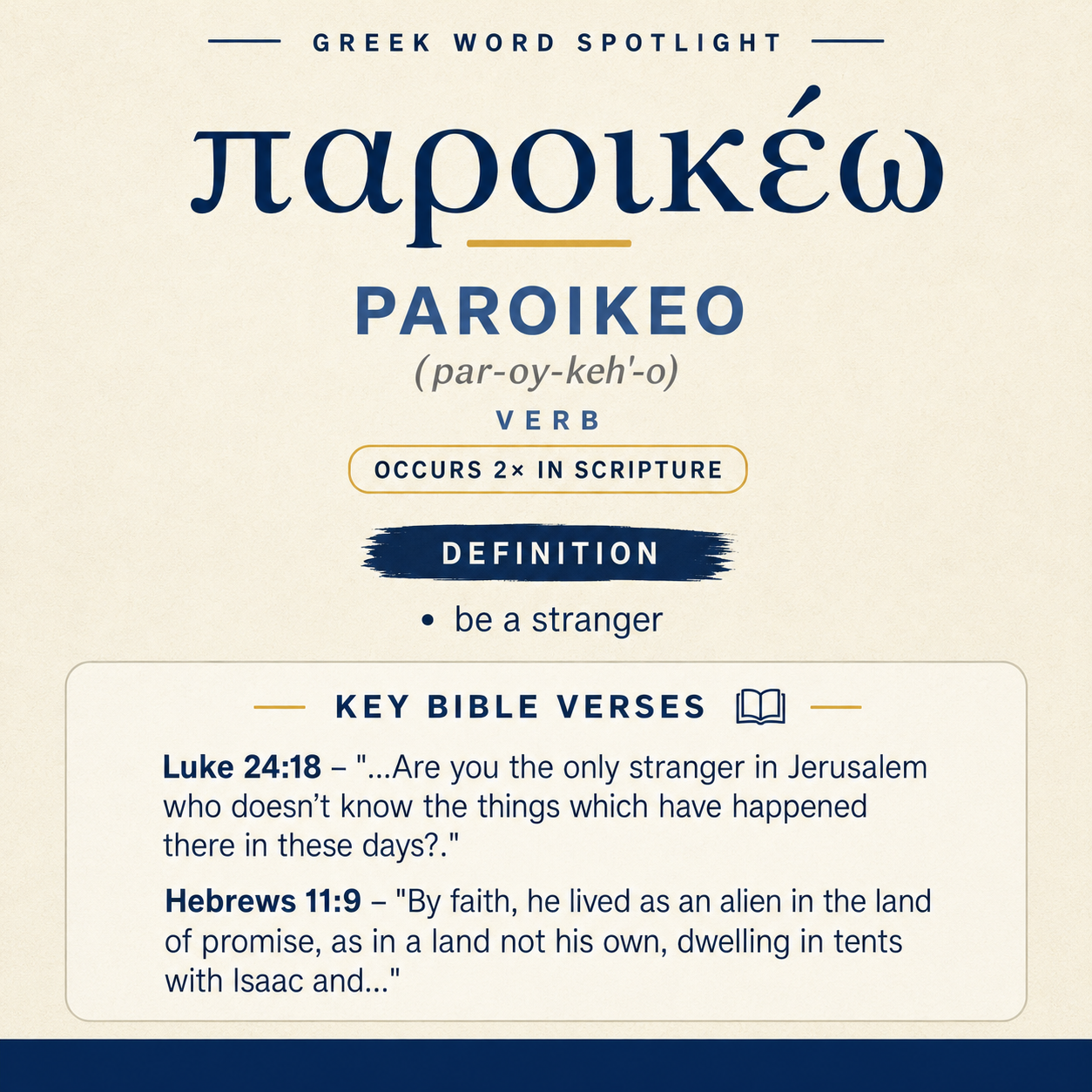
παροικέω (Paroikeo) means “be a stranger” and appears in Luke 24:18 and Hebrews 11:9.
Core Meaning
παροικέω means “be a stranger.” It conveys the experience of being an outsider.
Learn More →Scripture Occurrences
This verb occurs 2 times in Scripture. The references are Luke 24:18 and Hebrews 11:9.
Learn More →Context Snapshots
In Luke 24:18, Cleopas asks if someone is the only stranger in Jerusalem unaware of recent events. In Hebrews 11:9, it describes living as an alien in the land of promise, dwelling in tents.
Learn More →παροικέω expresses the condition of being a stranger, a way of living or being present in a place without full belonging. It appears in a question put to Jesus in Jerusalem and in a faith example describing life in the land of promise.
Root and Related Words
Paroikeo is connected with οἰκέω (oikeo), “to dwell,” and with παρά (para), “from/with/beside.”

Occurrences
“One of them, named Cleopas, answered him, “Are you the only stranger in Jerusalem who doesn’t know the things which have happened there in these days?”” (Luke 24:18)
In this scene two disciples are speaking with Jesus, though they do not recognize him. Cleopas frames his reply as a challenge: the events are so widely discussed that ignorance would mark someone out as an outsider. παροικέω fits the logic of the question by making “stranger” more than a label for a traveler; it sets up a social contrast between those who are embedded in the city’s recent happenings and one who is merely present in Jerusalem without participating in its shared knowledge. The word thus sharpens the irony of the exchange: the one addressed is treated as if he were the least informed person in the place precisely because he appears to stand at the margins of the community’s awareness—“the only stranger… who doesn’t know.” The force of the question depends on the assumption that a stranger would not have access to local report, conversation, and memory in “these days,” whereas inhabitants would.
“By faith, he lived as an alien in the land of promise, as in a land not his own, dwelling in tents with Isaac and Jacob, the heirs with him of the same promise.” (Hebrews 11:9)
Here παροικέω is set within a description of Abraham’s way of life “by faith.” The verse interprets his residence in the “land of promise” through the lens of strangeness: he “lived as an alien” even in the very place associated with promise. The text immediately elaborates what such a life looks like: it is “as in a land not his own,” and it is marked by “dwelling in tents.” The word therefore carries a settled pattern of existence rather than a momentary visit; Abraham’s life is portrayed as continuing in a location while still being characterized by non-belonging. The mention of Isaac and Jacob underscores that this posture extends across generations—he shares tent-dwelling with those who are “heirs with him of the same promise.” In this context, strangeness is not a failure to arrive but an intentional mode of life that accompanies faith, where even promised land is experienced without the ordinary markers of permanent possession.
Sense and Usage
Across these two passages, “being a stranger” functions in two complementary ways. In Luke 24:18, it operates as a social description: the stranger is the person whose distance from local life is evident because he lacks the common knowledge everyone else assumes. The scene depends on the everyday expectation that significant public events create a shared awareness, and that a stranger would be the exception. παροικέω, therefore, colors ignorance not as mere forgetfulness but as the kind of unknowing associated with being outside a community’s lived context.
In Hebrews 11:9, the same idea is broadened into a long-term condition. The verse pairs “lived as an alien” with phrases that frame the land as “not his own” and with the concrete image of tents. Strangeness here is not primarily about a lack of information, but about a status: a person can reside in a place and yet remain a stranger to it in the sense that the place is not “his own.” The phrase “dwelling in tents” gives the reader a tangible expression of that status—habitation without the settled security normally associated with full belonging. The shared life with “Isaac and Jacob” shows that this strangeness can persist within a family line even when the location remains the same, highlighting how the word can describe a durable posture rather than a temporary circumstance.
Taken together, these occurrences show παροικέω applied both to a perceived outsider in a city and to a faithful patriarch in a promised territory. In the first, the stranger is identified by what he does not know; in the second, by how he lives—treating even a promised land “as in a land not his own.” In both cases, the word organizes the reader’s sense of relationship to place: it marks a presence that does not equal belonging.
Imagery
Luke’s use evokes the bustle of Jerusalem in “these days,” with news circulating so thoroughly that only a stranger could miss it. Hebrews adds a quieter, enduring picture: tents in the land of promise, a way of occupying space that visually fits the life of an alien—present, dwelling, and yet not at home.
Sources: Lexical data from Strong’s Exhaustive Concordance and the Translators Brief Lexicon of Extended Strongs for Greek (STEPBible, CC BY). Occurrence data from the Translators Amalgamated Greek New Testament (STEPBible, CC BY). Scripture quotations from the World English Bible (public domain).





