Exploring the Meaning of Paradidomi in Greek
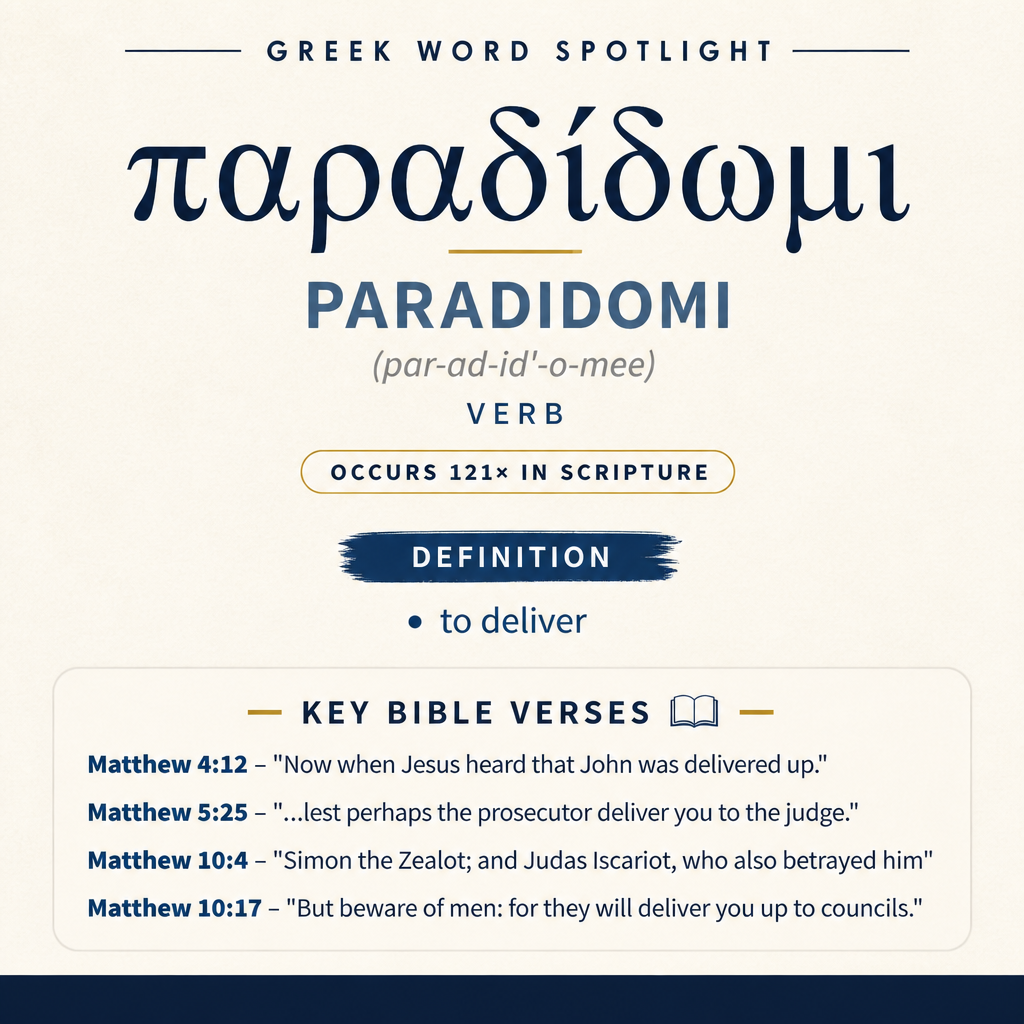
παραδίδωμι (Paradidomi) means “to deliver” and occurs 121 times in Scripture, including Matthew 4:12; 10:4; 11:27; and 17:22.
Core Meaning
παραδίδωμι means “to deliver.” In Matthew it is used for both handing someone over and delivering something to another.
Learn More →Matthew Examples
John was “delivered up” (Matthew 4:12), and Jesus warned that people would “deliver you up” to councils (Matthew 10:17). Judas Iscariot also “betrayed him” (Matthew 10:4).
Learn More →Handed Over
Jesus said “all things have been delivered to me by my Father” (Matthew 11:27). He also said the Son of Man would be “delivered up into the hands of men” (Matthew 17:22).
Learn More →παραδίδωμι expresses the act of delivering someone or something into another’s possession or control, often within legal, social, or hostile transfer. In the passages cited here, it appears in scenes ranging from judicial procedure and persecution to family betrayal and the handing over of the Son of Man.
Occurrences
“Now when Jesus heard that John was delivered up, he withdrew into Galilee.” (Matthew 4:12)
The word frames John’s situation as a completed transfer into another party’s power. Jesus’ withdrawal is presented as a response to that decisive change in John’s circumstances: John has been delivered up, and the setting of the ministry shifts accordingly.

“Agree with your adversary quickly, while you are with him on the way; lest perhaps the prosecutor deliver you to the judge, and the judge deliver you to the officer, and you be cast into prison.” (Matthew 5:25)
Here παραδίδωμι appears in a chain of formal handovers. The prosecutor’s delivering initiates the legal process, the judge’s delivering advances it, and the outcome is confinement. The repeated verb emphasizes how a person can be passed along from one authority to the next, each transfer narrowing freedom until imprisonment results.
“Simon the Zealot; and Judas Iscariot, who also betrayed him.” (Matthew 10:4)
In the list of the Twelve, the verb is attached to Judas as a defining action: he is the one who delivers Jesus. The placement within the apostolic roster highlights the shock of an insider effecting the transfer of Jesus into hostile hands.
“But beware of men: for they will deliver you up to councils, and in their synagogues they will scourge you.” (Matthew 10:17)
The word depicts a hostile delivering of disciples to local tribunals (“councils”), with punishment following in religious community spaces (“their synagogues”). The delivering is the decisive move that exposes them to interrogation and violence; it is not merely opposition but an official turning over to judgment.
“But when they deliver you up, don’t be anxious how or what you will say, for it will be given you in that hour what you will say.” (Matthew 10:19)
The delivering in view is the same kind of coercive transfer described just prior, but the emphasis falls on the disciples’ speech under pressure. Once delivered up, they stand in a constrained situation where their words matter; the verse contrasts human delivery into danger with the provision of words “in that hour.”
““Brother will deliver up brother to death, and the father his child. Children will rise up against parents, and cause them to be put to death.” (Matthew 10:21)
παραδίδωμι now marks betrayal within the closest bonds. The deliverer is not an impersonal institution but a brother or father; the delivered person is handed over “to death.” The verb captures the cruelty of transferring one’s own family member into lethal consequence, and it prepares for the escalation described as children actively participating in the fatal outcome.
“All things have been delivered to me by my Father. No one knows the Son, except the Father; neither does anyone know the Father, except the Son, and he to whom the Son desires to reveal him.” (Matthew 11:27)
This occurrence shifts to a non-hostile, purposeful delivery. “All things” are delivered from the Father to the Son, placing the verb in the realm of entrusted grant rather than betrayal or arrest. The surrounding statements about exclusive mutual knowledge and the Son’s revealing work present this delivery as foundational to the Son’s unique role.
“While they were staying in Galilee, Jesus said to them, “The Son of Man is about to be delivered up into the hands of men,” (Matthew 17:22)
The verb is future-oriented (“about to be delivered up”), and the destination is expressed concretely: “into the hands of men.” The language portrays an impending transfer of custody or control over the Son of Man, anticipating a sequence in which others will hold decisive power over his immediate fate.
“His lord was angry, and delivered him to the tormentors, until he should pay all that was due to him.” (Matthew 18:34)
Within the parable’s judicial setting, the master’s anger issues in a delivery to “the tormentors.” The verb indicates an authoritative turning over for punitive treatment, limited by a stated condition (“until he should pay all that was due”). Delivering here is not mere dismissal; it is a sentence that assigns the debtor to an enforcing agent.
““Behold, we are going up to Jerusalem, and the Son of Man will be delivered to the chief priests and scribes, and they will condemn him to death,” (Matthew 20:18)
This occurrence specifies recipients: “the chief priests and scribes.” The delivering initiates a legal-religious proceeding that ends in a verdict (“they will condemn him to death”). The verb signals the transfer that makes condemnation possible: once delivered to these authorities, formal judgment follows.
“and will hand him over to the Gentiles to mock, to scourge, and to crucify; and the third day he will be raised up.” (Matthew 20:19)
The delivery continues as a second-stage handover, now to “the Gentiles,” with a stated purpose: “to mock, to scourge, and to crucify.” The verb thus carries the narrative from internal condemnation to external execution. The final clause about being raised “the third day” places the violent intentions of the recipients alongside a divine reversal, but the delivering itself remains the mechanism by which the suffering is enacted.
“Then they will deliver you up to oppression, and will kill you. You will be hated by all of the nations for my name’s sake.” (Matthew 24:9)
In an outlook of coming hostility, the verb again describes disciples being transferred into the power of persecutors. The immediate results are “oppression” and death, set within a broader social climate of worldwide hatred. Delivering up here is not a single courtroom moment but the act that places believers into a sustained experience of suffering.

Sense and Usage
Across these passages, παραδίδωμι consistently functions as a transfer-verbal: it marks the moment when a person (or, once, “all things”) moves from one party’s sphere into another’s. The definition “to deliver” is elastic enough to cover both hostile and benevolent movement, and the contexts show how sharply the moral shape of the act is determined by the giver, the recipient, and the purpose stated in the sentence.
One prominent use is legal or quasi-legal procedure. In Matthew 5:25, the verb is repeated as a process of custody transfer within a system: prosecutor to judge to officer, resulting in prison. Matthew 18:34 portrays a superior “delivering” a subordinate to agents of punishment. In these, παραδίδωμι is not accidental; it is an authorized act that changes someone’s status and options.
Another cluster is persecution and coercion directed at Jesus’ followers. Matthew 10:17 and 10:19 speak of disciples delivered up to councils and placed under questioning, where speech becomes urgent. Matthew 24:9 expands the horizon to oppression and death and frames the delivering as a feature of widespread hatred. In such texts, the verb captures the chilling precision of betrayal: the opposition is not only hostility but also the act of placing someone into the grasp of an institution or mob capable of harm.
The word’s most theologically weighty narrative role in these citations is the delivering up of the Son of Man. Matthew 17:22 presents it as imminent, expressed as being delivered “into the hands of men,” a phrase that evokes physical custody and vulnerability. Matthew 20:18–19 breaks the process into stages—delivered to the chief priests and scribes, then handed over to Gentiles for mockery, scourging, and crucifixion—showing how delivery can be sequential: one group takes control, renders a judgment, and then transfers the condemned to another group for execution.
Yet παραδίδωμι is not limited to sinister transfer. Matthew 11:27 uses it for the Father’s delivery of “all things” to the Son. The accompanying statements about knowledge and revelation portray this delivery as purposeful entrustment that grounds the Son’s authority to reveal. This positive instance sharpens the contrast: the same verb can denote either a grant that supports life-giving disclosure or a betrayal that leads to death, depending on the relational and narrative setting.
Finally, the occurrences show that delivering is often interpersonal before it is institutional. Judas “betrayed him” (Matthew 10:4), and family members “deliver up” their own (Matthew 10:21). In both, a relationship that ought to protect becomes the channel by which the victim is transferred into danger. The verb thereby carries the social sting of turning someone over—sometimes by the hands of strangers, sometimes by those nearest.
Imagery
The imagery attached to παραδίδωμι in these passages is concrete: being passed from one set of hands to another. It can look like movement along a corridor of authority—prosecutor, judge, officer, prison (Matthew 5:25)—or like a person being placed into the grasp of councils and scourges (Matthew 10:17). In the passion predictions, it is explicitly “into the hands of men” (Matthew 17:22), then onward to mockery, scourging, and crucifixion (Matthew 20:19). Even where no violence is named, the verb still pictures transfer: “All things have been delivered to me by my Father” (Matthew 11:27) presents a handing over that establishes possession, responsibility, and the right to act.
Sources: Lexical data from Strong’s Exhaustive Concordance and the Translators Brief Lexicon of Extended Strongs for Greek (STEPBible, CC BY). Occurrence data from the Translators Amalgamated Greek New Testament (STEPBible, CC BY). Scripture quotations from the World English Bible (public domain).