Exploring the Meaning of Paraballo in Greek
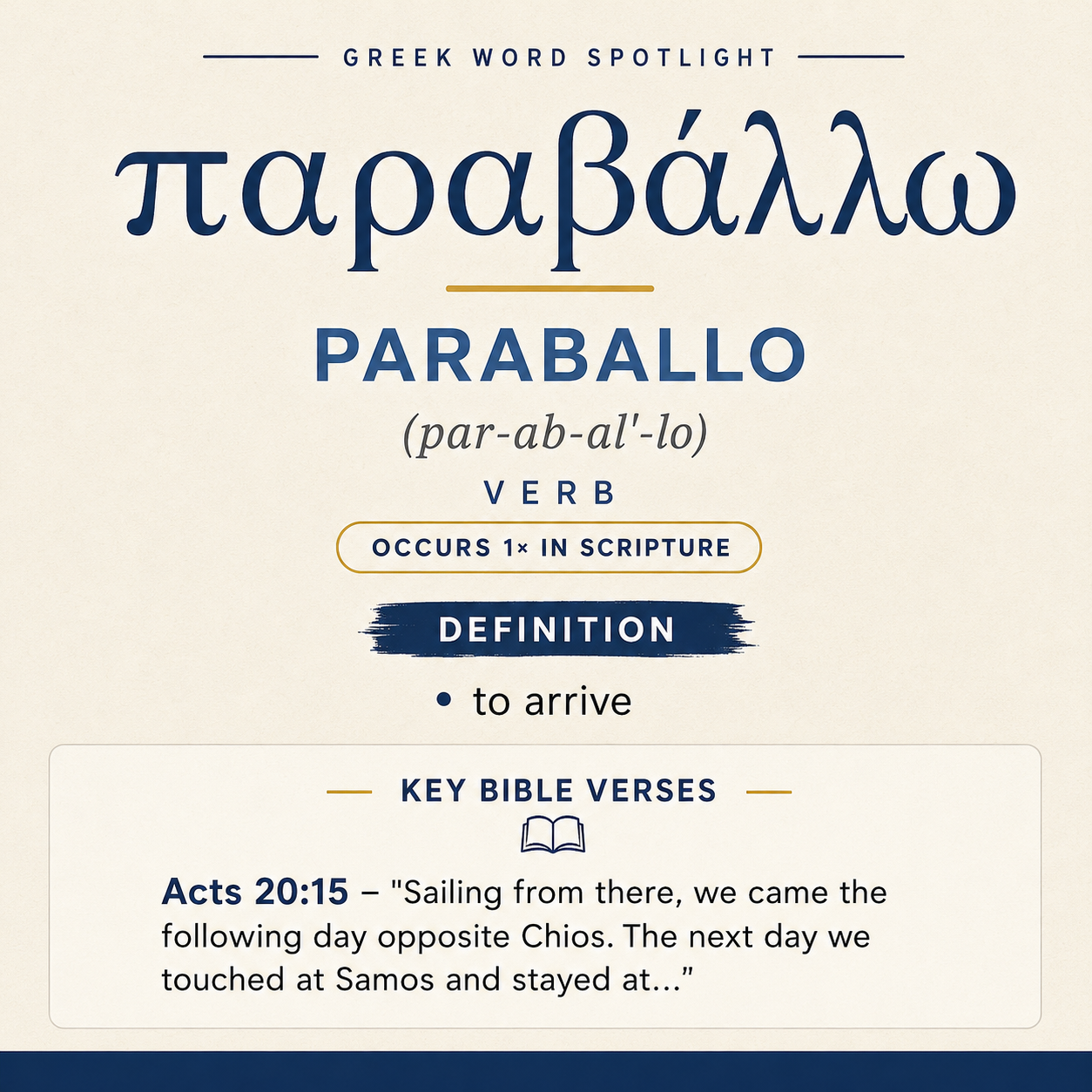
παραβάλλω (Paraballo) means “to arrive” and appears once in Scripture in Acts 20:15.
Scripture Occurrence
This word occurs 1 time in Scripture. Its single occurrence is in Acts 20:15.
Learn More →Context Snapshot
In Acts 20:15, it appears in a travel narrative: “Sailing from there, we came the following day opposite Chios.”
Learn More →παραβάλλω means “to arrive,” and it is used in a travel narrative in Acts to mark reaching a destination along a sequence of sea-journey stages. In its lone New Testament occurrence, it helps narrate the progress of a voyage by pinpointing the moment of coming to a particular place.
Root and Related Words
Paraballo (παραβάλλω) is connected with para (παρά), “from/with/beside,” and ballo (βάλλω), “to throw: throw” (Strong’s G3844; Strong’s G906). The compound form places the verb within a family of words that combine the sense of spatial relationship (para) with an action verb (ballo).
Occurrences
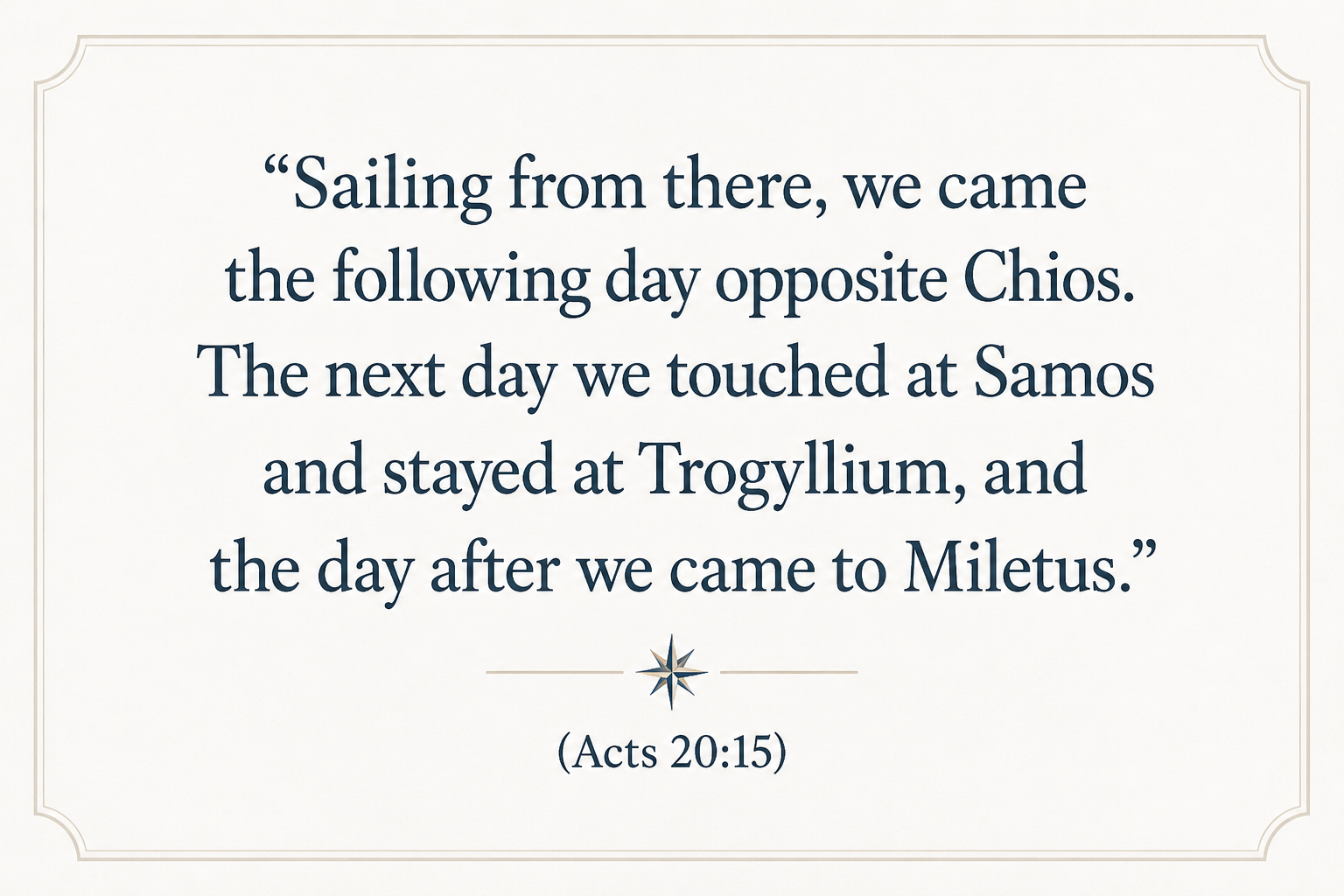
“Sailing from there, we came the following day opposite Chios. The next day we touched at Samos and stayed at Trogyllium, and the day after we came to Miletus.” (Acts 20:15)
Here παραβάλλω belongs to a tightly packed itinerary. The verse strings together several movement statements, each tied to a specific time marker (“the following day,” “The next day,” “the day after”) and a geographical reference point (opposite Chios, Samos, Trogyllium, Miletus). Within this chain, the verb functions as a clear boundary marker in the narrative: it signals the completion of one leg of travel and the reaching of a named destination. The line “the day after we came to Miletus” frames Miletus as the endpoint of that segment, following the intermediate stops (“touched at Samos,” “stayed at Trogyllium”).
The context is distinctly maritime: it begins with “Sailing from there,” and the route is described by successive days and islands or coastal locations. In that setting, παραβάλλω does not merely indicate motion in general; it serves the writer’s interest in charting where the travelers are at each step. The effect is to keep the reader oriented: the group is not drifting indefinitely but arriving at identifiable points along a planned passage. Even the alternation of verbs in English (“came,” “touched,” “stayed,” “came”) creates a rhythm of departure, contact, lodging, and arrival; παραβάλλω participates in that rhythm by giving one of those decisive “we came” statements that punctuate the journey.
The placement of the clause also matters. The verse has already reported reaching a position “opposite Chios,” then making contact with Samos, then staying at Trogyllium. By the time παραβάλλω is used for Miletus, the narrative has built expectation that another waypoint will be reached on schedule. Thus the verb contributes a sense of progress: each day yields a concrete result. In travel reporting, “arrive” is the word that turns distance into location; it converts the open-endedness of sailing into the definiteness of being somewhere. In Acts 20:15, that definiteness is anchored to the place-name “Miletus,” which stands as the capstone of the sequence described.
Sense and Usage
With the sense “to arrive,” παραβάλλω serves Acts 20:15 as a verb of completion within a journey account. It marks the point at which movement resolves into presence: the travelers are now at Miletus after prior stages that include being opposite an island, touching at another location, and staying overnight elsewhere. The verse’s structure shows how “arrive” can operate alongside other travel actions without replacing them. “Touched” describes making contact with a place, “stayed” indicates a pause, and “came” (using παραβάλλω in the clause about Miletus) delivers the climactic outcome of reaching the next named destination.
Because the narrative is dated by successive days, the verb also implicitly interacts with time. Arrival is not presented as instantaneous or detached from the process of travel; it is the expected conclusion after a day’s movement (“the day after”). In this way, παραβάλλω helps the itinerary read like a log: the reader can trace the path step by step, and each use of “came” signals that the day’s travel has achieved its goal. The sense of arrival is therefore practical and concrete, tied to navigable points and overnight stops rather than to an abstract notion of coming.
Acts 20:15 also shows that arrival can be narrated relative to multiple kinds of location statements. The earlier phrase “we came the following day opposite Chios” locates the travelers not by landing but by being “opposite” a known landmark. Then the narrative moves to landing language (“touched at Samos”) and lodging language (“stayed at Trogyllium”). Finally, παραβάλλω’s “we came to Miletus” brings the sequence back to a straightforward destination statement. In this clustered travel report, “to arrive” is the verb that cleanly attaches the group to a place-name and closes the segment with a clear endpoint.
Although only one occurrence is attested here, it is enough to illustrate how the verb’s sense works in narration: it is a hinge between the journey that precedes and the location that follows. The reader’s attention is directed away from the mechanics of sailing and toward the itinerary’s milestones. The verb’s contribution is therefore not decorative; it is organizational. It turns a list of places into a coherent progression, each stage measured by reaching a point that can be named.
Implied Imagery
The imagery attached to παραβάλλω in Acts 20:15 is that of travel resolved into arrival: a vessel moving day by day and then coming to a specific harbor or coastal destination. The verse’s repeated day-markers and place-names give “arrive” a chart-like feel, as though the journey can be followed by watching the coastline change from Chios to Samos to Trogyllium and finally to Miletus.
Sources: Lexical data from Strong’s Exhaustive Concordance and the Translators Brief Lexicon of Extended Strongs for Greek (STEPBible, CC BY). Occurrence data from the Translators Amalgamated Greek New Testament (STEPBible, CC BY). Scripture quotations from the World English Bible (public domain).