Exploring the Meaning of Oudeis in Greek
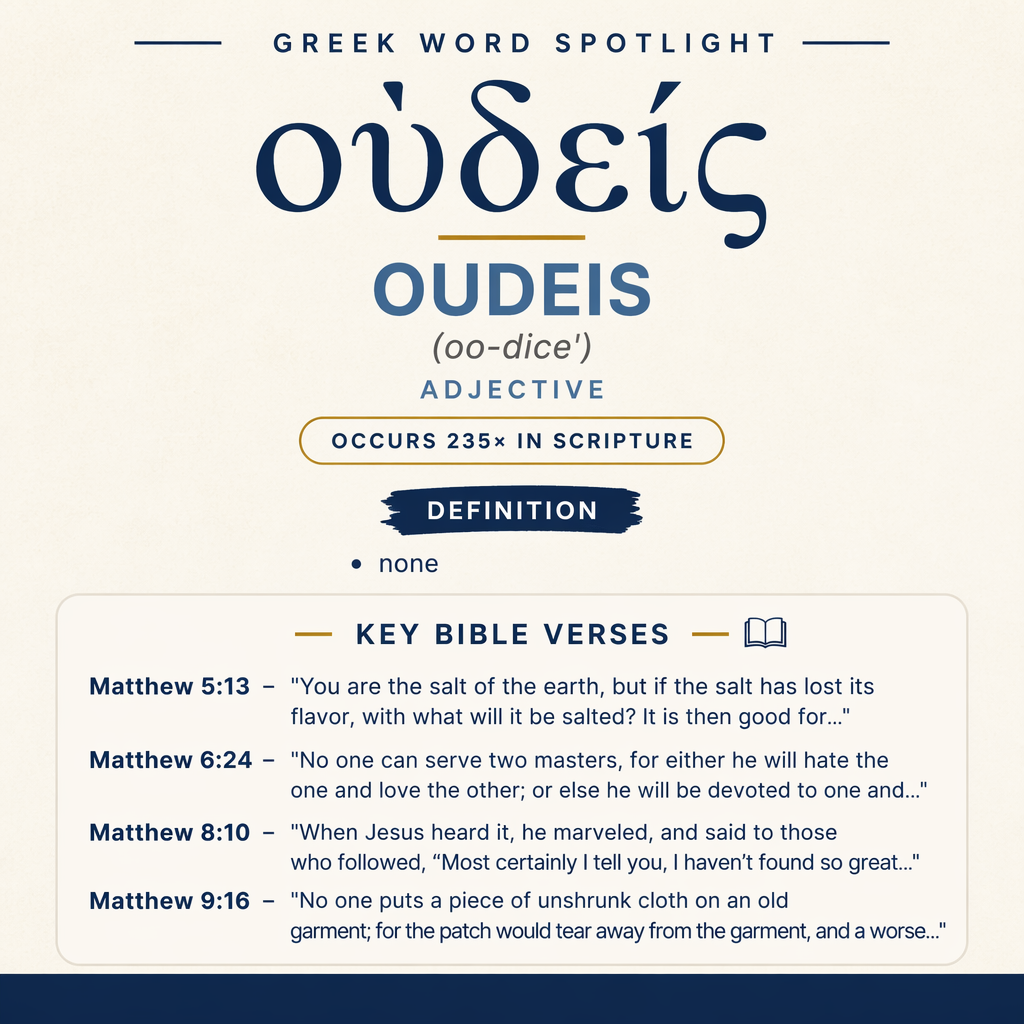
οὐδείς means “none” in Greek and occurs 235 times in Scripture, including Matthew 5:13; 6:24; 11:27; and 17:8.
Matthew Examples
In Matthew, it appears in statements like “No one can serve two masters” (Matthew 6:24) and “they saw no one, except Jesus alone” (Matthew 17:8).
Learn More →οὐδείς expresses “none,” marking an absolute negation that excludes any person or thing from a statement. In the cited passages it often draws sharp boundaries—what no one can do, what no one knows, what nothing contains, or what no one is present to be seen.
Occurrences
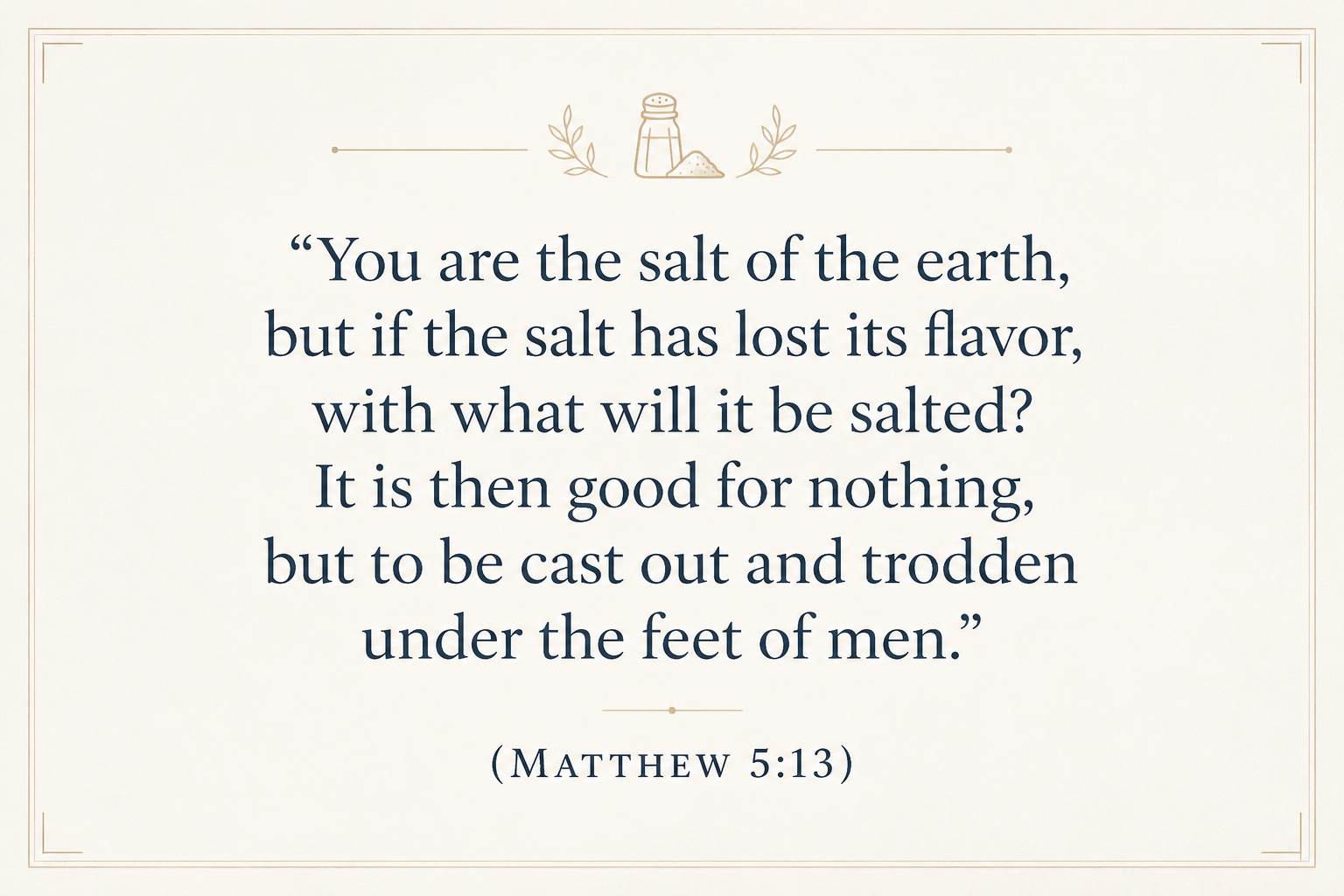
“You are the salt of the earth, but if the salt has lost its flavor, with what will it be salted? It is then good for nothing, but to be cast out and trodden under the feet of men.” (Matthew 5:13)
Here οὐδείς underlies the phrase “good for nothing.” The saying depends on total exclusion: once salt has “lost its flavor,” it falls into a category where it serves no useful end. The word strengthens the warning by refusing partial value; the salt is not merely less effective, but treated as having no remaining purpose in view.
“No one can serve two masters, for either he will hate the one and love the other; or else he will be devoted to one and despise the other. You can’t serve both God and Mammon.” (Matthew 6:24)
In this maxim οὐδείς sets an unqualified limit: “No one can serve two masters.” The explanation that follows (“either…or else…”) shows why “none” fits the logic. The allegiance demanded by “masters” is exclusive; the word frames the impossibility as universal, not limited to certain people or situations.
When Jesus heard it, he marveled, and said to those who followed, “Most certainly I tell you, I haven’t found so great a faith, not even in Israel.” (Matthew 8:10)
οὐδείς contributes to the comparative claim “not even in Israel.” Within Jesus’ statement, “none” functions to exclude every expected place where such faith might have been found. The marvel is intensified by the sweeping scope: among the people group singled out in the sentence, Jesus declares no matching instance has turned up.
“No one puts a piece of unshrunk cloth on an old garment; for the patch would tear away from the garment, and a worse hole is made.” (Matthew 9:16)
Here οὐδείς is tied to ordinary practice: “No one puts…” The point is not merely advice but a claim about what is never done because it leads to damage. By stating “none,” the sentence presents the action as categorically unsuitable—an action excluded from wise behavior because of its predictable outcome.
“Therefore don’t be afraid of them, for there is nothing covered that will not be revealed; and hidden that will not be known.” (Matthew 10:26)
In this encouragement, οὐδείς appears in “there is nothing covered.” The word supports a comprehensive assurance: concealment will not ultimately keep anything from being “revealed,” nor will hiddenness prevent something from being “known.” The scope is total, aimed at removing fear by denying exceptions.
“All things have been delivered to me by my Father. No one knows the Son, except the Father; neither does anyone know the Father, except the Son, and he to whom the Son desires to reveal him.” (Matthew 11:27)
οὐδείς frames the exclusivity of knowledge: “No one knows the Son, except the Father.” The paired statement about knowing the Father mirrors it and then introduces a specified opening: knowledge comes only where the Son “desires to reveal him.” The force of “none” heightens both the uniqueness of the Father-Son relationship and the dependence of others on revelation described in the verse.
Jesus spoke all these things in parables to the multitudes; and without a parable, he didn’t speak to them, (Matthew 13:34)
Within this narrative summary, οὐδείς stands behind “without a parable, he didn’t speak.” The word marks the absence of exceptions: in the setting described (“to the multitudes”), his speech is presented as uniformly parabolic. The claim is not that parables were frequent, but that none of his speech to them fell outside that mode.
Lifting up their eyes, they saw no one, except Jesus alone. (Matthew 17:8)
οὐδείς is used with direct perceptual force: “they saw no one.” The verse then narrows the scene with “except Jesus alone,” so the word clears the field of every other figure. The negation is visual and immediate; it defines what remains in view by stating that none other is present to be seen.
He said to them, “Because of your unbelief. For most certainly I tell you, if you have faith as a grain of mustard seed, you will tell this mountain, ‘Move from here to there,’ and it will move; and nothing will be impossible for you.” (Matthew 17:20)
Here οὐδείς supports “nothing will be impossible for you” in the conditional scenario described. The statement is tied to the preceding “if you have faith as a grain of mustard seed” and illustrated with a command to a mountain. Within that frame, “none” denies that any “impossible” case would remain once the condition is met.
“They said to him, ‘Because no one has hired us.’ “He said to them, ‘You also go into the vineyard, and you will receive whatever is right.’” (Matthew 20:7)
In this exchange, οὐδείς explains a social and economic situation: “no one has hired us.” The workers’ idleness is not portrayed as preference but as the result of being chosen by none. The landowner’s reply addresses that lack directly by sending them “into the vineyard,” where the earlier absence of hiring is replaced by his initiative.
Seeing a fig tree by the road, he came to it, and found nothing on it but leaves. He said to it, “Let there be no fruit from you forever!” Immediately the fig tree withered away. (Matthew 21:19)
οὐδείς appears in “found nothing on it but leaves,” expressing complete absence of fruit in the moment of inspection. The following pronouncement (“Let there be no fruit from you forever!”) echoes the same totalizing negation. The word’s contribution is to make the tree’s condition absolute: there is not even a single item of the expected produce.
They sent their disciples to him, along with the Herodians, saying, “Teacher, we know that you are honest, and teach the way of God in truth, no matter whom you teach, for you aren’t partial to anyone.” (Matthew 22:16)
Here οὐδείς is used in the claim “you aren’t partial to anyone.” The statement attributes to Jesus an impartiality that excludes every potential exception; none receives favored treatment that would distort his teaching. In the sentence as a whole, the word strengthens the portrayal of consistent integrity: his manner does not shift based on the person before him.

Sense and Usage
Across these passages οὐδείς works as a boundary-marker: it shuts the door on exceptions and forces the reader to reckon with totality. In some scenes the word is practical and proverbial, describing what is universally impossible or never done. “No one can serve two masters” (Matthew 6:24) and “No one puts a piece of unshrunk cloth on an old garment” (Matthew 9:16) present human action as constrained by realities that admit no loopholes; the following explanations in each verse reinforce that οὐδείς is not mere exaggeration but the grammatical backbone of an either/or logic.
In other contexts, οὐδείς is observational and concrete. The disciples “saw no one, except Jesus alone” (Matthew 17:8): the word creates a clean scene, stripping away all other presences. Similarly, the fig tree yields a negative inspection—“found nothing on it but leaves” (Matthew 21:19)—where the force of οὐδείς is felt in the disappointment of expectation unmet, a “none” that directly motivates the sentence that follows.
οὐδείς also serves sweeping, comprehensive assurances or claims. “There is nothing covered that will not be revealed” (Matthew 10:26) uses the word to guarantee that concealment has no final refuge; nothing remains permanently outside disclosure and knowledge. In Matthew 17:20, “nothing will be impossible for you” is similarly comprehensive within the conditional setting described, where the word strengthens the scope of the promise by denying that any “impossible” category remains.
Finally, οὐδείς is used to state exclusivity in relationships and in moral posture. In Matthew 11:27, “No one knows the Son, except the Father,” and the matching statement about knowing the Father, place knowledge within a defined circle and then point to the Son’s act of revelation as the only stated way beyond it. In Matthew 22:16, “you aren’t partial to anyone” uses “none” to describe an impartiality that is not selective but consistent across persons; the word makes the claim absolute rather than relative.
Imagery and Emphasis
The repeated effect of οὐδείς in these sayings and scenes is stark contrast: salt that becomes “good for nothing” (Matthew 5:13), servants split by competing loyalty (Matthew 6:24), hidden things with “nothing” exempt from exposure (Matthew 10:26), a field of vision emptied until “Jesus alone” remains (Matthew 17:8), and a tree that has “nothing on it but leaves” (Matthew 21:19). In each case the word pushes language toward clear edges—no residue, no remainder, no safe exception—so that what follows in the sentence stands out with sharper definition.
Sources: Lexical data from Strong’s Exhaustive Concordance and the Translators Brief Lexicon of Extended Strongs for Greek (STEPBible, CC BY). Occurrence data from the Translators Amalgamated Greek New Testament (STEPBible, CC BY). Scripture quotations from the World English Bible (public domain).